How to create a coffee corner with trays and bowls
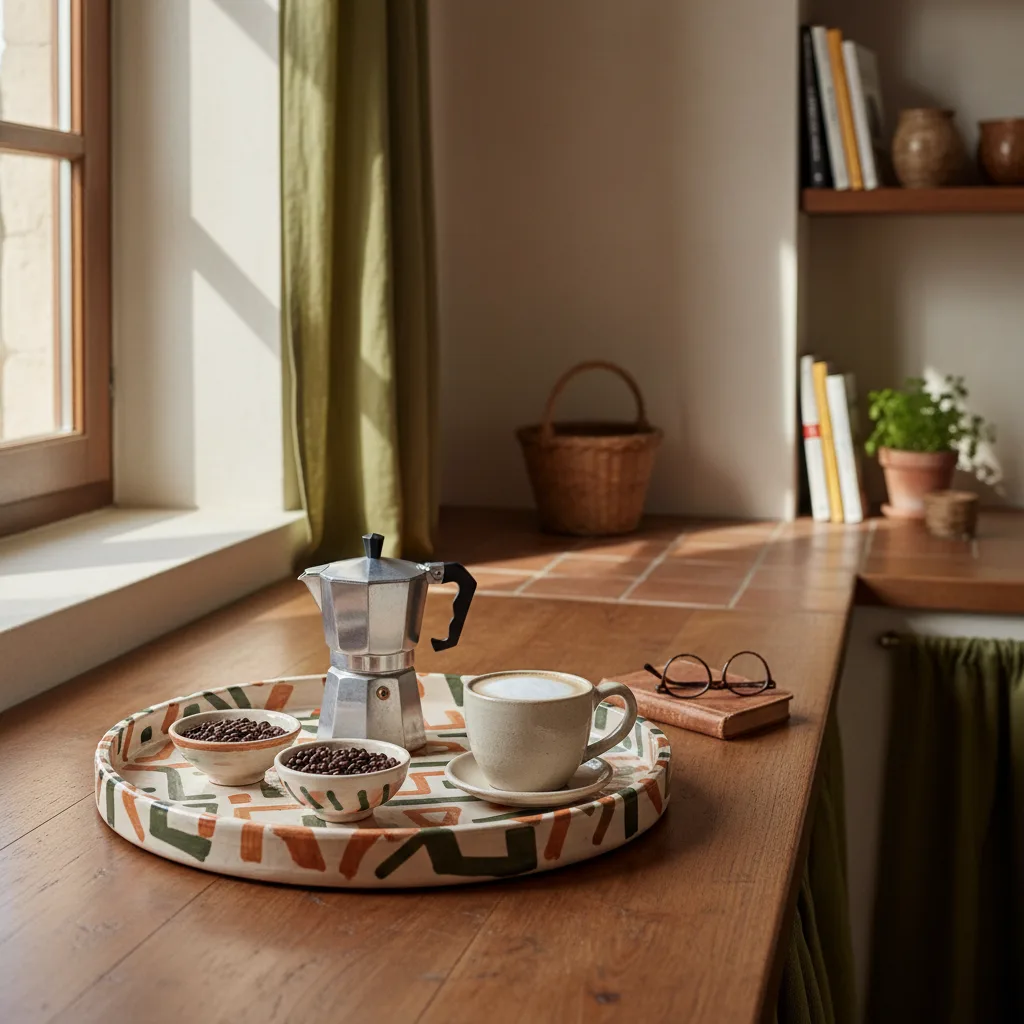
You have the coffee maker, the cups you love and that coffee you buy with care. But everything is scattered across the countertop, a high cupboard and the cutlery drawer. The result: a little chaos every morning. What you need isn't more space, but a round decorative tray and a couple of bowls that bring everything together in a single spot. A coffee corner that genuinely works and that, along the way, looks lovely without any effort. In this guide I'll explain how to set it up step by step, which pieces to choose and what mistakes to avoid so the result lasts longer than an Instagram photo.
Why a coffee corner changes your routine (and your kitchen)
A coffee corner isn't a magazine whim. It's an organisational decision disguised as decoration. When you group the coffee maker, cups, sugar and teaspoon in one spot, you eliminate unnecessary steps every morning. You stop opening three drawers and two cupboards. And when guests arrive, you don't have to improvise: everything is right there, visible and accessible.
What's interesting is that this small gesture transforms the perception of the whole kitchen. A tray with three or four well-placed elements creates visual order even when the rest of the countertop is in the middle of a culinary battle. It's the same principle that works with a centrepiece in the dining room: a focal point that anchors the eye and organises everything around it.
Choose the location before the pieces
Before thinking about trays or bowls, you need to decide where your corner will go. This step seems obvious, but skipping it is the most common mistake. The location determines the size of the tray, the height of the elements and the type of pieces that work.
Kitchen countertop
This is the most functional option. Look for a free stretch near a socket (for the coffee maker) and, if possible, close to the sink. The minimum useful space is around 40 × 40 cm. If your countertop is in dark tones (granite, stone), a light ceramic tray will create instant contrast. If it's light, you can play with ceramic in earthy or olive-green tones.
Auxiliary cart or small table
If your countertop can't take any more, a cart on wheels or a side table against the wall works just as well. Here you can use a larger tray —up to 35 cm in diameter— because you're not competing with other kitchen elements. The cart has an extra advantage: you can wheel it into the living room when you have guests.
Open shelving or ledge
For small kitchens, a floating shelf at eye level can hold a vertical coffee corner. In this case, the tray acts as a stable base so nothing falls, and the bowls work better stacked or in mini sizes.
The tray as a base: shape, size and material
The tray is the backbone of the corner. It isn't a secondary detail: it's what turns a group of loose objects into a composition with meaning. Choosing well here makes all the difference.
Round or rectangular
The round tray works better in compact corners and on countertops with corners, because it softens straight lines. The rectangular one fits better if you have many elements aligned (coffee maker + grinder + jar) or if your space is a long shelf. There's no absolute rule, but there is a guideline: if your corner has three elements or fewer, go round; if it has four or more, go rectangular.
Size: the margin rule
The tray should be big enough to hold all the elements without them touching, but small enough to leave a margin of at least 2-3 cm from the edge of the countertop or furniture. If the tray reaches the very edge, you lose the "organised island" effect and it looks as if it simply didn't fit anywhere else.
| Available space | Recommended diameter (round) | Recommended size (rectangular) |
|---|---|---|
| Small corner (30-40 cm) | 25-28 cm | 25 × 18 cm |
| Medium countertop (40-60 cm) | 30-35 cm | 35 × 22 cm |
| Cart or side table | 35-40 cm | 40 × 25 cm |
Material: ceramic, wood or metal
Each material tells a different story. Ceramic brings visual weight and an artisan character —especially if it has an irregular glaze or a handmade finish. Wood is warm and light, but stains easily if there are coffee drips. Metal (brass, steel) is clean and modern, though it can feel cold if the rest of your kitchen already has plenty of metallic finishes.
For a coffee corner with a Mediterranean personality, Italian ceramic is hard to beat. It has the resistance needed for daily use, withstands coffee stains better than untreated wood and ages with dignity. It's the same logic we explain in the guide on ceramic bowls: sizes and uses: the right material makes a piece work for years, not just weeks.
The bowls: the accessory no one expects and everyone needs
When you think of a coffee corner, you think of a coffee maker and cups. You rarely think of bowls. And that's the trick: a small bowl elevates the set from "things on a tray" to "a considered composition". It serves a real practical function and, at the same time, adds volume and texture.
What to keep in each bowl
An 8-10 cm bowl is perfect for brown sugar, sugar cubes or sweetener. A 10-12 cm one can hold tea bags, loose capsules or spices like cinnamon sticks. If you want to go further, a tiny bowl (6-8 cm) works as a rest for the teaspoon, keeping it from staining the tray. Three bowls is the reasonable maximum; beyond that, the corner starts to look like a buffet.
Coordinate without making everything identical
The most frequent mistake is buying bowls that are identical to the tray. It looks flat, lifeless. Better: the same colour family but a different finish. For example, a tray in smooth glazed ceramic and bowls with a rough texture. Or a neutral tray and bowls with a touch of muted colour —sage green, greyish blue, terracotta. The idea is for them to converse, not to repeat each other.
This principle is the same one that works when combining decorative vases in a modern living room: variation within coherence.
Step by step: set up your coffee corner in 15 minutes
You don't need a whole afternoon or an interior design course. With the right pieces, setting up the corner is a matter of minutes. Follow this order and the result will be coherent on the first try.
Step 1 — Clean the area. Remove everything from the chosen space. Clean the surface. Starting from an empty base forces you to decide what deserves to be there and what doesn't.
Step 2 — Place the tray. Position it with a margin from the edges. If it's round, don't push it against the wall: let it breathe a few centimetres.
Step 3 — Anchor the tallest element. The coffee maker, the grinder or a tall jar go at the back (against the wall). This creates depth and keeps the smaller elements from being hidden.
Step 4 — Add the cups. If they fit on the tray, place one or two cups in front of the tall element. If they don't fit, leave them off the tray but nearby: a wall hook or a small stand alongside.
Step 5 — Integrate the bowls. Sugar bowl in the foreground, spice or capsule bowl beside it. Make sure they are visible without covering anything.
Step 6 — The finishing touch. A sprig of fresh rosemary, a pretty spoon resting in a bowl, or a folded linen napkin. One single detail, not three. This is the moment the corner goes from functional to personal.
Five coffee corner styles (and the pieces each one calls for)
Not all coffee corners are the same, nor should they be. The style of your kitchen —or of the space where you set it up— dictates the tone of the pieces.
Mediterranean
Ceramic tray in warm tones (cream, terracotta, olive green), bowls with an irregular glaze, handleless tumbler-style cups. Natural materials, nothing shiny. It's the style that best fits authentic Italian pieces, because Mediterranean ceramic has spent centuries perfecting exactly this language.
Nordic
Light wood tray (beech, birch), smooth bowls in grey or matte white, refined lines. Few elements, plenty of empty space. Nordic minimalism works if your kitchen already breathes in that key; if not, it can feel cold.
Rustic
Aged wood or wrought-iron tray, thick stoneware bowls, earthenware cups. Glass jars with visible coffee. It works especially well in country kitchens or with solid wood countertops.
Modern industrial
Matte black metal tray, dark ceramic bowls, geometric lines. Fewer pieces, more impact. The trick is for each element to have its own presence without competing with the others.
Eclectic
A deliberate mix of materials and eras. Artisan ceramic tray with a vintage cup and a contemporary bowl. It's the hardest style to pull off well, but the most personal when it works. The key: a connecting thread of colour or texture that unifies the set.
Mistakes that turn your corner into clutter with a tray
Setting up a coffee corner is easy. Keeping it beautiful, less so. These are the slip-ups I see again and again, and they all have an immediate fix.
Overloading the tray. If you have to balance things to fit the last element, you've already gone too far. The tray should have visible empty space. If it doesn't, you need a bigger tray or fewer things on it.
Ignoring daily cleaning. Coffee stains. Sugar sticks. If you don't clean the tray at least a couple of times a week, the corner goes from "lovely" to "neglected" within days. Glazed ceramic wipes clean with a damp cloth in seconds; untreated wood absorbs stains and needs more upkeep.
Using pieces of the wrong scale. A huge bowl on a small tray looks comical. A giant cup next to a tiny bowl does too. Keep the proportions: the tallest element shouldn't be more than twice the height of the shortest. It's the same proportion rule that works with centrepieces.
Placing everything in a straight line. It seems tidier, but it's more boring. Alternate heights, set the bowls on a diagonal, let some element break the symmetry. A corner with life looks slightly imperfect.
Beyond coffee: other uses for the same combination
Once you have the tray and the bowls, you discover the formula serves many other purposes. The same principle of "grouping everyday elements on a beautiful base" works in any corner of the house.
In the bathroom, a tray with one bowl for cotton pads and another for soaps transforms an ordinary ledge. In the entryway, a tray with one bowl for keys and another for loose change. In the living room, a tray on the coffee table with candles and a small bowl as a decorative ashtray or for nuts when guests arrive. We explain it in more detail in the article on decorative trays: 5 uses you hadn't thought of.
The advantage of choosing ceramic pieces with character is that they never go out of fashion and don't need to "match" anything specific. A white ceramic vase works in any home, and the same happens with trays and bowls: if the piece has quality and a finish with personality, it adapts to whatever context you place it in.
Frequently asked questions
What size tray do I need for a basic coffee corner? For a corner with a coffee maker, one or two cups and a sugar bowl, a round tray 28-32 cm in diameter is enough. If you include a grinder or more accessories, go up to 35-40 cm or consider a rectangular one around 35 × 22 cm.
Does ceramic stain with coffee? Glazed ceramic resists coffee stains very well. Just wipe it with a damp cloth after use. Unglazed ceramic (biscuit or porous stoneware) can absorb liquids, so for a coffee corner it is better to choose glazed pieces. We expand on this topic in our guide on ceramic centrepieces and their care.
Can I use ordinary kitchen bowls or do I need decorative bowls? You can use any bowl, but decorative artisan ceramic bowls bring a visual finish that everyday bowls usually lack. The difference lies in the glaze, the thickness and the textural details that turn a functional piece into a piece with personality.
Does a coffee corner work in a very small space? Yes. In tight spaces, use a small tray (25 cm) with just a coffee maker and a bowl. Or set up the corner vertically with a floating shelf. The important thing is that the elements are grouped together, even if there are only a few.
How often should I change the corner's composition? There is no need to change it often. You can vary the seasonal detail —a sprig of lavender in summer, a cinnamon stick in winter— without touching the base structure. The beauty of investing in good pieces is that they don't demand constant renewal.
Complementary pieces to complete your coffee corner or carry the same decorative criteria to the rest of the kitchen.