Ceramic bowls: sizes, uses and how to get it right
You have four decorative bowls on the shelf that you never use. Three more in the cupboard that don't match each other. And when you need to serve a soup or present a salad for guests, you end up reaching for that odd bowl that survived three house moves. If this sounds familiar, the problem isn't how many bowls you have: it's that no one ever explained what size you need, what each one is for and how to choose pieces that work in the kitchen as well as on the table.
This guide clears it up, no fluff. Real sizes, concrete uses and criteria so that your next ceramic bowl purchase doesn't end up in a drawer.
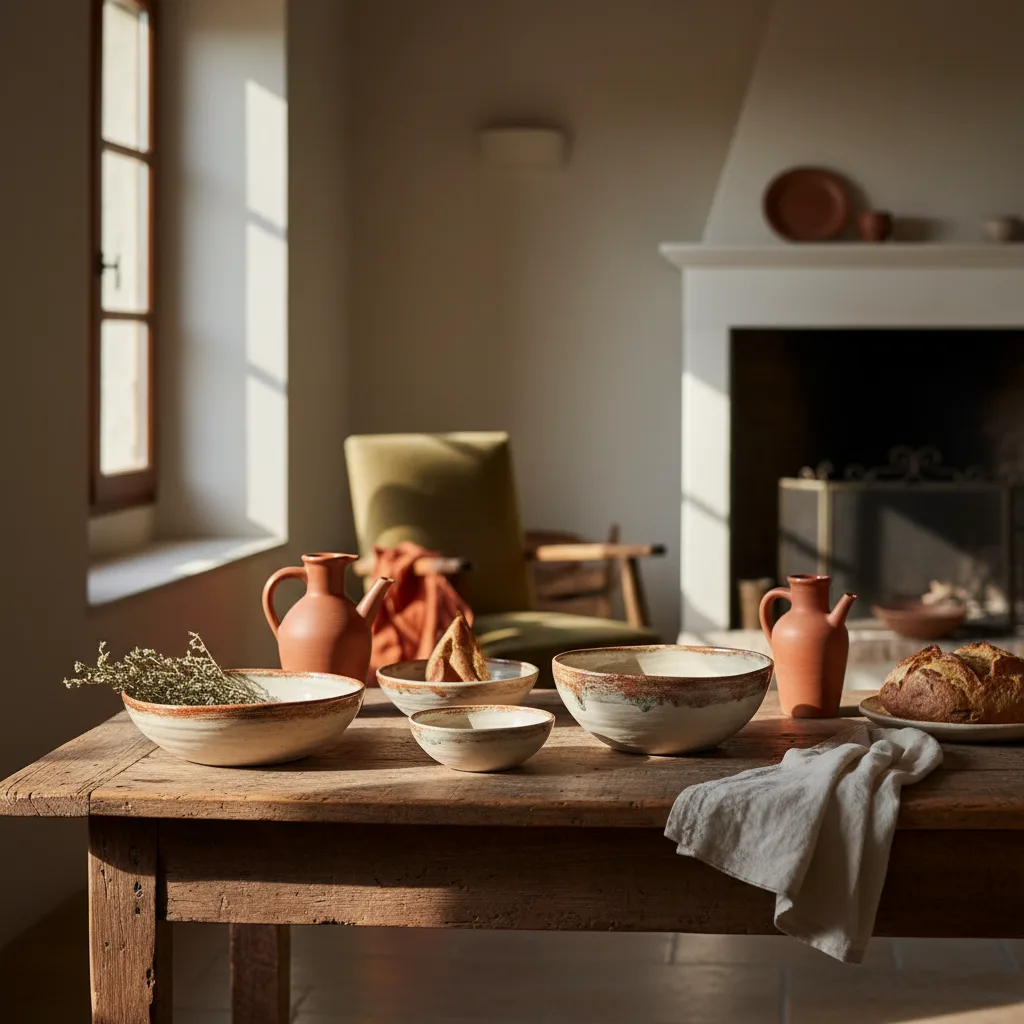
Why ceramic is still the material that pays off most
Before talking about sizes, it's worth understanding what makes a ceramic bowl special compared with other options. Because in practice, the material shapes everything else: durability, aesthetics, versatility and even how the food you serve in it tastes.
Ceramic —and its variants: stoneware, porcelain, earthenware— is a non-reactive material. That means it doesn't alter the flavour of acidic foods like tomato, lemon or vinegar, something that does happen with certain metals. Ceramic also holds temperature well: a preheated bowl will keep your pumpkin soup hot for longer than a glass or plastic one. And unlike stainless steel, a handmade ceramic bowl brings texture, colour and personality to the table effortlessly.
Some argue that ceramic is fragile. It's true that you can't throw it against the floor, but a piece of stoneware properly fired at high temperature will withstand daily use for decades. The key lies in the quality of the glaze and the firing, not in the material itself. A well-made Italian ceramic bowl, like the ones made by Brandani, is not a delicate object to keep in the display cabinet: it's a tableware tool designed to be used.
The size guide you need to have clear
This is where most people get lost. They buy "pretty" bowls without thinking about capacity, and then find that the salad bowl is too small for two people or that the appetiser bowl looks like a soup tureen. The following table gives you the reference measurements so you don't get it wrong.
| Size | Approx. diameter | Capacity | What to use it for |
|---|---|---|---|
| Small bowl (individual) | 10–13 cm | 150–300 ml | Sauces, olives, appetisers, nuts, individual dessert |
| Medium bowl (everyday bowl) | 14–18 cm | 400–700 ml | Cereal, soups, individual portions of salad or pasta |
| Large bowl (serving) | 20–26 cm | 1–2.5 litres | Salads to share, pasta, fruit, large poke bowls |
| XL bowl (salad/centrepiece) | 28–35 cm | 3–5 litres | Table salad bowls, decorative centrepieces, fruit bowls, display pieces |
A tip that rarely appears in guides: keep at least three sizes at home. The small one for everyday use and appetisers. The medium one as your personal bowl for full meals. And the large one as a serving piece when you have people over. With those three, you cover 90% of situations without piling up pieces you never use.
Bowls for cooking vs. bowls for serving: they're not the same
One of the most common mistakes is using the same bowl to mix in the kitchen and to present on the table. Technically you can, but there are differences that matter if you want your pieces to last and your table to have character.
Working bowls (kitchen)
A good kitchen bowl needs to be roomy, with a stable base and walls that don't splash when you mix. Here, design matters less than functionality. Thick stoneware bowls or ceramic ones left unglazed on the outside are ideal because they don't slip on the counter and handle temperature changes well. If you're going to marinate, ceramic is a better option than metal: it doesn't react with the acids in the dressing and doesn't absorb odours.
Stackable bowls are especially practical for the kitchen. If you can store three or four nested inside each other, you save cupboard space without giving up a range of sizes. That said, make sure the interior glaze is in good condition: cracks in the glazing can harbour bacteria over time.
Table bowls (serving and presenting)
This is where design comes in. A serving bowl is a piece your guests will see, touch and associate with the experience of eating at your home. The shape, the colour of the glaze, the thickness of the rim, the exterior texture: it all adds up. An Italian ceramic bowl with a reactive glaze that creates unique variations in tone is not just a container; it's an element that elevates the table without any need for vases or elaborate tablecloths.
For serving, look for bowls with a rim that curves slightly inward —it prevents spills when you pass it around— and a wide base that gives it stability. Matte or satin finishes tend to work better on the table than very glossy ones, because they reflect less artificial light and give a more natural look.
Six uses for bowls that go beyond food
If you think a bowl is only for eating, you're underusing one of the most versatile pieces in the home. Decorative bowls have a functional and aesthetic role that we often overlook.
In the entryway. A medium bowl on the console by the door is the perfect spot for keys, coins and sunglasses. Much more elegant than the plastic tray, and it gives personality to the first corner you see when you get home. If the piece has character —an irregular glaze, a terracotta tone, a handmade finish— all the better.
In the bathroom. A small bowl next to the sink to hold rings, earrings or cotton pads. It doesn't need to be a "bathroom" bowl: any ceramic piece with personality works. It's a detail that turns a utilitarian space into something more considered.
As a centrepiece. A large bowl with seasonal fruit or a few dried olive branches is a centrepiece that refreshes itself. No candles, no flowers that wilt, no upkeep. Just a beautiful piece with contents that change with the seasons.
For plants. Bowls without a drainage hole work as decorative planters for succulents or bulbs. The trick is to put a layer of gravel at the bottom so water doesn't pool around the roots. Use bowls that are unglazed inside so they absorb a little extra moisture.
As a desk organiser. Clips, pens, business cards. A small bowl on the desk does the same job as a plastic organiser, but with far more visual presence.
For scenting a room. An open bowl with dried flowers, lavender or potpourri is a simple way to perfume a corner of the house without plugs or sprays.
Ceramic, stoneware or porcelain: differences that matter when choosing
All three are "ceramic" in the broad sense, but their everyday behaviour is very different. Here's the essential information without getting into kiln technicalities.
Earthenware. This is the most basic ceramic, fired at low temperatures. More porous, lighter, more fragile. It works well for purely decorative pieces, but it's not the best option for intensive daily use. If an earthenware bowl loses part of its glaze, it can absorb liquids and stain.
Stoneware. Fired at higher temperatures, it's dense, durable and practically waterproof even when unglazed. It's the material that best balances durability and handmade aesthetics. Most quality Italian ceramic bowls —including those from brands like Brandani— are made of stoneware. They withstand the microwave, the dishwasher and daily use without losing their composure.
Porcelain. The most refined: fine, translucent, elegant. Resilient despite its delicate appearance, but with a more formal character. If your table is for everyday use and you're after Mediterranean warmth, stoneware usually fits better. If you're looking for sophistication for special occasions, porcelain has its place.
The most important practical difference: a stoneware bowl can go from the oven to the table without worry; an earthenware one can't. If you're going to invest in pieces that last for years and that you actually use, stoneware is almost always the best decision.
How to mix bowls without it looking like a bazaar
Having beautiful bowls is of little use if each one is in a different style and the table looks like a second-hand shop. The key to combining bowls coherently is to follow three simple principles.
Choose a palette and stick to it. You don't need all your bowls to be identical, but they should share a colour family. Warm neutral tones (cream, sand, soft terracotta) combine effortlessly. If you want a touch of colour —a cobalt blue, an olive green— use it as an accent on one or two pieces, not on all of them.
Vary the size, not the style. The best way to create a bowl collection with personality is to buy different sizes within the same line or from the same maker. That way you get functional variety without losing visual coherence. Bowls from the same collection in three different sizes create a natural set you don't need to force.
Mix finishes with judgement. A matte bowl next to one with a glossy glaze can work if they share a tone. But mixing a rustic clay bowl with a fine porcelain one rarely looks good. The rule: the more different the finishes are, the closer they need to be in colour and shape to coexist.
Common mistakes when buying ceramic bowls
After seeing hundreds of tables and kitchens, these are the slip-ups that come up most often. Avoid them and you'll save money and space.
Buying on looks alone. A gorgeous bowl that isn't the right size for anything specific ends up as forced decoration or tucked away in the cupboard. Always think about the use first and the aesthetics second.
Ignoring the base. A bowl with a narrow base tips over easily, especially if you use it for serving. Check that the ratio between the diameter of the base and the rim is well proportioned. Quick rule: the base should measure at least a third of the top diameter.
Not checking whether it's dishwasher-safe. Many handmade bowls with decorative glazes don't tolerate the dishwasher. If you're going to use the piece daily, make sure beforehand. High-fired stoneware ceramics are usually safe, but hand-painted finishes can degrade with the wash cycles.
Buying single bowls without thinking about the set. An isolated bowl solves nothing. Think in minimal collections of three or four pieces that work together. It's more useful and visually more powerful than five mismatched bowls.
Confusing decorative with useless. Just because a bowl is beautiful doesn't mean it shouldn't be used. The best Italian ceramic pieces are designed for the real table, not the display cabinet. Use them. They become more beautiful with use.
small ceramic bowls for appetisers
Basic care so your bowls last for years
Ceramic is durable, but not indestructible. With a few minimal habits, your pieces can stay with you for decades. Caring for ceramic isn't complicated, but it's worth keeping in mind.
Avoid sudden temperature changes. Don't take a bowl out of the fridge and put it straight in the oven. Let it come to room temperature for a few minutes. This is especially important with earthenware and fine porcelain; stoneware tolerates thermal contrasts better, but don't push it.
If you stack bowls to store them, place a soft cloth or a paper napkin between each piece. This prevents the scuffs that, over time, damage the glaze and create greyish marks (the infamous "metal marks" left by cutlery or contact with other pieces).
For stubborn stains —tea, coffee, turmeric— a paste of baking soda with a few drops of lemon left on for half an hour usually works without harming the glaze. Avoid abrasive scourers: always use the soft side.
Pieces that complement a bowl collection to complete the table.
Frequently asked questions about ceramic bowls
Can ceramic bowls go in the microwave? Most stoneware and porcelain bowls are microwave-safe, as long as they have no metallic details (gold or silver rims). Earthenware is usually compatible too, but check that the glaze has no cracks, as it could accumulate moisture and heat unevenly.
What size bowl do I need for a salad for four people? A bowl 24 to 28 cm in diameter with a capacity of 2 to 3 litres is enough for a generous salad for four. If you like plenty of room to toss the ingredients, go up to a 30 cm bowl.
Are handmade ceramic bowls food-safe? Yes, as long as the glaze is food-grade —that is, free of lead and cadmium. European manufacturers such as Brandani comply with CE regulations, which require glazes in contact with food to be certified. If you buy ceramic of unknown origin, always ask about the certification.
Is it worth investing in Italian ceramic bowls? It depends on what you value. A well-made Italian ceramic bowl —high-fired stoneware, durable glaze, thoughtful design— costs more than a mass-market one, but it lasts longer, ages better and gives your table a character that generic pieces never achieve. It's a long-term investment, not an expense.
How do I tell whether a bowl is earthenware, stoneware or porcelain? The simplest way: look at the unglazed base. Stoneware is dense and greyish or tan in tone. Porcelain is white and slightly translucent if you hold it up to the light. Earthenware is lighter and paler than stoneware, and sounds more hollow when tapped gently. If the maker is a quality one, they'll specify it on the product page.
— anchor text: "creative uses for decorative trays"
- Decorative fruit bowl or tray: which piece to choose for your kitchen — anchor text: "fruit bowl or tray for the kitchen"
- Ceramic fruit bowl: why it's still prettier than the plastic one — anchor text: "ceramic vs plastic fruit bowl"
- How to choose the perfect centrepiece for your dining room — anchor text: "choosing a centrepiece for the dining room"
- Ceramic centrepieces: why they last and how to care for them — anchor text: "caring for ceramic tableware"
- What to use as a centrepiece: the cliché-free guide — anchor text: "centrepiece ideas without clichés"
- Decorative salad bowl: the useful gift no one buys — anchor text: "decorative salad bowl as a gift"
- How to create a coffee corner with trays and bowls — anchor text: "coffee corner with trays and bowls"