How to choose the perfect centrepiece for your dining table
A dining table centrepiece can completely change the personality of a room. Or it can get in the way, throw off the proportions and end up in a cupboard within a couple of weeks. The difference between the two isn't a matter of budget or of blindly following trends: it's a matter of understanding what your table, your space and your way of living at home actually need.
If you've ever felt that your dining room looks "unfinished" but you can't quite say what's missing, this is probably it. A focal point that gives the table meaning when there are no plates on it. A piece that speaks of you without needing any explanation. This guide helps you choose it well —no waffle, no clichés and no purchases you'll end up regretting.
Why the centrepiece matters more than you think
In many Spanish homes, the dining room is where life really happens. Weeknight dinners, Sunday lunches, the table where friends linger after a meal. And that table, when there's nothing on it, speaks. It says whether the home has a point of view or whether things were simply allowed to pile up.
A good centrepiece is not a decorative whim. It's the element that visually ties the space together, that sets the tone of a room and that —when chosen well— makes everything else look more considered. Interior designers call it the "visual anchor point": the piece that tells your eye where to look first when you walk into a room.
The problem is that most people choose it the wrong way round. First they buy something pretty and then they try to fit it onto their table. The right order is exactly the opposite: first understand your table, your space and your lifestyle, and then look for the piece that fits all of that.
Table shape: the first criterion everyone ignores
Before thinking about materials, colours or styles, there's a basic question that conditions everything else: what shape is your table? The geometry of the surface sets the rules of the game, and skipping it is the most common mistake.
Rectangular table
It's the most common in Spanish dining rooms. The trick is not to concentrate everything on a single central point, but to think in a line. A table runner with several pieces at different heights works better than a lone vase in the middle. Think of an elongated composition: a ceramic centrepiece flanked by two low candles, or an oval tray with natural elements.
Round table
Here symmetry rules. A voluminous, rounded centrepiece —a wide bowl, a fruit bowl with presence— works because it echoes the shape of the table and reinforces that sense of gathering. Avoid pieces that are too tall: at a round table, all the diners face one another, and a tall centrepiece breaks that connection.
Square table
It calls for symmetry and restraint. A single element with character —a compact ceramic vase, a geometric candlestick— is enough. Arrangements of many small pieces on a square table tend to look cluttered.
Oval table
The most elegant and the hardest to decorate. The centrepiece should be elongated but with softened lines, to follow the curve of the table without competing with it. An oval ceramic tray with a simple composition inside is almost always the best bet.
Proportion and height: the two rules you can't skip
If there's one thing that separates a well-chosen centrepiece from one that simply "sits there", it's these two measurements.
The one-third rule. The centrepiece should take up no more than one third of the table's width. If your table is 90 cm wide, the centrepiece shouldn't exceed 30 cm. It sounds like a little, but it's the proportion that leaves enough room for plates, glasses and elbows without making the table look like a shop window.
The height rule. When you're seated at the table, you should be able to see the person opposite without having to peer around the side of the centrepiece. This means the ideal height is around 25-30 cm at most. Taller pieces work as permanent décor —when the table isn't set—, but they should be easy to remove at mealtimes.
| Table size | Maximum centrepiece width | Recommended height |
|---|---|---|
| Small (4 people) | 15-20 cm | Up to 20 cm |
| Medium (6 people) | 20-30 cm | Up to 25 cm |
| Large (8+ people) | 30-40 cm | Up to 30 cm (or a low, elongated composition) |
There's a common trap: thinking that a large table needs a large, eye-catching centrepiece. Not always. Sometimes a composition of three small pieces at different heights —a low bowl, a candle, a slim vase— is more visually interesting than one huge piece that looks like a trophy.
low decorative Italian ceramic bowl
Materials: ceramic, glass, wood and metal
The material of the centrepiece defines its character. And it should dialogue with the materials you already have in the dining room: the table, the chairs, the lighting, the floor.
Ceramic
It is, probably, the most versatile material for a centrepiece. It brings warmth without feeling heavy, ages well and works in everything from matt, rustic finishes to glossy, contemporary glazes. Italian ceramic in particular has a centuries-old tradition of tableware pieces that combine function and beauty with no apparent effort. A well-made ceramic centrepiece never goes out of fashion because it was never tied to a particular trend.
Crystal and glass
They bring lightness and luminosity. They're ideal for small dining rooms or those with little natural light, because they reflect and multiply whatever light there is. Glass works especially well on glass or metal tables, but it can look cold in a warm wooden dining room if it isn't combined with other elements that balance it out.
Wood
Trays, carved bowls, turned pieces. Wood brings an organic touch that connects with nature. It works very well in rustic or Nordic dining rooms, but beware of overdoing it: if the table is already wooden, a centrepiece in the same material can feel monotonous. Look for a contrast in tone or finish.
Metal
Candlesticks, brass trays, copper or iron bowls. Metal adds a touch of sophistication and reflection that may be just what a dining room that feels too "soft" needs. It combines well with ceramic and with natural textiles such as linen.
Decorative style: find yours before you buy
There's no such thing as a universal centrepiece. What works in a minimalist living-dining room would be a disaster in a rustic Mediterranean one. Before choosing, identify the dominant style of your dining room.
Mediterranean and rustic
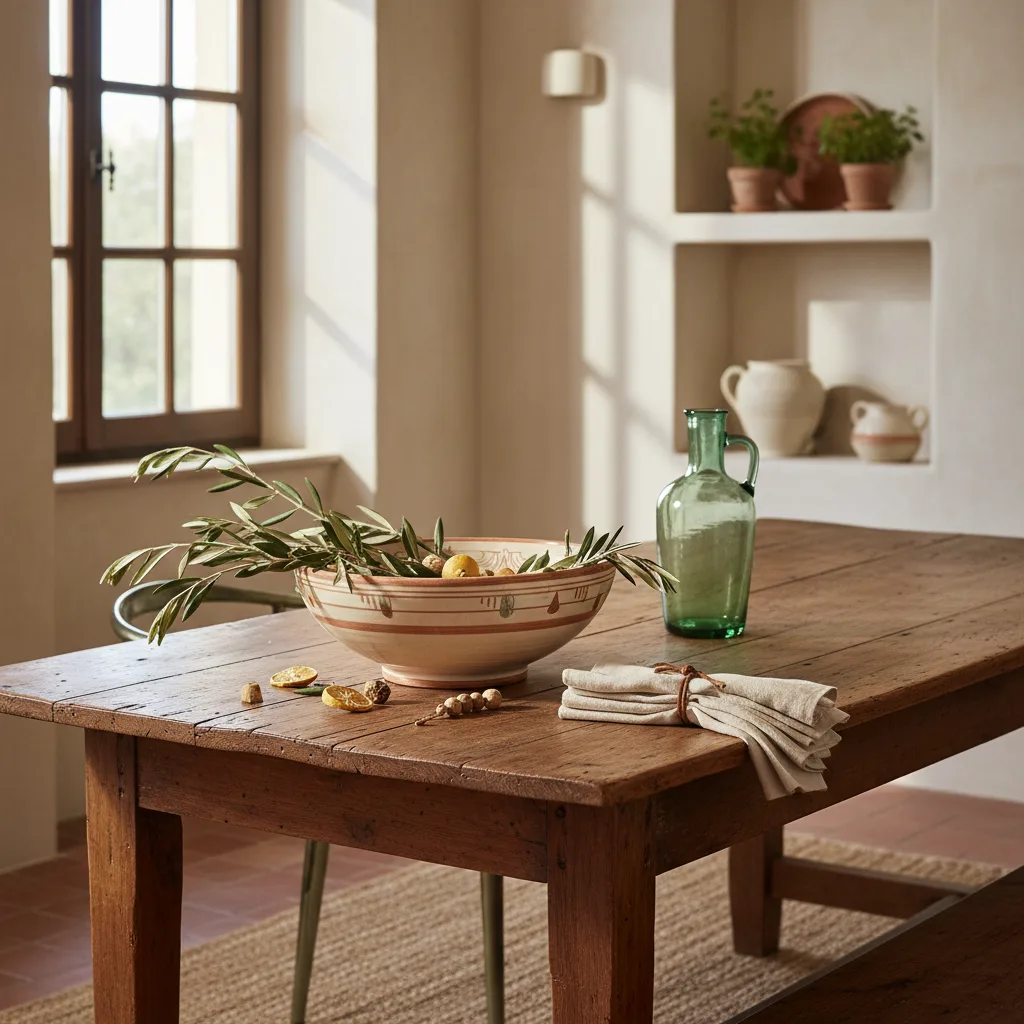
Natural materials, warm tones, visible textures. This is where ceramic centrepieces with irregular glazes fit, fruit bowls with real fruit, compositions with olive or rosemary branches. The spirit is generous but not overloaded: the Mediterranean table always leaves room for what really matters, which is the food and the conversation. It's the style that best represents the authentic Italian table, where every piece has a function and a reason.
Modern and minimalist
Clean lines, a single material, a single piece with presence. A sculptural vase without flowers, a bowl with geometric lines, a ceramic sphere. Minimalism isn't putting little out: it's putting out only what makes sense. If this approach interests you, the guide on minimalist vs maximalist centrepieces will help you pin down your exact point.
Nordic
Similar to minimalist but with more warmth. Light wood, white or soft grey ceramic, green plants. The contrast comes from textures (smooth against rough, matt against glossy) rather than from colours.
Eclectic
For those who mix eras, origins and materials without fear. Here it's fine to combine a vintage ceramic bowl with a modern candlestick and a couple of stacked books. The key is that there's a common thread —a colour, a finish, a line— that keeps it from looking like a flea market.
Seasonal adaptation: a table that changes with you
One of the advantages of having a good "base" centrepiece —a ceramic piece, a wide bowl, a tray with presence— is that you can change what you put inside it according to the season without buying anything new.
In spring and summer, fresh flowers from the market, aromatic herbs in a glass inside the bowl, seasonal fruit that smells good too. In autumn, dried leaves, pomegranates, a small pumpkin if the style allows it. In winter, low candles, pine cones, pine branches. If the Christmas theme interests you, there are specific ideas in the guide to Christmas centrepieces with Italian inspiration.
The base piece is the smart investment. What goes inside changes with whatever you have to hand and with whatever you fancy that week. That's why it's worth choosing that piece well: it's going to be with you for a long time.
Mistakes that keep happening (and how to avoid them)
After everything above, these are the most common slip-ups we see again and again:
- A centrepiece too tall for dinners. If you use the table every day, the centrepiece must allow conversation. Save the tall pieces for hallway tables or sideboards.
- Too many elements with no common thread. Three pieces chosen with care always beat seven with no connection between them. If you want to dig deeper into this, the rule of 3 for centrepieces explains it in detail.
- Ignoring proportion. A centrepiece that takes up half the table doesn't decorate: it invades.
- Buying without thinking about real use. Got children? Rule out fine glass for everyday use. Entertain a lot? Look for pieces that are easy to move. Cook often? A decorative fruit bowl that also holds the week's fruit is more practical than an untouchable sculpture.
- Copying a magazine "look" without adapting it. What works in a Pinterest photo with professional lighting and a 3-metre table can be a disaster in your 12 m² dining room. The guide on what to use as a centrepiece without clichés helps you think about it more freely.
For a more complete rundown of common blunders, there's an article dedicated to the 7 common mistakes when choosing a centrepiece.
Italian ceramic fruit bowl with a sculptural design
Quick checklist before choosing your centrepiece
Before adding anything to the basket, run through these points:
- Have I measured the width of my table? (the centrepiece shouldn't exceed one third)
- Does the height allow you to see the diner opposite?
- Does the material dialogue with what's already in my dining room?
- Is it easy to move when I set the table for a meal?
- Does it work empty or does it only make sense with flowers/fruit inside?
- Can I change what goes inside according to the season?
- Does it stand up to the real use of my home (children, pets, frequent dinners)?
If you've answered yes to most of them, you're probably looking at a good choice. If not, keep looking. Better to wait than to get it wrong with a piece that will be at the centre of your home —literally— every single day.
Complementary pieces to round off the décor of your dining table with stylistic coherence.
Frequently asked questions
What can I use as a centrepiece if I don't like flowers? Plenty of options: a ceramic bowl with seasonal fruit, an empty sculptural fruit bowl as a decorative piece, an arrangement of candles at different heights, or a tray with small objects you love (stones, small books, figurines). The important thing is that the piece has presence in its own right, without depending on what it holds inside.
What is the best material for a long-lasting centrepiece? Quality ceramic is hard to beat: it withstands daily use, doesn't fade in the light, is easy to clean and gains character over time. Glass also lasts but is more fragile. Wood needs a little more maintenance to avoid damp stains. Metal is practically indestructible but can scratch.
Should the centrepiece match the tableware? Not necessarily. In fact, a little contrast is usually more interesting than a perfect match. What it should share is a "visual family": if your tableware is ceramic in warm tones, a ceramic centrepiece in a complementary tone will work better than one in polished steel. Coherence matters more than uniformity.
How do I decorate the centrepiece on a table I use every day? The key is that it's easy to move. Choose a base piece —tray, bowl or fruit bowl— that you can lift away in one go when you set the table. Avoid arrangements of many loose elements that have to be cleared away piece by piece every lunchtime. Practical and beautiful aren't at odds: you just have to think it through before buying.
Is it worth investing in a designer centrepiece? If it's a piece that will be on show every day, in the literal centre of your home, yes. A quality Italian ceramic centrepiece can last for decades and never goes out of fashion because its design is based on proportions and materials, not passing trends. It's a small investment with a big visual impact.