Napkins, tablecloths and chargers: the base that transforms your table
You can have the most beautiful dinnerware in the world and an impeccable centrepiece, but if there's nothing underneath —or a plastic oilcloth you haven't changed in three years— the kitchen table decor loses all its effect. Textiles and bases are the first thing to touch the table and the last thing we tend to think about. And that's the mistake.
Napkins, tablecloths and chargers are not secondary accessories. They are the canvas on which everything else is built: the colour, the texture, the sense of care perceived by whoever sits down to eat with you. In Italy they've understood this for generations: before the first plate is set down, the table already has to tell a story.
This guide helps you choose each piece with judgement, combine them without fear and understand why that seemingly small change completely transforms the experience of sitting down at the table.
Why the textile base matters more than you think
Think about the last time you dined at a restaurant you genuinely liked. You probably don't recall the tablecloth precisely, but you do recall the feeling: something soft when you rested your elbows, a napkin that wasn't paper, a plate that rested on something that gave it presence. That perception is no accident. It's design.
The textile base serves three functions that go beyond the decorative. First, it protects the table from scratches, heat and stains —a practical function that justifies the investment on its own. Second, it dampens sound: a table with a tablecloth absorbs the noise of cutlery and glasses, and that changes the tone of the conversation without anyone consciously noticing. Third, it visually unifies the whole. A good tablecloth or a well-chosen charger connects dinnerware, glassware and centrepiece into a single story.
In the Italian tradition of table setting, the textile is not an add-on: it's the starting point. It's chosen before the dinnerware, because it sets the tone for everything that goes on top. If you want to delve deeper into how Italians understand the table, you'll want to read how to set an authentic Italian table without clichés.
Tablecloths: how to choose yours without regrets
The tablecloth is the most visible piece and the one that raises the most doubts. Size, material, colour, plain or patterned… There are so many options that it's easy to settle for the first one you find or, worse, use none at all. Let's simplify.
Material: the difference you can feel
The tablecloth's material defines its drape, its feel and its durability. And there are no shortcuts here: quality is perceived instantly.
| Material | Feel and drape | Ideal for | Maintenance |
|---|---|---|---|
| 100% linen | Natural drape, noble texture | Formal dinners, everyday tables with character | Wrinkles (and that's part of its charm). Gentle machine wash |
| Cotton | Soft, clean drape | Everyday use, families with children | Easy to wash, handles cycles well |
| Linen-polyester blend | Fewer wrinkles, good presentation | Those who want linen without so much ironing | Balance between quality and practicality |
| Pure polyester | Stiff, no texture | Emergencies, outdoor use | Easy to clean, but you can tell it's not natural |
If you have to choose just one, go for good-quality linen or cotton in a neutral tone. It's the investment with the most mileage: it works for Tuesday's breakfast and for Saturday's dinner with guests.
Size: the rule that prevents disaster
A tablecloth that's too short looks like a patch. One that's too long catches on your knees. The classic rule is simple: the tablecloth should hang between 25 and 35 centimetres on each side of the table. No more than a third of the distance between the surface and the floor. For a 160 × 90 cm table, you need a tablecloth of at least 210 × 140 cm.
Colour: less risk than you imagine
White and ecru are the most versatile colours and the ones that best match any dinnerware. But they're not the only valid option. A tablecloth in olive green, midnight blue or anthracite brings sophistication without being risky, especially in autumn and winter. The key is to respect a simple rule: if the tablecloth has colour, the napkins go in a neutral or complementary tone. If the tablecloth is plain, you can play with patterned napkins. Never both patterned at once.
Cloth napkins: the detail that separates the everyday from the special
There's an exact moment when a table stops being functional and becomes something cared for. That moment is usually the napkin. When it's cloth —not paper— the message changes: someone here took an extra minute.
Cloth napkins are not a luxury reserved for Christmas dinners. In many Italian homes they're used daily, washed with the regular laundry and last for years. The trick is to have an everyday set (cotton, neutral colours, no fear of staining them) and an occasions set (linen, tones that contrast with the tablecloth, a more careful fold).
Sizes according to the occasion
Not all napkins are the same size, nor should they be. Proportion matters as much as colour.
- Formal dinner napkin: 50 × 50 cm or 50 × 60 cm. It's the one folded on the plate or beside it.
- Everyday napkin: 40 × 40 cm. Enough for regular use without being bulky.
- Afternoon or brunch napkin: 30 × 30 cm. Smaller, more informal, perfect for a coffee corner with trays and bowls.
- Cocktail napkin: 20 × 25 cm. Just for standing appetisers.
How to fold them without overcomplicating
Forget the YouTube tutorials with origami folds. For a table that's beautiful and real, two options are enough: the simple rectangle (napkin folded in three, placed to the left of the plate or on top of it) or the classic triangle (diagonally, with the point facing up). Both are clean, elegant and require no master's degree in paper folding.
If you want an extra touch, place a sprig of rosemary or a small flower on the folded napkin. That minimal gesture is pure Mediterranean style and costs nothing.
Chargers: the piece almost nobody has (and everybody notices)
The charger —also called a presentation plate or service plate— is that large piece that goes underneath the service plate. You don't eat on it. You don't serve on it. Its function is purely aesthetic and protective, and that's precisely why it makes the difference between a set table and a well set table.
In Italian hospitality of a certain level, the charger is mandatory. At home it's optional, but its effect is immediate: it gives visual structure to each place setting, frames the dinnerware and adds a layer of texture that enriches the whole.
Materials and when to use each one
The choice of charger depends on the style of your table and the occasion.
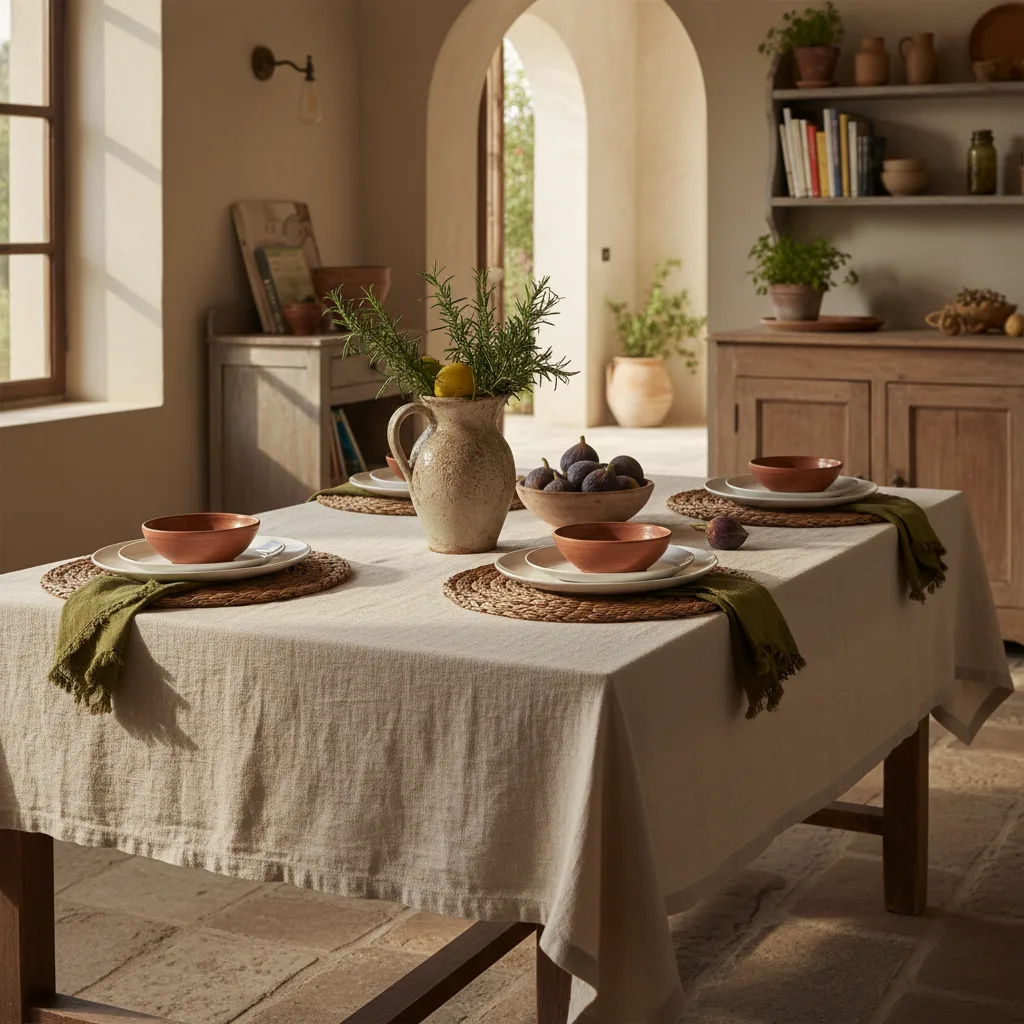
Chargers in wicker or natural fibre (rattan, palm leaf, rush) suit Mediterranean, rustic or coastal-inspired tables. They're light, stackable and bring warmth without competing with the dinnerware. If your style is close to what you'd describe as an authentic Italian table, this is your natural choice.
The wooden ones —oak, olive, acacia— work on tables with a Nordic or contemporary rustic aesthetic. They weigh more, but their presence is striking.
Ceramic or porcelain chargers are the most formal option. They pair well with dinnerware of the same material and elevate the table for special occasions. If you already have ceramic centrepieces, the consistency of material adds points.
The gold or silver metal ones look spectacular on gala tables, but for everyday use they can be excessive. Use them sparingly and always over a plain tablecloth.
Proportion and placement
The charger should be at least 5 centimetres wider than the plate that goes on top. If your dinner plate is 27 cm in diameter, look for a 32-33 cm charger. That visible rim around the plate is what creates the visual effect. If the charger ends up hidden, it loses all its purpose.
It's placed centred at the diner's setting, aligned with the edge of the table at about two centimetres. It isn't removed during the meal —it stays as a base until dessert— and is wiped between courses if necessary.
How to combine the three pieces without it looking like a catalogue
The temptation when setting a table with tablecloth, napkins and chargers is to buy everything from the same set, same colour, same manufacturer. It works, but it's predictable. The magic lies in combining with judgement, not in coordinating to the millimetre.
Here are three combinations that always work, tested on real tables:
Everyday Mediterranean table. Ecru or sand linen tablecloth, cotton napkins in terracotta or sage green, natural wicker charger. White dinnerware or ceramic with an irregular glaze. It's the table you might find in a Tuscan trattoria with good light.
Elegant table for guests. White linen tablecloth, napkins in anthracite grey or midnight blue, white ceramic or porcelain charger. Fine glassware and a low centrepiece with candles. No fuss, pure visual cleanliness.
Informal table with character. No tablecloth (bare wooden table or over a placemat), napkins in subtly patterned cotton, wooden charger. It works for brunch, weekend meals or midweek dinners when you want something special without staging a whole production.
The rule that ties the three together: a maximum of two different materials and a maximum of three tones. If you respect that, the table will always have cohesion.
⚠ PRODUCT_CARD without match — Cotton napkins in warm colours: the easiest change for any table.
The table protector: the invisible piece that changes everything
There's one piece almost nobody mentions and that hospitality professionals consider essential: the table protector or undercloth. It's a quilted fabric placed between the table and the tablecloth. You can't see it, but you can feel it.
The table protector serves functions no other element can replace. It stops the tablecloth from slipping, protects the table surface from the heat of platters and dishes straight out of the oven, absorbs small spills before they reach the wood and, above all, dampens the sound of cutlery and glasses being set down. A table with a protector sounds different. It sounds like a serious dinner.
It should be the same size as the tablecloth but without overhanging the edges. It doesn't need to be thick: a centimetre of padding is enough. If you're only going to invest in one piece that can't be seen but that everyone notices, make it this one.
Common mistakes (and how to avoid them)
After talking about what works, it's worth reviewing what doesn't. These are the most common mistakes when dressing the base of a table:
Mixing too many patterns. Patterned tablecloth + patterned napkins + decorated dinnerware = visual noise. If one element is patterned, the rest go plain.
Using paper napkins on a set table. If you've brought out the tablecloth, paper napkins break the coherence. Better few cloth napkins than many paper ones.
A charger the same diameter as the plate. If it doesn't show, it adds nothing. You need those extra 5 cm of visible rim.
A tablecloth that's too short. The minimum drop is 25 cm per side. Less than that looks like a cloth thrown on in a hurry.
Not having a table protector. The tablecloth slips, glasses clink when set down, the hot platter leaves a mark. All of that is solved with a 15-euro table protector.
Buying only white for "safety". White is versatile, yes, but a set of napkins in terracotta, olive green or mustard transforms the table without risk. Start with the napkins if you don't dare with the tablecloth.
If you're interested in the most common mistakes when setting a complete table, take a look at the 5 mistakes when setting the table for a special dinner.
Your checklist for dressing the table base
Before setting the table next time, run through this quick list:
- Do you have a table protector or undercloth? If not, place at least a table protector
- Does the tablecloth hang between 25 and 35 cm on each side?
- Are the napkins cloth? (even the everyday ones, always cloth)
- Is there a maximum of one patterned element between tablecloth and napkins?
- Does the charger show at least 5 cm on each side of the plate?
- Do the overall tones stay within three colours?
- Is the whole consistent with the style of the centrepiece and the dinnerware?
If you've ticked everything, your table already has a base. What you put on top —the dinnerware, the glasses, the centrepiece you've chosen— will shine all the more.
Natural complements to complete the table over the textile base you've just set
Frequently asked questions
Do you have to use a tablecloth for a properly set table?
No. A beautiful wooden table can look great without a tablecloth, using placemats or chargers as a base. What matters is that there is a textile or protective element that defines each place setting and adds texture to the whole. A full tablecloth is the most formal option, but not the only valid one.
Can I use chargers without a tablecloth?
Yes, and it is an increasingly popular combination. A charger placed directly on a wooden table or on a placemat creates a contemporary, clean look. It works especially well with natural wood or marble tables you want to show off.
Which napkins should I use every day without it being a hassle?
Cotton napkins measuring 40 × 40 cm in dark or neutral colours (grey, dark green, terracotta). They wash with the regular laundry, do not need perfect ironing and hide small stains better than white ones. Keep a set of at least 8 so you can rotate them while some are in the washing machine.
How often should table linen be replaced?
A good-quality linen or cotton tablecloth easily lasts between 5 and 10 years with regular use. Everyday napkins wear out sooner —reckon on 3 to 5 years— because they're washed more often. The sign that it's time to change is not the time but the feel: when the fabric loses body or fine wear appears, it's time to renew.
What is the difference between a charger and a placemat?
A charger is a rigid piece (ceramic, wood, wicker) shaped like a large plate that frames the dinnerware. A placemat is a textile or flexible material that protects each diner's area. They can be used together —placemat underneath, charger on top— or separately, depending on the level of formality you're after.
Related articles: