5 mistakes to avoid when setting the table for a special dinner
Dining table décor for a special dinner is one of those moments when you want everything to go right. You have bought the ingredients, chosen the wine, cleaned thoroughly. And when the time comes to set the table, something just doesn't click. The beautiful tableware looks odd next to the napkins. The centrepiece hides your sister-in-law's face. The cutlery seems placed at random.
It's not that you lack taste. It's that there are mistakes almost everyone makes because no one stops to explain why they don't work. Mistakes with an easy, quick fix and—best of all—without having to buy anything new (although sometimes one well-chosen piece changes everything).
These are the five most common ones. Spot them, fix them, and your next dinner will start working before you serve the first course.
Overloading the table until there's no room left to eat
It's the most repeated mistake and the easiest to make. You have that pretty serving dish, the new candles, a centrepiece you love, flowers from the market, the coasters someone gave you… and suddenly the table looks like a shop window where, by the way, you also have to dine.
The problem isn't decorating. The problem is not letting the table breathe. A special dinner needs space for the plates, for the glasses, for the bread, for elbows. When every centimetre is taken up by a decorative object, guests feel uncomfortable even if they can't explain why. And you end up removing things halfway through dinner, which is exactly what you wanted to avoid.
The rule that works is simple: put everything you want on the table and then remove a third. What's left will be enough. A low centrepiece, a couple of candles and well-arranged tableware create more impact than ten elements competing with each other.
If you'd like to dig deeper into proportions, in the article on the rule of 3 for centrepieces we explain how to work out the right height and volume for any table.
Ignoring the coherence between the pieces
You've inherited your grandmother's cutlery, you bought some glasses on sale, the tableware comes from two different sets and the napkins are the ones that were in the drawer. On their own, each piece may look fine. Together, the result is a jumble that conveys improvisation rather than intention.
Everything doesn't have to be from the same set or the same brand. In fact, a table with personality mixes eras and styles. But the mix has to be deliberate: a unifying thread of colour, material or finish that ties the whole together. It could be a colour palette (everything in neutral tones with a green accent), a dominant material (ceramic in the plates and in the centrepiece) or a recurring texture (linen in the tablecloth and in the napkins).
The trick is to choose that thread before taking anything out of the cupboard. Think about the mood you want—warm, elegant, relaxed, festive—and discard anything that doesn't fit. Three pieces that talk to each other are more powerful than eight that have nothing in common.
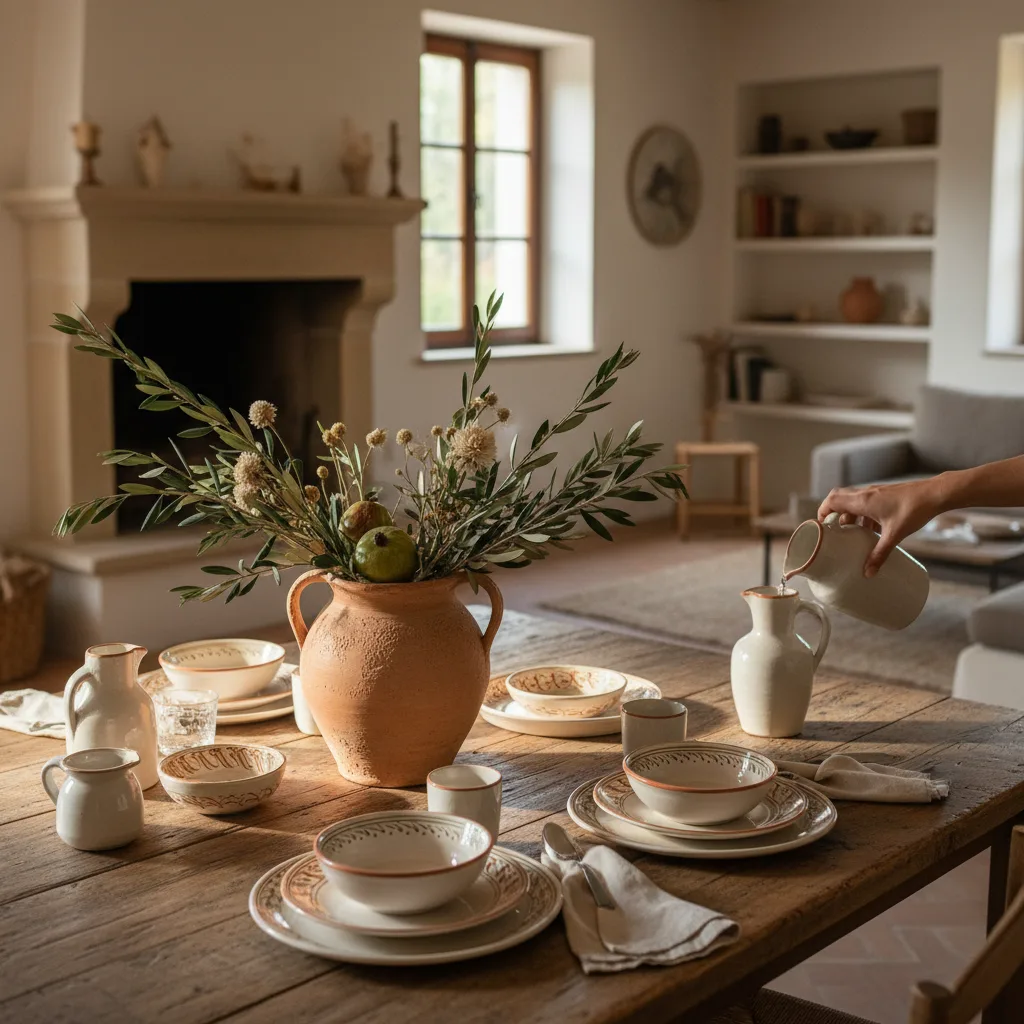
Italian ceramic tableware with an artisanal finish
Visual coherence is also what sets an authentic Italian table apart from a pile of pretty objects with no connection between them. It's not about rigid etiquette, but about intention.
Choosing a centrepiece that hides the guests
This mistake deserves its own section because it's the one that most ruins the experience of a dinner without you realising until it's too late. A tall centrepiece—a slender vase with long branches, a five-arm candelabra, a tower of fruit—looks gorgeous in an overhead Pinterest photo. In real life, it splits the table into two worlds that can neither see nor hear each other.
Conversation is the soul of a special dinner. If your guests have to lean around the floral arrangement to talk to the person opposite, the décor has failed no matter how beautiful it is.
The practical reference: the highest point of your centrepiece should not rise above the eye line of a seated guest. That's usually between 25 and 35 centimetres from the surface of the table. Within that height there's room for plenty of options: bowls with floating candles, trays with seasonal fruit, ceramic centrepieces with organic shapes, small clusters of low candles.
| Type of centrepiece | Recommended height | Does it block the view? |
|---|---|---|
| Tall vase with flowers | 50-70 cm | Yes — avoid on tables of 4-8 guests |
| Tall candelabra | 45-60 cm | Yes — only works on long tables (10+ people) |
| Low decorative bowl | 10-20 cm | No — ideal for any table |
| Ceramic centrepiece | 15-30 cm | No — if it stays below eye line |
| Cluster of candles | 5-15 cm | No — perfect for intimate dinners |
If you want more ideas on what works as a centrepiece and what doesn't, the guide on what to use as a centrepiece without clichés gives you concrete alternatives.
Neglecting the lighting (or overdoing it)
Light is the invisible element that changes how everything else is perceived. The same table, with the same tableware and the same flowers, can look cosy or clinical depending on how it's lit. And for a special dinner, the general ceiling light—that fitting you've been meaning to replace for years—is rarely the answer.
The most common mistake is leaving the ceiling light on at full blast. That whitish glare flattens the colours of the food, eliminates the shadows that give warmth and turns dinner into something that looks more like a working lunch than a special occasion. At the opposite extreme, switching everything off and leaving just two candles may seem romantic in theory, but in practice no one can see what they're eating and the conversation becomes awkward.
The sweet spot lies in combining several sources of soft light. A few candles on the table—always without a strong scent, so they don't compete with the food—add warmth in the foreground. A floor lamp in the corner of the dining room provides ambient light without glare. If you have a dimmer on the ceiling light, turn it down to 30-40%. The idea is for the table to be the most brightly lit point, but with warm light, and for the rest of the room to fall into soft shadow.
A detail that makes all the difference: real candles (not LED ones, please) create a subtle movement that the eye perceives as cosy. And a couple of ceramic candleholders with an Italian finish in earthy tones blend the light into the table décor without looking like an add-on.
Laying out the cutlery and glassware with no order or logic
This is the mistake many people don't consider a mistake because "at home you don't need etiquette". And it's true: you don't need a diplomatic banquet table. But a special dinner is exactly that, special. And the difference between laying out the cutlery any old way and placing it with a minimum of order is noticeable the moment you sit down.
It's not about memorising an etiquette manual. It's about each guest knowing, without thinking, where their fork is, where the water glass is and where the napkin goes. That clarity creates a sense of care that guests appreciate even if they don't put it into words.
The three basic rules that solve 90% of the doubts:
- Cutlery from the outside in: the pieces used first (starter) go on the outside; those for the main course, closer to the plate. The knife always on the right with the blade facing the plate, the fork on the left.
- Glassware on the diagonal: the water glass right above the knife, the white wine glass to its right and slightly lower, the red wine glass behind and higher. If you only use two glasses (water and wine), place them in a diagonal line towards the right.
- The napkin, on the left or on the plate: never inside the glass. It's a gesture you see in nineties weddings and that looks dated today. A well-folded fabric napkin, resting on the plate or beside the fork, conveys effortless elegance.
If you want to dig deeper into how to organise each element, the article on a table set for guests: the order no one explains to you details the complete layout step by step.
Quick checklist: before the guests arrive
Before lighting the candles and opening the door, run through these points:
- Can you see everyone's face without leaning over? (low centrepiece)
- Is there enough room for each plate, glass and elbow? (you haven't overloaded it)
- Do the pieces on the table share at least one unifying thread? (colour, material or texture)
- Is the light warm and soft, neither glaring nor leaving people in the dark?
- Does each guest intuitively know where their glass and napkin are?
If you answered yes to everything, your table is ready. Everything else—the food, the conversation, the music—will flow better than you imagine.
Accessories that elevate the table without complicating it: textiles, glassware and serving trays
Frequently asked questions
Do I need to use a tablecloth for a special dinner?
It is not mandatory, but it is recommended. A fabric tablecloth (linen, cotton) protects the table, dampens the clatter of plates and glasses, and adds a visual layer that ties the whole setting together. If your table has a beautiful finish (natural wood, for example), you can skip the tablecloth and use chargers or placemats.
How many glasses should you set per guest?
For a special dinner, two glasses are enough: one for water and one for wine. If you are going to serve two types of wine (white and red), add a third. More than three glasses per person is excessive for a dinner at home.
What do I do if I don't have enough matching pieces for everyone?
Mix with intention. You can combine two sets of tableware that share a tone or style, or use different plates for the starter and the main course. What matters is that the mix looks deliberate, not accidental. Alternating colours or shapes symmetrically helps.
Are fresh flowers always a good idea as a centrepiece?
It depends. Fresh flowers add life and colour, but they carry two risks: an intense fragrance (avoid lilies or jasmine if you are about to dine) and height (trim the stems so they do not exceed 25-30 cm). An alternative is greenery (eucalyptus, olive branches), which is aromatically neutral and looks elegant.
Can I mix candles with a decorative centrepiece?
Yes, and it is one of the most effective combinations. The key is for the candles and the centrepiece to share the same area of the table (grouped, not scattered) and for the candles to be plain, without a strong scent. Pillar candles or low candlestick candles blend in better than tall candlestick candles.