Round or rectangular table: which centrepiece to choose
Choosing a centrepiece for your dining table seems easy until you try. You've seen gorgeous photos on Pinterest, but what works on a long rectangular table becomes a nuisance on a round one. And that solitary vase that looks perfect on a circular table disappears on a two-metre surface. The problem isn't taste: it's the shape.
The shape of your table determines which centrepiece works — in proportion, in height and in the number of pieces. In this guide you'll find clear criteria to get it right whether you have a round, rectangular, oval or square table. No magic formulas, but visual logic you can apply today.
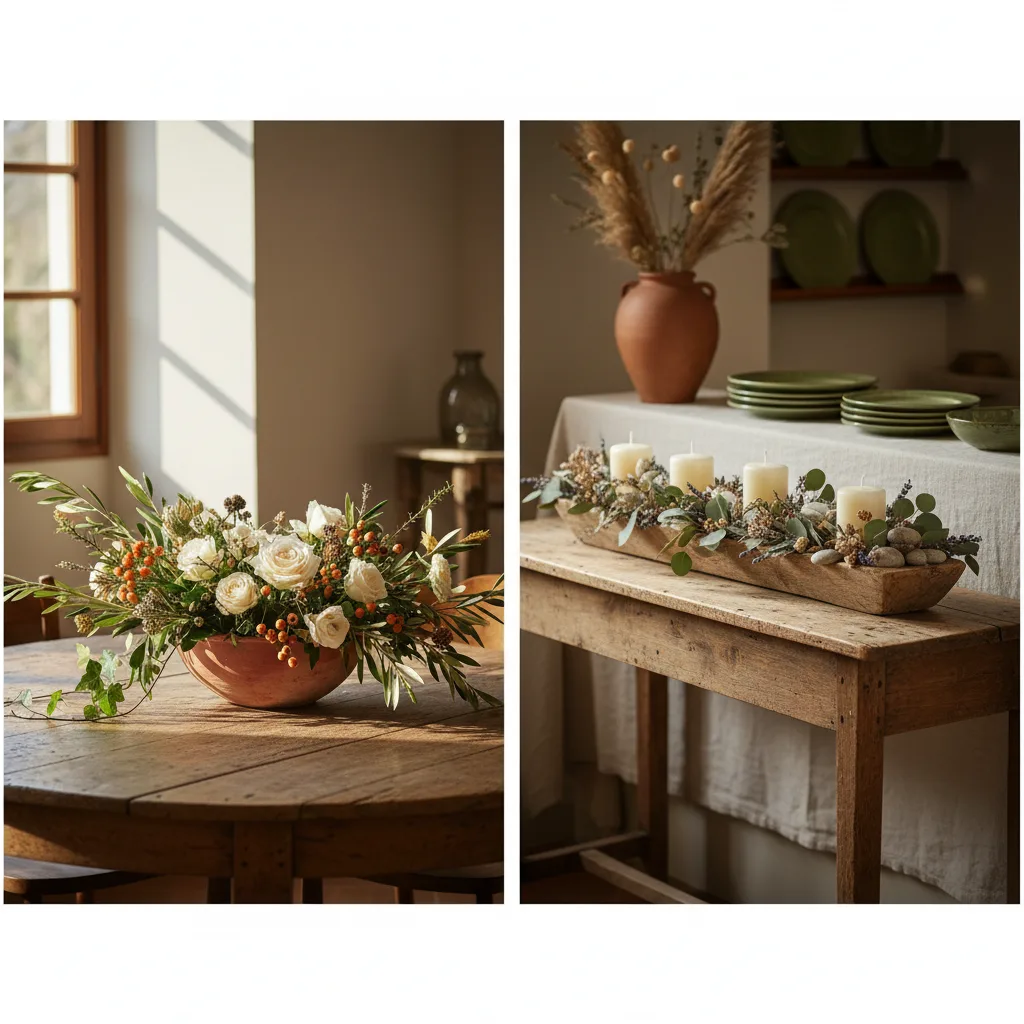
Why the shape of the table changes everything
The centrepiece isn't an isolated object: it's a piece that converses with the surface it rests on. When that conversation is harmonious, the table looks as if it were designed by someone with taste. When it isn't, the result is that awkward "something doesn't fit" feeling you notice but can't quite explain.
The reason is geometric. A round table concentrates attention on a central point; any element you place there automatically becomes the star. A rectangular table, on the other hand, spreads the gaze along a horizontal axis, and asks the decoration to accompany that visual journey. If you place a single small element in the centre of a 2.20-metre table, the emptiness on either side shouts louder than the piece itself.
What's more, the shape affects functionality. On a round table, every guest is the same distance from the centre; the usable space is smaller but more democratic. On a rectangular one, the long sides offer more surface to decorate, but also more risk of the centrepiece becoming a visual barrier between the guests on either side.
Centrepiece for a round table: a single focal point
The round table calls for a centrepiece that works as a single focal point. The radial symmetry of the table already creates a natural axis at the centre: your job is to place it there and let geometry do the rest.
What works on round tables
A ceramic vase with volume — neither too tall nor too wide — is the safest option. A generous bowl with seasonal fruit or olive branches also works, especially if you're after that Mediterranean air without falling into the obvious. The key is for the centrepiece to be a single element or a compact composition that doesn't "sprawl".
If your round table is small (under 1.10 m in diameter), a centrepiece more than 20 cm in diameter can already feel invasive. In that case, a thick candle on a decorative plate or a narrow vase with a single branch is more than enough. The most common mistake on small round tables is overloading: since the surface is limited, every centimetre counts once you set out the plates.
Key proportions for round tables
The practical rule is that the centrepiece shouldn't exceed a third of the table's diameter. If your table measures 1.20 m, the centrepiece should take up at most around 40 cm in diameter. In height, keep the piece below the eye line of seated guests — around 30–35 cm — so no one has to lean over to see the person opposite.
| Table diameter | Max. centrepiece diameter | Max. recommended height |
|---|---|---|
| 90–110 cm | 25–30 cm | 20–25 cm |
| 110–130 cm | 30–40 cm | 25–30 cm |
| 130–160 cm | 40–50 cm | 30–35 cm |
| > 160 cm | Up to 55 cm | 35 cm or a tiered composition |
Centrepiece for a rectangular table: the horizontal axis
The rectangular table changes the rules. The eye travels across the surface horizontally, and the centrepiece should accompany that movement rather than halt it. This is where the concept of linear composition comes into play.
Linear composition: the strategy that works
Instead of a single element, the rectangular table calls for a series of pieces lined up along the central axis. Three ceramic vases of staggered heights create visual rhythm without blocking the conversation. A linen table runner with candles and a couple of decorative elements on the sides creates structure. The idea is for the decoration to extend out — without covering more than a third of the table's total length — so there's real room to eat.
linear Italian ceramic centrepiece
The rule of thirds is useful here: mentally divide your table into three equal sections. The decoration occupies the central third; the two end thirds are for the guests. If your table measures 2 metres, you have around 65–70 cm in the centre to set out your composition. That's not little: it's enough for a vase, a candle holder and a small bowl without crowding.
What to avoid on rectangular tables
The classic mistake is placing a single round, compact element — a fruit bowl, a bowl — right at the geometric centre. It's not that it looks bad, but it wastes the opportunity the elongated shape gives you. The rectangular table invites you to create a "scene", not a central monument. Another common mistake: filling the entire length of the table with decoration, leaving guests with no room to rest their elbows, the bread or their wine glass.
The oval and square table: the in-between cases
Not every table fits into the round-rectangular pairing. Oval and square tables have their own logic, and they deserve a moment of attention.
Oval table
The oval table combines features of both shapes: it has a longitudinal axis like the rectangular one, but its rounded edges bring it closer to the round table. What works best is an elongated centrepiece with organic shapes — an oval ceramic bowl, a decorative tray with soft curves. Avoid compositions that are too geometric or angular: they visually clash with the table's gentle lines.
Square table
The square table calls for symmetry. A square or circular centrepiece works equally well, but the composition must respect the symmetrical structure of the surface. A simple trick: place four identical elements (four candles, four small glasses with flowers) in a square formation, leaving the centre free. Or a single element with presence — a ceramic sculpture, a generous bowl — taking up the central point without invading the corners.
Quick guide: table shape → ideal centrepiece type
| Table shape | Ideal centrepiece type | Recommended composition | Mistake to avoid |
|---|---|---|---|
| Round | Single piece with volume | Bowl, wide vase or fruit bowl | Overloading with many small pieces |
| Rectangular | Linear composition | 3 pieces in a row or table runner + elements | A single object "lost" in the centre |
| Oval | Elongated centrepiece, organic shapes | Oval tray or elongated bowl | Angular pieces that clash with the curves |
| Square | Symmetrical, centred | 1 strong central piece or 4 elements in a square | An asymmetrical composition that throws it off balance |
Material and shape: combinations that work (and those that don't)
Getting the shape of the centrepiece right isn't enough. The material matters too, and the way it interacts with the table creates very different results.
A natural wood table pairs well with ceramic in warm tones, blown glass or organic materials like wicker. Wood already brings warmth, so a ceramic centrepiece in earthy tones — the kind of piece Brandani has spent 75 years perfecting — reinforces that atmosphere without competing. By contrast, a cold metallic centrepiece can create an interesting contrast on dark wood tables, but feels jarring on light, Nordic-style woods.
Glass tables call for centrepieces with a certain visual weight. Since the table "disappears" visually, you need the centrepiece to have presence of its own. A thick ceramic bowl or an opaque vase work better than transparent pieces, which would be lost in the transparency of the surface. Tables lacquered in white or neutral colours take almost any material, but they especially appreciate textured ceramic, which breaks up the uniformity of the smooth finish.
Three mistakes you make without realising
There are slip-ups that crop up in almost every dining room. It's not a matter of bad taste, but of not having thought about how the geometry of the table works.
The first: ignoring scale. A centrepiece that's gorgeous in the shop can be gigantic or tiny in your dining room. The solution isn't to measure with a ruler — nobody does that — but to test first with an everyday object of the same size (a salad bowl, a couple of stacked books) to see whether the proportion works.
The second: blocking the conversation. If you put a tall centrepiece on a table for six, the people on one side can't see those on the other. The 30 cm height rule exists for a reason: it's the line below which a centrepiece decorates without getting in the way. For formal dinners with tall candelabra the exception is legitimate, but for everyday use, prioritise visibility.
The third: decorating the table as if it weren't going to be used. The centrepiece has to coexist with plates, glasses, cutlery, napkins and bread. If, when you set the table for four, you have to remove the centrepiece because it doesn't fit, the centrepiece is too big or the composition has too many pieces. A good test: lay the table fully for your usual number of guests and then add the decoration. Whatever fits without crowding is what works.
How to adapt one centrepiece to two different shapes
If you have an extendable table that goes from round to oval, or from square to rectangular, you need a versatile centrepiece. The most practical strategy is to work with modular pieces: a set of three elements you can group together (for the compact version) or spread out along the axis (for the extended version).
A real-life example: three small ceramic bowls that, together, form a compact composition for your round table for four; and spread out along the centre, they dress your rectangular table when you extend it for eight. Another option: a table runner with decorative trays that you roll up or unfold depending on the configuration.
modular Italian ceramic bowl set
The key is for each piece in the set to also work on its own. A vase that only makes sense alongside two others is less versatile than a vase that looks good on its own on a shelf, in the centre of a round table or as part of a larger composition.
Accessories that complete the centrepiece composition according to the table's shape
Frequently asked questions
Which centrepiece looks best on a small round table? On round tables under 1.10 m in diameter, a single, contained piece is ideal: a low vase, a thick candle on a decorative plate or a small bowl with natural elements. Avoid multi-piece compositions that take up too much of the space you need for plates.
How many pieces should I put on a rectangular table? The rule of odd numbers works well: three pieces of different heights (for example, a vase, a candle holder and a bowl) lined up along the central third of the table. On tables longer than 2 metres you can go up to five elements, but without covering more than a third of the total length.
Should the centrepiece have the same shape as the table? Not necessarily. A round centrepiece can work on a rectangular table if it is accompanied by other elements that balance the composition. What does need to match is the proportion and visual rhythm: organic shapes on tables with curves, linear compositions on long tables.
How do I keep the centrepiece from getting in the way while eating? First lay the table fully (plates, glasses, cutlery) for your usual number of guests. Then place the decoration in the remaining space. If you have to force it into place or someone's elbows knock into a vase, reduce the size or the number of pieces.
Can I use the same centrepiece in summer and in winter? Yes, if you choose neutral pieces. A ceramic bowl in a natural tone works all year round: in spring you fill it with fresh flowers, in autumn with dried branches, in winter with pine cones or candles. What changes is the contents, not the container.
Keep reading on the Vita Italian Living blog: