Ceramic fruit bowl: why it still looks better than plastic
There are objects in the kitchen we buy thinking it makes no difference, that they all do the same job anyway. A ceramic fruit bowl and a plastic one both hold fruit, true. But what they do to your kitchen — the mood, the light, the feeling of walking in and seeing something nicely arranged — is radically different. If you have ever felt that your worktop looks like a temporary storage area rather than a place where you actually want to cook, the problem probably isn't the fruit. It's what's holding it.
This isn't about snobbery or spending for the sake of it. It's about understanding which materials genuinely work in a space you spend hours in every day, and which ones age badly after the first month. Let's compare with hard facts, no beating around the bush.
What plastic promises and what it actually delivers
The argument for plastic is always the same: it's cheap, light and unbreakable. And that's true. But that promise has small print you only discover with daily use.
Plastic loses colour with sun exposure, which is unavoidable in a kitchen with a window. After a few months, that white fruit bowl that looked clean starts to yellow. Colour tones — green, orange, grey — fade until they look washed out. The material absorbs odours over time; if a piece of fruit has gone off and left juice on the base, the stain stays as a permanent reminder.
Functionally, plastic is so light that it slides when you load heavy fruit on one side. A bunch of bananas is enough to unbalance a cheap plastic fruit bowl. And there is one factor that is rarely mentioned: static electricity. Plastic gathers dust more easily than any other kitchen material, which means that fruit bowl needs cleaning more often than you would think.
None of this means plastic is an outright disaster. For a picnic, an outdoor terrace or a student-flat kitchen, it does the job. But if you're looking for a piece that adds something to your kitchen — not just one that stays out of the way — plastic falls short.
Why ceramic still comes out on top
A ceramic fruit bowl doesn't need to defend itself with complicated arguments. You put it on the worktop and it speaks for itself. But if you want concrete reasons beyond the first impression, here are the ones that matter.
Real durability, not theoretical
Glazed ceramic doesn't fade in the sun, doesn't absorb odours and doesn't scratch with everyday use. A well-cared-for ceramic fruit bowl looks exactly the same after five years as it did the day you bought it. The glaze acts as a barrier: the surface is sealed, waterproof, easy to wipe clean with a damp cloth. If you want to go deeper into how to maintain ceramic pieces over the long term, the guide on ceramic table centrepieces and how to care for them gives you a routine that works just as well for fruit bowls.
Weight as a virtue, not a flaw
The weight of ceramic is often cited as a drawback. It's the opposite. A fruit bowl with weight of its own won't move when you load fruit, won't tip over with an accidental nudge of the elbow, and feels solid in the hand. That sense of density isn't a whim: it's perceived quality and real functionality. Lightweight plastic solves transport; ceramic solves daily use.
Every piece has unique variations
Here is the difference no industrial material can replicate. Handcrafted ceramic — Italian especially — shows small variations in tone, texture and glaze that make each piece slightly different. They are not defects; they are the marks of a process involving human hands, kiln temperature and the composition of the clay. That turns a functional object into a piece with character. Plastic, by definition, aims for perfect uniformity. And that uniformity is exactly what makes it invisible in your kitchen.
Head to head: ceramic vs plastic on what matters
Sometimes a table is worth more than three paragraphs. Here are the criteria that genuinely affect your daily experience with a fruit bowl.
| Criterion | Ceramic | Plastic |
|---|---|---|
| Colour durability | Doesn't fade in the sun or with use | Yellows or dulls within months |
| Odour absorption | None (sealed glaze) | High — retains odours from ripe fruit |
| Stability on the worktop | High — its own weight keeps it firm | Low — slides when loaded with fruit |
| Ease of cleaning | Damp cloth, no special products | Easy but builds up stains over time |
| Impact resistance | Weak point: can break if dropped | Resistant to impacts |
| Looks over time | Improves or stays intact | Degrades visually |
| Sustainability | Natural material, recyclable, long-lasting | Petroleum-derived, short lifespan |
| Initial price | Higher (€15-€50 depending on the piece) | Low (€3-€10) |
| Real cost over 5 years | The same fruit bowl is still intact | You've probably bought 2-3 |
The table's conclusion is clear: plastic wins on entry price and on resistance to drops. In everything else, ceramic is superior. And if you work out the cost per year of use, the price difference dissolves quickly.
The fruit bowl as a decorative piece: beyond holding fruit
There is a shift in mindset that marks the difference between a kitchen that works and a kitchen you love. It comes down to no longer seeing the fruit bowl as a utilitarian accessory and starting to see it as a decorative piece that also happens to serve a purpose.
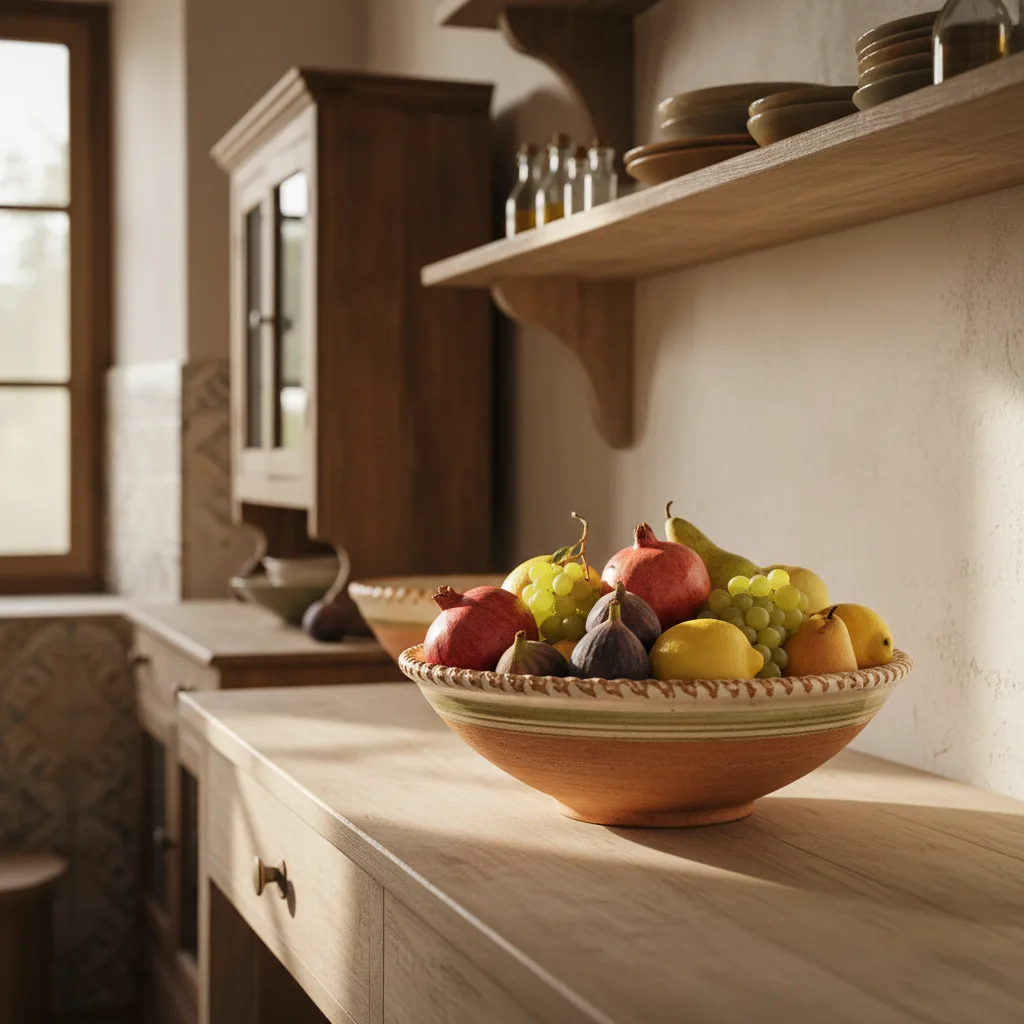
A well-chosen ceramic decorative fruit bowl acts as a focal point on the worktop. It adds vertical volume in a space dominated by flat surfaces, introduces organic colour through the fruit it holds — lemons in winter, peaches in summer, pomegranates in autumn — and creates that "lived-in kitchen" effect that magazines chase and that plastic simply can't achieve.
But the fruit bowl doesn't have to stay in the kitchen. If you have a dining room with a table where you eat every day, a ceramic fruit bowl with the right proportions works as a centrepiece. No flowers, no candles, no fuss: seasonal fruit that changes on its own and brings vivid colour. It's a simple trick you can see explored in the guide on what to use as a centrepiece without the clichés.
If what interests you is comparing the fruit bowl with the tray as a kitchen organising piece, the decorative fruit bowl vs tray guide goes into that detail.
How to choose a ceramic fruit bowl that lasts for years
Not all ceramic fruit bowls are the same. There are differences in quality, finish and design that determine whether your purchase will be a lasting success or a well-intentioned disappointment.
Inside and outside glaze
A fruit bowl glazed on both faces is easier to clean and doesn't absorb moisture. Some rustic ceramic fruit bowls are only glazed on the outside; the unglazed inner base can retain fruit juices and develop stains. Always ask whether the glaze covers the entire surface.
Proportion relative to the space
The proportion and height rule that works for centrepieces applies in exactly the same way here. The fruit bowl shouldn't take up more than a third of the width of the surface it sits on. A huge fruit bowl on a narrow worktop feels overwhelming; a tiny one on a large island gets lost. Measure before you buy.
A stable, flat base
It seems obvious, but it isn't. Some designs prioritise sculptural form over stability. If your worktop is polished granite or marble — slippery surfaces — make sure the base of the fruit bowl is flat and wide. Footed or pedestal fruit bowls are elegant, but they need an area free of busy hands.
Timeless design over passing trend
An off-white fruit bowl, a soft terracotta tone or a deep Mediterranean-ceramic blue are options that never go out of fashion. If you want something bolder, make sure the rest of your kitchen is neutral: the standout piece should be one, not ten. The article on why a white ceramic vase works in any home develops this principle of neutrality that applies equally to fruit bowls.
The Italian factor: why origin matters
In the world of ceramics, Italy isn't just one origin among many. It's the country that has spent centuries perfecting glazing, firing and design techniques that the rest of the world imitates. Italian tableware ceramic — from Faenza to Deruta, by way of the Tuscan tradition — has a density of history and craft that you can feel in the touch, in the weight and in how the piece ages.
Brandani, for instance, has spent more than 75 years designing table and kitchen pieces with that judgement. This isn't tourist-catalogue craftwork; it's Italian industrial design with artisanal roots, made to be used every day. If you want to know the story behind the brand, the article on 75 years of Brandani and the Italian table gives you real context.
When you buy an Italian ceramic fruit bowl from an online store specialising in the brand, such as Vita Italian Living, what you are buying isn't just an object: it's the guarantee that the glaze is food-safe, that the firing is correct and that the design has passed through a judgement that has been refined over decades.
Three mistakes people keep making when choosing a fruit bowl
After all of the above, these are the slip-ups you see most and that are easiest to avoid.
The first is buying on impulse at the nearest discount store. A three-euro plastic fruit bowl seems harmless, but it ends up shoved in a cupboard in less than a year. If you're going to buy something that will be on display in your kitchen every day, spend five minutes thinking about which material, which size and which tone fit with what you already have.
The second is ignoring proportion. A fruit bowl that's too big turns the worktop into an obstacle. One that's too small fulfils neither the practical nor the decorative function. Measure the available space, apply the rule of thirds and get it right first time.
The third is choosing a design that competes with everything else. If your kitchen already has patterned tiles, coloured appliances and three plants, the fruit bowl should be neutral. If your kitchen is minimalist and white, then yes, you can allow yourself a fruit bowl that's the splash of colour. The key is having a single visual lead per area. To better understand this balance, the guide on ceramic bowls: sizes and uses tackles the same logic of proportions applied to functional pieces.
Complementary pieces to complete the worktop or the table with the same ceramic and Italian-design judgement
Frequently asked questions
Is a ceramic fruit bowl safe to place fruit in directly?
Yes, as long as the glaze is food-safe. Quality glazed ceramic — such as Italian ware with EU certification — is designed for use with food. Avoid purely decorative, uncertified pieces if you plan to rest fruit on them directly.
How do you clean a ceramic fruit bowl?
With a damp cloth and mild soap. The glaze stops dirt from penetrating. For dried fruit-juice stains, soak it for five minutes and clean with a non-abrasive sponge. Never use a metal scourer: it scratches the glaze.
Can a ceramic fruit bowl go in the dishwasher?
It depends on the piece. Most glazed ceramic fruit bowls are dishwasher-safe, but handcrafted pieces with hand-painted decoration can lose detail after repeated washes. Always check the manufacturer's instructions.
Is it worth paying more for a ceramic fruit bowl over a plastic one?
If you are going to use it daily and it will be on display, yes. The price difference is offset by durability (years rather than months), the looks, and the fact that you won't need to replace it. It is a purchase that pays for itself with use.
What size fruit bowl do I need for my kitchen?
For a household of 2-3 people, a fruit bowl 25-30 cm in diameter is enough. For larger families, or if you buy a lot of fruit, go up to 30-35 cm. The basic rule: the fruit bowl should take up no more than a third of the available width on the worktop.