Decorative salad bowl: the useful gift nobody buys
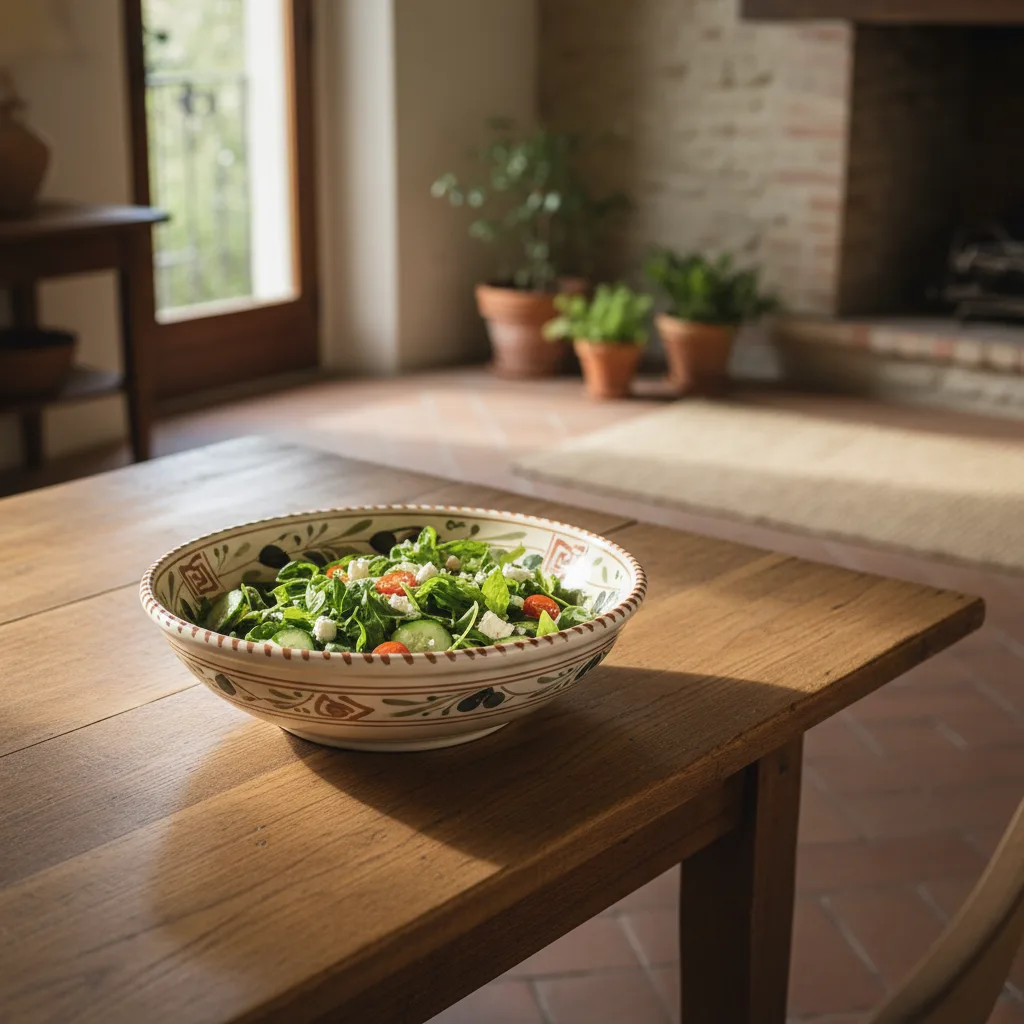
Think about the last wedding, housewarming or birthday gift you gave. You probably considered candles, photo frames, maybe a plant. What probably never crossed your mind was a ceramic salad bowl. And that is exactly where the opportunity lies: the decorative salad bowl is one of the most used tableware pieces in any kitchen, yet almost nobody chooses it as a gift. It is practical, eye-catching, lasts for years and takes centre stage on the table. And yet it remains the great forgotten option among thoughtful gifts.
In this article you will understand why a well-chosen salad bowl is one of the smartest gifts you can give, what to look for to get it right and how to avoid giving something that ends up at the back of the cupboard.
Why nobody gives salad bowls (and why they should)
There is a curious disconnect between what people need in their homes and what they receive as gifts. When someone moves house or celebrates a major event, the shelves fill up with purely decorative objects that gather dust: figurines, generic prints, scented candles that are never lit. Meanwhile, the tableware pieces that actually get used every day —salad bowls, serving dishes, good bowls— are bought in a hurry, without aesthetic judgement and almost always from low-cost chains.
The reason is simple: giving tableware is perceived as unromantic. It seems too "practical", too everyday. But that perception changes radically when the piece has design, character and a story behind it. A handcrafted Italian ceramic salad bowl is not just another utensil: it is a piece that takes the lead on the table every time there are guests. It is the kind of gift the recipient remembers because they use it, not because they store it.
And here comes an important nuance: the best gift is the one a person would not buy for themselves. Almost all of us buy the basics, the functional, the urgent. But few of us invest in tableware with personality. Giving a decorative salad bowl with character fills exactly that gap.
What makes a ceramic salad bowl special compared to other materials
Not all salad bowls are the same, and the material makes a difference that goes beyond aesthetics. If you are going to choose one as a gift —or for your own home—, it is worth understanding what each option offers.
| Material | Advantages | Drawbacks | Ideal for… |
|---|---|---|---|
| Handcrafted ceramic | Unique texture, visual warmth, retains temperature, non-reactive with acids | Heavier, requires some care | Gifts with personality, everyday and special tables |
| Porcelain | Fine, elegant, lightweight, dishwasher-safe | Less handcrafted character, cooler aesthetic | Formal tables, Nordic styles |
| Glass | Transparent, neutral, goes with everything | Fragile, no tactile warmth, every mark shows | Modern styles, summer tables |
| Wood | Warm, organic, lightweight | Not suitable for prolonged acidic dressings, requires maintenance | Rustic style, serving bread or fruit |
| Plastic / melamine | Unbreakable, cheap | No personality, industrial look, scratches | Outdoors, children, hard daily use |
Ceramic, especially the handcrafted kind, has something no other material achieves: each piece is slightly different. The variations in the glaze, the small irregularities of the throwing, the colour nuances that depend on the position in the kiln. That turns each salad bowl into a unique piece, something that carries special weight when we talk about gifts.
What's more, ceramic is a non-reactive material. You can dress salads with vinegar, lemon or tomato without the material altering the flavour or deteriorating. Something that wood, for example, does not tolerate as well with continued use.
How to choose the perfect salad bowl to give as a gift
If you want to get it right with a decorative salad bowl as a gift, there are five criteria that matter more than the price.
Size: neither giant nor ridiculous
The most common mistake is giving a salad bowl that is too small. For it to work as a serving piece —which is its main use when there are guests—, you need a diameter of between 24 and 30 cm and a capacity of at least 2 litres. That way a generous salad for four people fits without overflowing. If you settle for 18 cm, you are giving an individual bowl, not a salad bowl.
At the other extreme, pieces of 35 cm or more are spectacular as a centrepiece, but they can be tricky to store in small kitchens. The sweet spot for a gift is between 25 and 30 cm in diameter.
Colour and finish: go for neutral with character
The temptation is to choose a piece with a bold colour or a heavily decorated pattern. And it can work if you know the recipient's tastes very well. But if you have doubts, warm neutral tones —cream, sand, stone grey, soft terracotta, off-white— are the ones that fit in more homes and more styles. The important thing is that the finish has texture: a reactive glaze, a slightly irregular rim, a surface that invites you to touch it. That is what distinguishes a piece with character from a generic bowl.
Versatility: it should serve more than one purpose
A good salad bowl doesn't just serve salad. It is used for pasta, for fruit, as a centrepiece with nuts at a dinner, for serving popcorn on a movie night. The most versatile ones are those with an open shape —not too deep— with a stable base. If it only works for salad, you are limiting its potential.
Origin and brand: the story that wraps the gift
When you give a salad bowl from an Italian brand with history like Brandani, you are not just giving a container. You are giving a piece of ceramic tradition, a piece with origin and a name. That makes an enormous difference compared to buying something generic from a large retail chain. The recipient notices it when they unwrap the package, when they read the label, when they realise that someone took the trouble to look for something with judgement.
Presentation: the packaging matters more than you think
A gift that arrives in a beautiful box creates a completely different first impression than one wrapped in newspaper. If the piece comes in careful packaging —something common among Italian tableware brands—, the "wow" effect when opening it is part of the gift. Don't underestimate that moment.
Five occasions when a salad bowl is the perfect gift
You don't have to wait for the "right" occasion. A decorative salad bowl works as a gift in more situations than you imagine.
Housewarming. This is possibly the context where it makes the most sense. The person has just moved, needs new tableware and has probably prioritised furniture and appliances. Giving them a salad bowl with personality fills a real need they haven't yet resolved. If you are looking for more ideas for this context, take a look at our guide to gifts for a new home for under €50.
Wedding. In Italy, giving quality tableware for the table is a tradition. It is no coincidence: an Italian ceramic piece lasts decades and accompanies the couple through all the dinners they will share. It is an original wedding gift that stands out from the generic wedding registry.
Birthday of someone who entertains at home. If the person enjoys cooking for friends, a large, beautiful salad bowl is a gift they will use soon. It is personal without being intimate, useful without being boring.
Mother's Day. Especially if your mother or mother-in-law is one of those who sets the table with care. A piece of authentic Italian tableware, Made in Italy, tells her "I know what you like and I looked for something worthy of you".
Thank-you. Has someone invited you to dinner several times and you want to return the favour? A salad bowl is a gesture that goes beyond the bottle of wine. It is a gesture that elevates the relationship.
Decorative salad bowl vs. functional salad bowl: do you have to choose?
Here is the trap many home décor shops fall into: they sell "decorative" salad bowls that you can't actually use for serving food. They are too porous, the glaze is not food-safe, or the shape is so artistic that nothing fits inside.
The good news is that you don't have to choose between beauty and function. Quality Italian ceramic salad bowls —like those in the Vita Italian Living collection— are designed for both. The glaze complies with European food-contact regulations. The shape lets you toss and serve comfortably. And the handcrafted finish gives them the presence you need when you place them at the centre of the table.
The key criterion is simple: if you can eat from it and you want to look at it, it is the right piece. If it only works for one of the two, you are settling.
Something similar happens with ceramic bowls: there are pieces that work both in the kitchen and on the table, and others that only serve to decorate. The difference lies in the quality of production, not in the price.
How to care for a ceramic salad bowl so it lasts decades
Well-made ceramic is not delicate. But it does appreciate minimal care that extends its useful life without complicating yours.
Dishwasher: it depends. Most glazed ceramic salad bowls withstand the dishwasher without a problem. However, pieces with handcrafted finishes —reactive glazes, hand-painted details— last longer if you wash them by hand. The dishwasher's aggressive detergent can dull the glaze tones over time. If the piece is a special gift, wash it by hand. It takes thirty seconds.
Sudden temperature changes: avoid them. Don't put a salad bowl fresh out of the fridge directly onto a very hot surface. Ceramic withstands temperatures well, but sudden changes can generate micro-cracks in the glaze over time. Let it come to temperature for a couple of minutes first.
Storage: no stacking without protection. If you store several pieces stacked, place a tea towel or a felt protector between them. That way you avoid the bases scratching the inner glaze of the piece below. It is a simple gesture that makes a difference in the long run.
Persistent stains. If the glaze gets stained with beetroot, turmeric or red wine, an hour-long soak with bicarbonate and warm water usually solves the problem. No abrasive scourers: they scratch the glaze and open pores where more dirt then accumulates.
The definitive argument: cost per use
When you assess a gift by its price —thirty, forty, fifty euros—, it seems like an expense. But when you assess it by the use the recipient will get from it, the perspective changes. A quality ceramic salad bowl is used several times a week for years. Do the maths: if the piece costs €40 and is used three times a week for ten years, the cost per use is less than three cents. It is probably the gift with the best impact-to-price ratio you can give.
Compare it with a €35 candle that lasts forty hours, or a €30 bunch of flowers that lasts a week. The salad bowl is still on the table when those gifts are long gone. And every time the recipient uses it, they think —if only for an instant— of whoever gave it to them.
It's not romanticism: it's common sense applied to giving well.
Complementary pieces to complete the table or expand the gift with a coordinated set.
Frequently asked questions about ceramic salad bowls
Can a ceramic salad bowl go in the microwave? It depends on the type of ceramic and the glaze. Most stoneware and glazed ceramic salad bowls without metallic elements are microwave-safe. If the piece has gold or silver detailing, don't put it in: metals generate sparks. When in doubt, check the manufacturer's instructions.
What is the difference between a ceramic salad bowl and a porcelain one? Ceramic is fired at a lower temperature than porcelain and usually has a more rustic finish, with more texture and visual warmth. Porcelain is finer, translucent and stain-resistant. For a gift with handcrafted character, ceramic wins; for a formal, minimalist table, porcelain may be a better fit.
How much does a good ceramic salad bowl for gifting cost? The rough range for a quality piece with good design is between €25 and €60. Handcrafted Italian salad bowls tend to fall in the €30-50 bracket, a very reasonable price for a gift that will be used for years.
How do I know if the glaze is food-safe? Look for pieces that indicate compliance with European food-contact regulations. Established brands like Brandani specify this on their product sheets. Avoid purely decorative ceramics if you intend to use the piece for serving food.
Is it better to give a salad bowl on its own or a set? It depends on the budget and the occasion. A large salad bowl on its own is a gift with impact —a standout piece—. A set of a salad bowl plus individual bowls is more complete and functional. For weddings or housewarmings, the set usually makes more sense; for birthdays or thank-yous, the single piece is more than enough.