What to use as a table centerpiece: the no-clichés guide
You've spent days thinking about what to use as a table centerpiece and every search returns the same thing: a vase of flowers, a white candle, an empty bowl. Nothing wrong with that, but if you've been searching for a while it's because you sense your table deserves something more personal. Something that doesn't look pulled from a generic catalogue or copied from your sister-in-law's living room.
This guide is about exactly that: real options, chosen with judgment, that work in actual dining rooms. No magic formulas, no endless lists of random objects. Just the questions that really matter before you put something in the center of your table —and the answers nobody usually gives.
Before you choose: the three questions that filter everything
Most articles go straight to the list of objects. But the problem usually isn't a lack of ideas, it's not knowing what criteria to apply. Before deciding what to place, answer this:
Is the table for everyday use or only for special occasions? A table used every day needs a centerpiece that doesn't get in the way when passing plates, that's easy to remove, and that holds up without constant care. A table for special dinners can take more elaborate pieces, taller ones, even more fragile ones. Mixing the two registers is the most common mistake.
How much actual space do you have in the center? Measure before you buy. A centerpiece that takes up more than a third of the table's width will get in the way. On a table 90 cm wide, the centerpiece shouldn't exceed 25-30 cm in diameter. It seems obvious, but it's the number one reason a centerpiece ends up in a cupboard.
Which style dominates your dining room? It's not about everything matching to the millimeter, but about nothing clashing. A rustic ceramic bowl in a Nordic minimalist dining room can work if the color is neutral. The same bowl in glossy terracotta, probably not. The material and finish matter more than the shape.
Ideas by type of object (the ones people actually use)
You won't find fifty options here. You'll find the categories that work in real dining rooms, with their advantages and their honest limitations.
Bowls and ceramic pieces
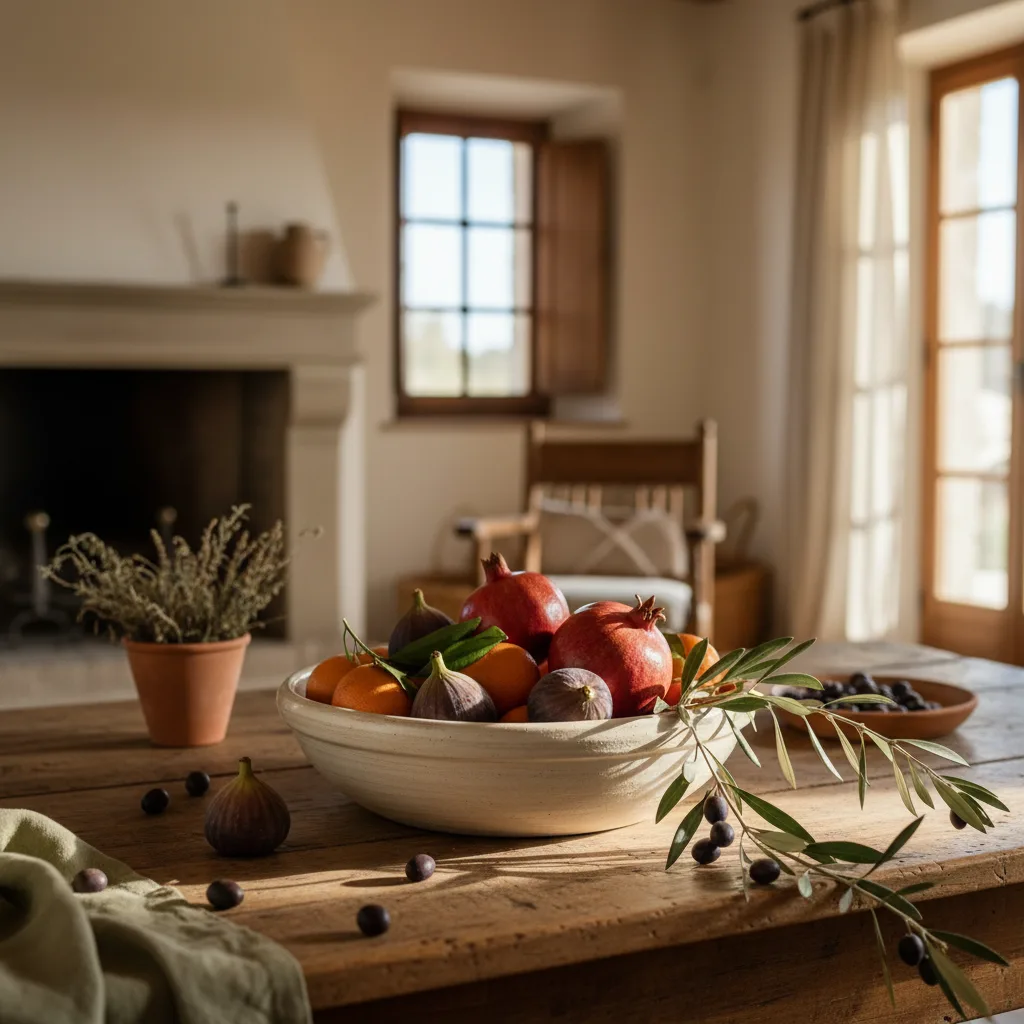
A generous ceramic bowl is probably the most versatile centerpiece there is. Empty, with seasonal fruit, with nuts in autumn or with lemons in summer. Change the contents and you have a different centerpiece every month without buying anything new.
The key is the quality of the piece. A ceramic bowl with character —with texture, with an interesting glaze, with an organic shape— works even when empty. A generic bowl with a smooth surface always needs something inside so it doesn't look like a forgotten container. Italian handcrafted ceramic pieces, for example, have that touch of irregularity and warmth that gives them presence on their own.
Trays as an organizing base
A tray isn't a centerpiece in itself, but a platform that turns several small objects into a coherent composition. A candle, a pretty salt cellar and a sprig of rosemary scattered loose on the table look like clutter. The same three objects on a decorative tray look like a conscious decision.
It works especially well on long rectangular tables, where a single central object gets lost. The tray creates a visual "stage" that anchors the eye. Choose one in a fine material —wood, ceramic, patinated metal— and avoid plastic or melamine, which cheapen the whole arrangement.
Candles (but not the way you think)
Candles are the most mentioned resource and the worst executed. An aromatic candle in a glass jar with the label still showing isn't a centerpiece: it's an unopened product sitting on your table. For a candle to work as a centerpiece, it needs intention.
Pillar candles (the thick ones, no container) in a group of three different heights on a flat plate. Or a low candle inside a ceramic bowl with water and a floating leaf. The difference between "I have a candle on the table" and "I've composed a centerpiece with candles" lies in the holder, the grouping and the height. Never in the candle alone.
Natural elements with seasonal rotation
Olive branches in spring. Lemons and aromatic herbs in summer. Small pumpkins and nuts in autumn. Pinecones and fir branches in winter. Nature already has a perfect aesthetic calendar; you just need an attractive container to present it in.
This approach has a huge advantage: the centerpiece never gets boring because it changes with the seasons. And the cost is minimal if the base piece —the bowl, the plate, the decorative cup— is good quality. You invest once in the container and the season gives you the contents.
Books and objects with a story
Stacking two or three attractive books (cookbooks, travel books, photography books) and crowning them with a small object —a figurine, a votive candle, a ceramic piece— is a centerpiece with instant personality. It says something about you. It's not neutral decor: it's a statement.
It works best on living-dining tables that aren't used exclusively for eating. If you have dinner at that table every day, the books will get in the way. But if your table is also a work area, a coffee spot, a place to relax, this option adds intellectual warmth effortlessly.
What to use depending on the shape of your table
The shape of the table matters more than it seems. Filling the center of a round table is not the same as creating visual rhythm on a two-meter rectangular one. Here's a quick reference:
| Table shape | Recommended centerpiece | What does NOT work |
|---|---|---|
| Round (up to 120 cm) | A single central piece: bowl, decorative cup or compact arrangement | Elongated elements that break the natural symmetry |
| Square | Geometric object or symmetrical arrangement on a square tray | Very organic or asymmetrical pieces that create visual imbalance |
| Short rectangular (up to 160 cm) | Tray with an arrangement of 2-3 elements or a generous bowl | A centerpiece that's too small and gets lost on the surface |
| Long rectangular (over 180 cm) | A line of repeated elements (3 candles, 3 small bowls) or a table runner with pieces | A single central object that leaves the ends empty |
| Oval | An elongated organic centerpiece: oval tray, long branch, flowing arrangement | Rigid or square elements that contradict the curve |
The proportion and height rule we explain in another article will help you fine-tune the exact scale. But as a quick reference: the centerpiece should never exceed a third of the width nor be so tall that it blocks your view of the person opposite.
The materials that elevate (and the ones that cheapen)
It's not all about which object you choose. The material defines whether the arrangement reads as considered or improvised. There's a visual hierarchy that works almost always, regardless of your home's style.
Materials that add value: handcrafted ceramic (with irregular glazes, matte textures), solid or reclaimed wood, blown glass, patinated metal (aged brass, copper), natural stone (marble, travertine). These materials age well and gain character with use. A handmade Italian ceramic piece has micro-imperfections that make it unique —and that is exactly what sets it apart from an industrial piece.
Materials that detract: plastic (even when it imitates another material, it shows), melamine, thin industrial glass with no interesting shape, shiny chrome metal (too cold for a dining table). It's not that these are bad materials in general, but in the center of a table —where the eye keeps coming to rest— the quality of the material shows more than anywhere else in the home.
If you're weighing up options and don't know where to start, the article on how to choose the perfect centerpiece for your dining room gives you a complete decision framework.
The clichés you can avoid (guilt-free)
Let's say it plainly: there's nothing objectively wrong with any of these resources. But if you're after a centerpiece with personality, it helps to know what's already very overdone so you can consciously decide whether you want to go that way or not.
Mediocre-quality artificial flowers. Good-quality preserved or dried flowers, yes. Plastic flowers that try to look real and don't quite manage it, no. The price difference between the two is small; the difference in result is enormous.
The clear vase with decorative pebbles. It had its moment. If you like it, use it. But if you want your table to say something different, there are options with more character. An opaque ceramic vase with a single dried branch has more visual impact than a glass vase full of colored pebbles.
The composition identical to the catalogue. Copying a Pinterest photo to the millimeter rarely works, because your table, your light and your space are different. Better: take inspiration from the composition (proportion, colors, heights) and adapt it with your own pieces. The result will be less perfect but much more your own.
If what you're looking for is fresh ideas with personality, take a look at our article on modern table centerpiece ideas for 2026. There we go into detail on the trends that are really being used this year.
Five specific compositions to copy today
We've left the theory behind. Here are five specific combinations you can recreate with pieces you probably already have (or can easily find):
Everyday Mediterranean composition. A wide ceramic bowl (30 cm) with lemons and a sprig of fresh rosemary. Straight onto the table, no tablecloth. Setup time: two minutes. Lifespan: a week, until you change the lemons.
Centerpiece for a special evening. Three pillar candles of different heights on a flat ceramic plate or a small tray. Around them, some eucalyptus leaves or a few short olive branches. Remove the branches the next day and keep the candles as your everyday centerpiece.
Book composition for a living-room table. Two stacked books (a large one on the bottom, a small one on top) with a small ceramic bowl on top holding a votive candle. Beside it, a personal object: a postcard, a beach pebble, a small figurine. Personal and one of a kind.
Permanent minimalist centerpiece. A single sculptural ceramic piece —an organically shaped vase, a sphere, an irregularly shaped bowl— in the exact center of the table. Nothing else. It needs a piece with enough presence to work on its own. This is where the quality of the material makes all the difference.
Rhythmic line for a long table. Three identical small pieces (three bowls, three candles, three mini vases) lined up at regular intervals. It creates visual rhythm and fills the table without overloading it. It's the safest option for tables over 180 cm.
ceramic bowls with Mediterranean character
How much to spend (and how much not to)
A good centerpiece doesn't have to be expensive, but it does have to be good. The difference between a centerpiece that elevates your dining room and one that cheapens it isn't in the price, but in the material and the design.
As a rough guide, a quality handcrafted Italian ceramic piece —a bowl, a decorative cup, a designed fruit dish— sits in a range of €25 to €90. It's an investment that lasts years (ceramic doesn't go out of style if the piece has good design) and that transforms the look of your table every day. Compare it to spending €15 every two weeks on fresh flowers: over six months, the quality piece works out cheaper and the result is more consistent.
The key isn't to spend a lot. It's to spend once on something with enough character to work for years, and to complement it with seasonal natural elements that cost little or nothing.
Complementary pieces for composing table centerpieces with personality
Frequently asked questions
What can I use as a table centerpiece if I don't want flowers? You have plenty of options with more personality: a ceramic bowl with seasonal fruit, an arrangement of candles on a tray, stacked books with a decorative object, or a single sculptural piece with enough presence to work on its own. What matters is that the object has good material quality and a scale suited to the size of your table.
What is the ideal height for a table centerpiece? The basic rule is that it shouldn't block your view of the person sitting opposite. In practice, this means a maximum of 25-30 cm for everyday tables. For special dinners with tall candles or floral arrangements, you can go up to 35-40 cm if the base is narrow and doesn't block the line of sight.
Is one large object better or several small ones? It depends on the shape of the table. On round or square tables, a single central object works best because it respects the symmetry. On long rectangular tables, a line of repeated small objects (three candles, three bowls) fills the space better and creates visual rhythm.
How often should I change the table centerpiece? If you use natural elements (fruit, branches, herbs), seasonal change is natural and enough: every 2-3 months. If your centerpiece is a ceramic piece or a permanent decorative object, you don't need to change it. You can vary what you put inside or around it depending on the season.
What can I use as a centerpiece on a small table? On tables under 100 cm, less is more. A single small piece with character: a 15-20 cm bowl with a candle inside, a mini vase with a dried branch, or a pillar candle on a small plate. Avoid arrangements of several objects that steal functional space.
See Italian table centerpieces