Large Vases for Entryways: A Guide to Proportion and Style
Choosing large decorative vases for an entryway seems simple until you try it. You buy a vase that looked imposing in the shop, you place it in the hallway, and one of two things happens: either the space swallows it up and it disappears, or it dominates the entrance like an uninvited guardian. The problem is almost never the vase. It's the proportion.
A home's entryway is the first impression you offer to anyone who crosses your threshold —and the last before they leave. A well-proportioned vase turns a transit corridor into a place with personality. A poorly chosen one turns it into an obstacle. In this guide you'll find the real criteria for getting it right: measurements, materials, styles and the mistakes that come up time and again.
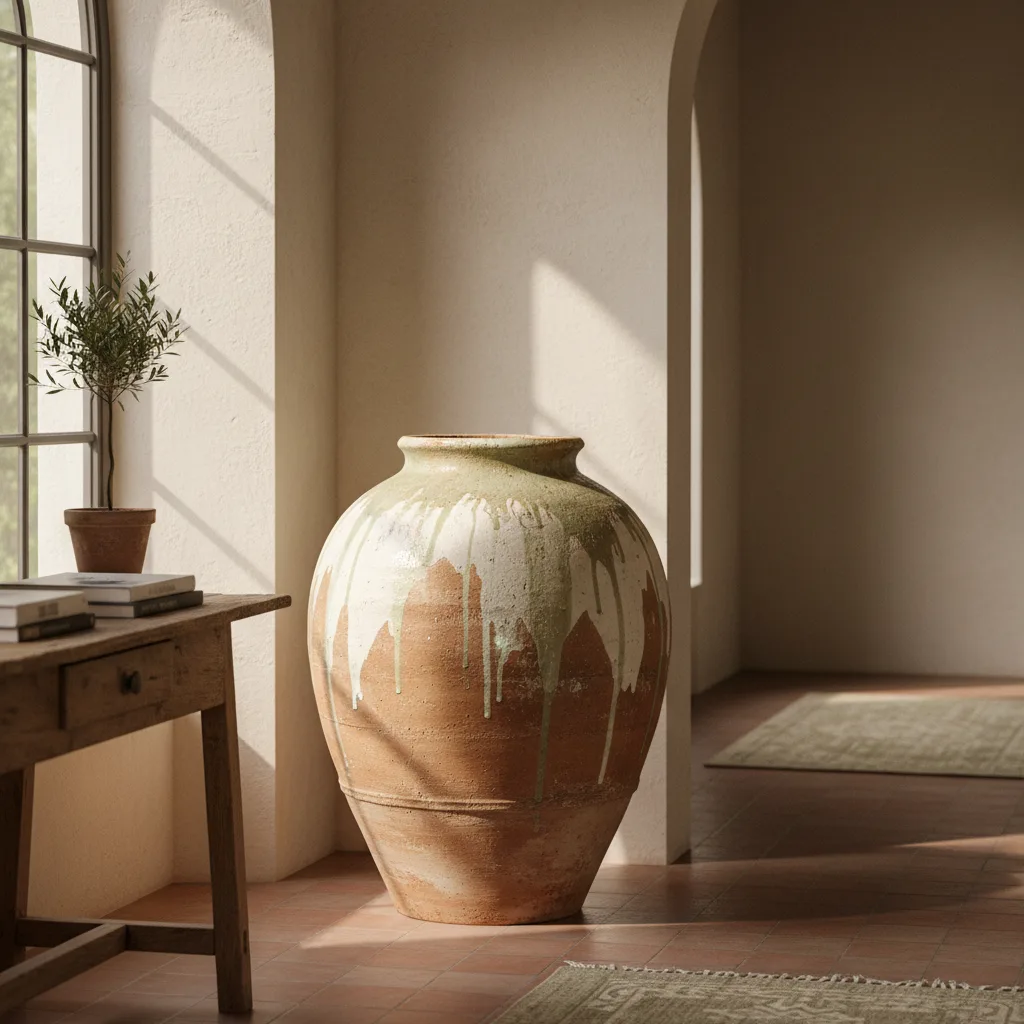
Why the entryway needs a large-format piece
Most entryways share one problem: they are pass-through spaces with no identity of their own. A coat rack, a mirror, maybe a shoe cabinet. Functional, yes. Memorable, no. Large floor vases have an advantage that other decorative elements don't offer: they occupy vertical space without consuming usable floor area.
A tall vase doesn't block the passage. It doesn't need free wall space to hang from. It requires no installation. All it needs is a corner —next to the door, beside a console, in the corner that always stays empty— and it transforms that dead spot into a focal point. It's decoration that works vertically, and in narrow entryways that's worth its weight in ceramic.
What's more, a large-format vase in the entryway serves a function that is rarely mentioned: it sets the tone for the rest of the house. Anyone who walks in and sees a handcrafted ceramic piece with character already expects the living room to continue that line. It's a statement of intent without saying a word.
The proportion rule no one explains to you
This is where most people get it wrong. They buy the vase they like without measuring anything, get home and discover that the proportion doesn't work. There's a simple rule that interior designers use as a starting point, and you can apply it with no training:
The height of the vase should be between one third and one half of the floor-to-ceiling distance at the spot where you're going to place it. If your entryway has 2.70 m ceilings, your vase should measure between 90 cm and 1.35 m (including whatever you put inside: branches, dried flowers, pampas plumes). If it measures less than 60 cm under a 2.70 m ceiling, it will look tiny. If it exceeds 1.40 m, it will feel oppressive.
This rule has its nuances, of course. If the vase sits on a console or entryway table, it's the combined height (furniture + vase) that must respect that proportion, not just the vase alone. A 40 cm vase on an 85 cm console adds up to 1.25 m, which fits perfectly under a standard ceiling.
Proportion according to the width of the space
Height isn't the only measurement that matters. The width of the vase must bear a relationship to the width of the available space. A pot-bellied vase 50 cm in diameter in a 90 cm hallway is an obstacle. In an open entryway of 2 metres, that same vase blends in without a problem.
| Width of the space | Recommended maximum vase diameter | Ideal shape |
|---|---|---|
| Less than 1 m (hallway) | 20-25 cm | Slender, cylindrical |
| 1-1.5 m (medium entryway) | 25-35 cm | Cylindrical or slightly oval |
| More than 1.5 m (spacious entryway) | 35-50 cm | Any shape, including pot-bellied |
| Beside a console (on the floor) | ≤ width of the console | Proportioned to the furniture |
The shape of the vase also matters. Slender, tall vases work in narrow hallways because they don't steal walkway space. Wide-profile vases —amphora or bottle types— need more free surface around them to breathe. If your entryway is narrow, choose vertical, slim silhouettes.
Materials that work in an entryway
A home's entryway is not a protected living room. It's a transit zone, of bags being dropped, keys being tossed, children running past. The material of the vase is not just an aesthetic question: it's a practical decision.
Ceramic: the most balanced choice
Ceramic combines durability, weight (stability against light knocks) and a variety of finishes that no other material offers. A ceramic vase in a matte finish or with an artisanal glaze brings warmth without looking fragile. Italian ceramic pieces, in particular, tend to have a thickness and a weight that make them stable on the floor —they won't fall over from a slammed door or a draught.
The most recommended finishes for an entryway are matte and semi-matte. A vase with a glossy glaze can work, but it reflects light in unpredictable ways in a space that usually has changing lighting (the door that opens, the natural light that comes and goes).
large Italian ceramic vase in a matte finish
Stoneware and terracotta: Mediterranean character
If you're after a vase with rustic presence but without falling into generic rusticity, high-fired stoneware and quality terracotta are solid options. Terracotta has a particular advantage in entryways: its natural warm tone offsets the coldness that many hallways have due to their proximity to the front door. It's a material that visually wraps around you and says "welcome" without the need for words.
The drawback of porous terracotta is that it absorbs moisture. If your entryway opens directly to the outside and there's a risk of rain splashes, opt for vitrified terracotta or stoneware, which keeps the earthy look without the porosity.
Crystal and glass: elegance with caution
A large glass vase in an entryway is an undeniable gesture of elegance. It's also a risky gesture. Foot traffic, accidental knocks and the inherent fragility of glass make it a more suitable option for spacious, low-traffic entryways than for narrow hallways where four people pass at once.
If you decide on glass, choose thick glass or hand-blown artisanal glass, which has irregularities that are not only beautiful but also give it more strength than thin industrial glass.
Five styles of large vase and where each one fits
Not all large vases suit all entryways. The style of the vase should converse with the space, not impose itself upon it. These are the five most common profiles and the kind of hallway where they work best.
Minimalist cylindrical
Clean lines, no ornamentation, in solid colours (matte black, off-white, grey). It works in modern entryways with straight-lined furniture and few elements. It's the lowest-risk vase because it competes with nothing. If your hallway has a simple-lined console and a frameless mirror, a tall ceramic cylinder on the floor completes the composition without complicating it.
Mediterranean amphora
Curved profile, narrow mouth, wide body. It's the shape that immediately evokes the Mediterranean without resorting to clichés. A terracotta or glazed ceramic amphora in earth tones beside the door works in homes with clay floors, natural stone or aged wood. In a modern flat with grey porcelain flooring, it can look out of context unless the rest of the décor goes along with it.
Sculptural vase
Asymmetrical, organic or geometric shapes that turn the vase into an almost artistic piece. This type of vase works on its own —it needs no contents or company. It's the option for anyone who wants the entryway to have a point of view. The risk: if the rest of the house doesn't have that level of decorative intent, the sculptural vase looks like an odd element rather than a statement.
Tall bottle
Long, narrow neck, proportioned body. It's a classic of Italian design that works both empty and with a single long branch. Its vertical silhouette makes it ideal for narrow entryways where other formats don't fit. Its elegance is discreet, not imposing.
Cube or prism
Pure geometric shape, no curves. It works in contemporary or industrial-style entryways. It's less common and, for that reason, riskier: if the proportion isn't right, it can look more like a planter than a decorative vase. The key lies in the finish: a ceramic cube with an artisanal texture reads as decoration; a smooth, glossy one reads as a container.
What to put inside (or nothing at all)
One of the most frequent questions about large vases is whether they need to be filled. The short answer: not necessarily. A large-format vase with an interesting finish works perfectly empty. In fact, many interior designers prefer to leave floor vases without contents so that the shape and material speak for themselves.
If you decide to put something inside, these are the options that work best in an entryway, ordered from highest to lowest maintenance.
Dried natural branches. Olive branches, dried eucalyptus, cotton or cherry. They last for months with no maintenance, add extra height and organic texture. It's the most coherent option for a Mediterranean or natural style.
Pampas grass or ornamental plumes. A trend that is still going strong in 2026, though with caveats: one or two tall stems, not a bunch that looks like a shrub. Too much pampas turns any entryway into a 2021 Instagram photo.
Fresh flowers. Beautiful but not very practical for an entryway, where no one remembers to change the water every couple of days. Save fresh flowers for the dining table, where they're enjoyed up close. If you'd like a specific article on table centrepieces with flowers and candles, here's a step-by-step guide.
Nothing. An empty vase with a bold shape and a careful glaze is an object in itself. It needs no justification.
The mistakes that come up again and again
After seeing hundreds of entryways decorated with large vases, these are the slip-ups that appear time and again. Avoid them and you'll be closer to getting it right than most.
Vase too small for the space. It's the most common mistake. A 40 cm vase on the floor of a hallway with 2.70 m ceilings looks like a forgotten object, not a decorative piece. If you're torn between two sizes, choose the larger one. It's easier for a large vase to look good than for a small one.
Vase pressed against the wall. Floor vases need a minimum of separation from the wall (5-10 cm) to create shadow and depth. Pressed against the skirting board, it loses its three-dimensionality and looks like you've cornered it rather than placed it.
A style that doesn't converse with the space. A colourful ethnic vase in a minimalist Nordic entryway grates. A matte black cylinder in a rustic hallway with wooden beams does too. The vase doesn't have to be identical to the style of the house, but it must share a vocabulary: the same family of materials, the same chromatic temperature, the same decorative intensity.
Too many vases grouped together. In a living room you can create compositions of three or four vases. In an entryway, less is more. One large, well-proportioned vase is usually enough. Two at most if the space is generous. Three large vases in a hallway look like a warehouse, not a welcome. For more elaborate compositions, see the guide to combining vases in the living room.
Contents that exceed the mouth of the vase by too much. If the branches or flowers you place inside are more than twice the height of the vase, the proportion becomes unbalanced and the vase stops being the protagonist to become a mere support. The rough rule: the contents visible above the mouth should not exceed 50-70% of the vase's own height.
How to choose the vase according to the type of entryway
Not all entryways are the same. Orientation, light, foot traffic and the shape of the space determine which vase fits best. Here's a quick guide for the most common types.
Corridor entryway (long and narrow)
It's the most common type in urban flats. The space is limited in width but generous in length. What works: a slender, tall vase (minimum 70 cm, maximum 1 m) at one end of the corridor, preferably near the front door. Material: ceramic in light tones so as not to darken a space that is usually already poorly lit. Avoid wide-mouthed or pot-bellied vases.
Open entryway (connected to the living room)
Here the vase serves a double function: it decorates the entryway and is seen from the living room. You need a piece that converses with both spaces. The style of the vase should connect with the living room décor, not just with that of the entryway. An Italian ceramic vase in a terracotta tone that echoes the colour of the sofa cushions creates visual continuity.
Entryway with a console or hallway furniture
If you already have a piece of furniture, the vase can go on top (if it's medium-sized, 30-45 cm) or beside the furniture on the floor (if it's large, 60 cm+). Don't combine the two options: a vase on top of the console AND another on the floor beside it creates visual competition. Choose one position and let the piece breathe.
Entryway of a house with a garden or porch
Here you can allow yourself larger, bolder vases, even terracotta amphorae of 80-100 cm. The outdoor space gives you room and the natural light enhances artisanal finishes. It's the ideal setting for stoneware or vitrified terracotta pieces that can withstand temperature changes.
The material matters more than the brand (but the brand matters)
You can find large floor vases from 15 € in mass-market décor chains all the way up to 600 € in specialist shops. The difference isn't just the price: it's what happens with the vase after you buy it.
An industrially mass-produced ceramic vase has a uniform, predictable finish. It has no flaws, but it has no history either. A handcrafted Italian ceramic vase —where the glaze varies slightly from piece to piece, where the ceramist's hand leaves a subtle mark on the form— has something the first one can't replicate: character.
That doesn't mean you have to spend a fortune. It means that, when you choose a large vase for your entryway, it's worth investing a little more in a piece with soul. The entryway is the first thing you see when you arrive home. If you're going to put something there, make it something that makes you smile every time you open the door.
At Vita Italian Living we are the online store specialising in Brandani in Spain, with a catalogue of ceramic and glass vases that ranges from table pieces to large-format floor vases. Authentic Italian design, real Made in Italy, with attentive service and shipping from Spain.
Frequently asked questions
How tall should a large vase be for the entryway? It depends on your ceiling height. As a general rule, the vase (or vase + contents) should measure between one third and one half of the floor-to-ceiling distance. For standard ceilings of 2.50-2.70 m, that means vases of between 70 cm and 1.20 m if they go on the floor.
Is one large vase better than several small ones in the entryway? In most entryways, a single well-proportioned large vase works better than a grouping of several small ones. Multiple arrangements are more suited to the living room, where there is surface area and visual distance to appreciate them. In the entryway, clarity wins.
Which material is most durable for an entryway vase? High-fired stoneware ceramic and vitrified terracotta are the most resistant options when it comes to knocks and temperature changes. Glass is more delicate and is recommended only for spacious entryways with little foot traffic.
Can a large vase be placed directly on the floor? Yes, as long as the floor is smooth and stable. On uneven stone floors or floating laminate that shifts, place an adhesive felt pad on the base of the vase to prevent scratches and improve stability.
Do large floor vases go out of style? The shape and material may follow trends, but the concept of a floor vase as a decorative element is timeless. It has been working for centuries. What expires are the styles very specific to an era (woven bamboo vases in the 2000s, mirrored vases in the 2010s). A ceramic piece with a classic shape and careful finish never goes out of style.
Complementary pieces to complete your entryway décor with a coherent style