Decorative Vases Without Flowers: The 2026 Trend
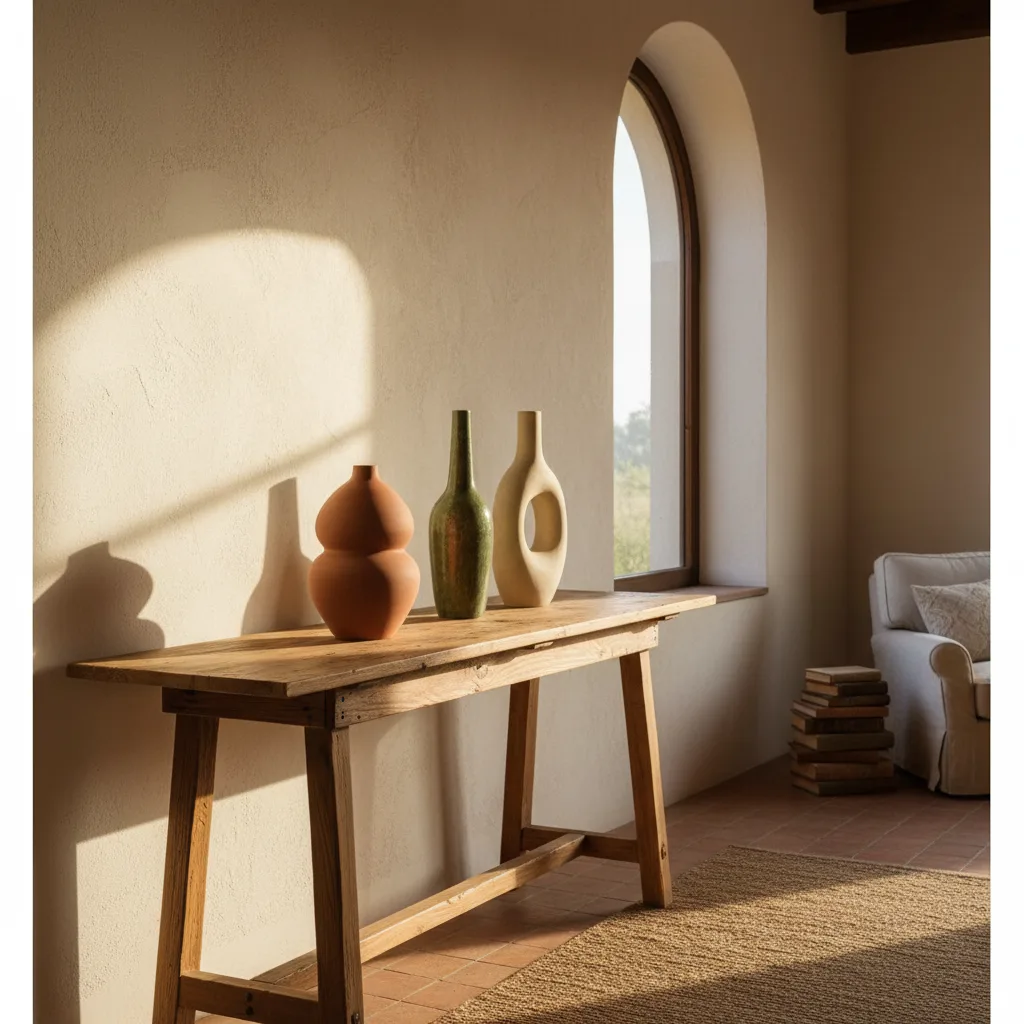
There's an idea that has gone unquestioned for far too long: that a vase needs flowers to justify its presence. As if a piece with its own shape, texture and colour were merely a container waiting for a bouquet. In 2026, modern vases have shaken off that label. Interior design magazines, design shop windows and the most characterful homes across the Mediterranean all agree on the same thing: the empty vase is the sculptural piece that contemporary decorating was missing.
This isn't about leaving a sad flower vase in a corner. It's about choosing pieces with character of their own —organic shapes, artisanal finishes, noble materials— that work like small works of art in your living room, your hallway or your shelving. And about understanding why this shift isn't a passing fad, but a logical evolution in the way we think about the home.
Why vases without flowers work better than you think
Resistance to the empty vase has cultural roots. For decades, home decorating in Spain has associated the vase with its function as a container: it's the object that holds flowers. Full stop. But that reading ignores a dimension that Italian designers have been exploiting for a long time: the piece as volume, as a play of light and shadow, as a visual accent that anchors a corner without needing to add anything else.
A well-chosen vase brings three things that flowers can't deliver on their own. First, permanence: it doesn't wilt, you don't have to change it every week, it creates no waste. Second, texture: a matte finish, an artisanal relief or a raw stoneware surface adds a tactile layer that flowers — however beautiful — don't provide. And third, controlled scale: you can fine-tune exactly the proportion you need on that shelf, on that console, in that corner of the hallway, without depending on the height or volume of a bouquet you can never quite predict.
The result is decorating that is more intentional and less accidental. Instead of buying flowers because "the vase is empty", you choose a vase that needs nothing else to work. It's a shift in mindset, and once you try it, it's hard to go back.
The shapes that define 2026: organic, sculptural and with an artisanal touch
If you're looking for decorative vases that work without flowers, shape is everything. And the 2026 trend is clear: perfect, symmetrical lines give way to irregular silhouettes, to curves that seem moulded by hand (because they often are) and to volumes that bring a sculpture to mind more than a container.
Organic and irregular shapes
Vases with asymmetric mouths, sinuous profiles or slightly off-balance bases dominate the offerings from Italian design houses this year. That imperfection isn't carelessness; it's intention. Each piece carries the mark of the process, a character that mass-produced industrial pieces simply can't replicate. Think of silhouettes that evoke natural forms —a drop of water, a river pebble, a plant stem— translated into ceramic or stoneware with clean but never rigid lines.
Sculptural vases: the piece that takes the place of a painting
The sculptural vase is, probably, the clearest expression of this trend. These are pieces meant to be contemplated, not filled. They can have an elongated tubular shape, a coral-like profile or impossible geometries that play with visual balance. On a hallway console or above a fireplace, a sculptural vase does the job that once required a painting, a mirror or a composition of several objects.
The key lies in proportion: a sculptural vase needs space around it to breathe. If you squeeze it between books and photo frames, it loses its effect. Give it air, and it transforms the whole corner.
Minimalism with personality
Not everything that works without flowers has to be eye-catching. The minimalist current is still alive, but it has evolved. It's no longer the cold, clinical minimalism of a decade ago, but one with more warmth, more texture and, above all, more personality. A cylindrical white ceramic vase with a slightly grainy finish can be just as visually powerful as a complex organic piece — as long as the material speaks for itself.
Materials that speak for themselves: ceramic, stoneware, terracotta and beyond
The material defines the character of an empty vase far more than when it holds flowers, because without the distraction of the bouquet, the surface is the first thing you see and the first thing you touch. These are the materials that work best in 2026 decorating.
| Material | Typical finish | Style it reinforces | Best placement |
|---|---|---|---|
| Matte ceramic | Smooth, velvety | Mediterranean, contemporary | Living room, hallway, bedroom |
| Raw stoneware | Rough, tactile | Wabi-sabi, modern rustic | Shelving, console |
| Refined terracotta | Warm, porous | Mediterranean, organic | Entrance, covered terrace |
| Fine porcelain | Smooth, glossy | Elegant, renewed classic | Sideboard, dining table |
| Blown glass | Transparent or translucent | Nordic, minimalist | Window, side table |
Matte ceramic is the undisputed star of this trend. Its finish absorbs light rather than reflecting it, which creates a visual presence that is warmer and less aggressive than the gloss of porcelain or glass. It's the material that best conveys the feeling of "a piece made by someone" as opposed to "an object produced in series". And when we talk about Italian ceramic —with its centuries-old tradition built around clay, glaze and kiln—, the leap in quality compared to industrial alternatives is obvious the moment you hold it in your hands.
Terracotta has come back strongly, but not the saturated orange terracotta of garden pots. We're talking about refined pieces, with simple lines and a matte finish, in shades of sand, light clay or even pinkish grey. They bring a warmth that glass or metal can't achieve, and they connect any space with the earth — literally.
The colour palette that works empty
When a vase holds flowers, the colour of the piece takes a back seat: the bouquet rules. But when it's empty, the tone of the vase becomes the star. The 2026 palette for decorative vases without flowers revolves around three pillars.
Warm neutrals with a nuance. Off-white —not the cold, hospital white, but one with a drop of cream or bone— is the most versatile and the most sought-after tone this year. It's no coincidence: the 2026 Pantone Colour of the Year, Cloud Dancer, points in exactly that direction. A white ceramic vase with the right colour temperature works in any room, with any style, on any surface. Sand, greige and warm grey complete the family.
Deep earth tones. Terracotta, brick red, chocolate brown, dark olive green. These are colours that call for large pieces with presence — a floor vase, a generous table centrepiece. They work especially well in bright spaces, where the contrast with natural light brings them to life without any need for gimmicks.
Colour with intention. Cobalt blue, sage green, soft mustard yellow. A vase in a vivid colour works as an accent, the brushstroke that breaks the monotony of a neutral living room. The rule is simple: if the rest of the space is restrained in colour, a single eye-catching vase can be all you need. If your home already has plenty of colour, go back to neutrals.
Five ways to use empty vases that really work
Theory is all well and good, but what you need are concrete ideas you can apply this afternoon. Here are five tried-and-tested compositions that work in real homes, not just in magazine spreads.
A trio on a hallway console
Three vases of different heights, the same material (or at least the same colour family), aligned with a touch of controlled disorder on a console. The tallest at the back, the two shorter ones in front, slightly off-centre. It's the most classic composition and the most reliable. If you add a decorative tray beneath the two small ones, you gain visual cohesion and stop them from looking "just plonked there". The key is that the three vases share something —colour, texture or style— but aren't identical.
A single piece on a fireplace or ledge
A single sculptural vase, centred or shifted slightly to a third of the ledge, with enough space on both sides for it to breathe. Nothing more. No candles, no frames, no figurines. This composition requires the piece to be interesting enough on its own to hold attention — and this is where ceramic or glass vases with Italian design make the difference compared to generic options.
A composition on open shelving
Billy-style bookcases or floating ledges are the perfect playing field for small and medium vases. The rule: alternate vases with books and other objects, but never put two vases on the same shelf unless they form a deliberate set. One vase per shelf, with a book or two leaning beside it, creates visual rhythm without overcrowding. Matte finishes work better here than glossy ones, because they don't compete with the spines of the books.
A floor vase beside a low piece of furniture
Large vases —from 40 cm in height— can go straight on the floor, beside a sofa, a low sideboard or an armchair. It's a solution few people consider, but it brings verticality to corners that tend to look visually flat. Choose pieces with a stable base and enough weight that they won't tip over at the slightest knock.
A grouping on a tray on the coffee table
On a coffee table or dining table, group two or three small vases on a round decorative tray. The tray defines the composition's territory and stops the vases from looking lost on the surface. Add a chunky candle or a small bowl to finish. It's the decorative equivalent of a still life: a few elements, well chosen, in dialogue with one another.
Mistakes to avoid with empty vases
A vase without flowers can be a statement of style or an object that looks forgotten. The difference is in the details. These are the most common slip-ups — and how to sidestep them.
The wrong scale. A tiny vase on a two-metre dining table disappears. An enormous vase on a narrow shelf crushes it. Before you buy, measure the space and look for a piece that takes up between a third and half of the available width on the surface where it's going. If in doubt, take a look at the common mistakes when placing vases we've put together.
Too many vases with no common thread. Collecting beautiful vases is all very well, but displaying them all at once with no criteria creates visual noise, not style. If you have a lot, rotate them: store some and bring others out each season.
The "stopgap" vase. A vase left in a corner with no intention — next to the router, on top of the fridge, on the bathroom windowsill — doesn't decorate, it gets in the way. Every vase needs a thoughtful placement, with space around it and in relation to other elements in the same corner.
Ignoring the surface beneath. The vase doesn't float: it rests on something. If that surface is a glass table, a rough ceramic will create an interesting contrast. If it's a dark wooden console, a white vase will stand out. Think of the vase and its base as a single unit.
How to tell whether a vase works without flowers (before you buy it)
Not all vases are designed to look good empty. Those that are usually meet at least three of these five characteristics:
- They have a shape that tells a story: they aren't generic cylinders or cubes with no personality. Their silhouette is interesting from any angle.
- The finish is the star: matte, rough, glazed with tonal variations, with relief. Something that invites you to come closer and touch.
- The colour has depth: it's not a flat industrial white or a plain black. It has nuance, it has warmth or it has character.
- The proportion invites you to leave them alone: pieces with a wide mouth and wide body "ask" to be filled. Pieces with a narrow mouth and an expressive body work better empty.
- They have weight: weight conveys quality and presence. A vase as light as plastic rarely convinces as a standalone decorative piece.
When you buy authentic Italian ceramic vases, these five points usually come as standard. The Italian ceramic tradition works with noble materials, shapes with intention and finishes that don't need to hide behind a bunch of tulips.
Complementary pieces to create compositions with vases: trays as a base, bowls and table centrepieces from the same aesthetic universe.
Frequently asked questions
Doesn't an empty vase look sad or neglected? Only if it isn't well chosen. A vase with a sculptural shape, a noble material and a thoughtful placement conveys intention, not neglect. The key is that the piece has enough visual character to stand on its own: an interesting finish, an expressive silhouette or a colour with depth.
What size of vase is best for decorating without flowers? It depends on the space. For shelves and ledges, vases of 15 to 25 cm work well. For consoles and side tables, between 20 and 35 cm. For the floor, from 40 cm upwards. The general rule: the vase should take up between a third and half of the width of the surface where it sits.
Can you mix vases of different materials? Yes, but with a common thread. You can mix ceramic and glass if they share a colour palette. Or combine stoneware and terracotta if a range of earthy tones connects them. What doesn't work is mixing five different materials with no relationship: that creates noise, not harmony.
Is an empty vase better, or one with dried branches? Dried branches are a valid option for anyone who doesn't dare leave it completely empty. But the 2026 trend leans clearly towards the piece on its own. If you add branches, keep them few and discreet — a couple of cotton branches, a dried olive sprig. The vase is still the star, not what's inside it.
Is it worth investing in an Italian design vase if it won't hold flowers? It's precisely because it won't hold flowers that the quality of the piece matters most. An empty mass-produced vase shows: the finish is flat, the shape generic, the weight light. An Italian ceramic vase made with care has presence, texture and a quality of material that justifies the space it occupies in your home.
Keep reading on the Vita Italian Living blog: