7 common mistakes when placing vases at home
You have a beautiful vase —ceramic, perhaps, or glass— and you put it wherever it fits. The end. That is exactly what most people do, and it is why so many decorative vases end up invisible or, worse, getting in the way. Mistakes in placing vases in your décor are not a matter of taste: they are a matter of proportion, height and common sense. And the good news is that they can be fixed in five minutes, without buying anything new.
This guide goes through the seven most repeated slip-ups and gives you the direct solution for each one. Because a well-placed vase does not need flowers to work.
Choosing a vase without looking at the space
The most frequent mistake happens before you place anything: buying a vase you like in the shop without thinking about where it is going to live. A 50 cm vase looks striking on a wide sideboard, but ridiculous on a 40 cm-wide bedside table. And the other way around: a little 15 cm vase gets lost on a metre-and-a-half entryway console.
The proportion between the piece and the furniture holding it comes first. As a quick rule, the vase should not exceed a third of the furniture's height or take up more than a quarter of its surface. If in doubt, measure before deciding. It is not a lack of spontaneity: it is good judgement.
Placing vases on the floor without thinking it through
Putting a vase straight on the floor seems like a solution when it does not fit on any piece of furniture. The problem is threefold: it loses visibility (the eye is drawn to eye level, not to the feet), it risks trips and breakages, and it gathers dust easily. And if you also have children or pets, the equation gets more complicated.
Does that mean you can never put a vase on the floor? No. But it needs to meet certain conditions: it must be a large piece (at least 60-70 cm), it must be in a corner away from walkways, and the floor around it must be clear. A floor vase only works as a focal point when it has room to breathe. If it ends up wedged between the sofa and the lamp, it does not decorate — it gets in the way.
Grouping without varying heights or shapes
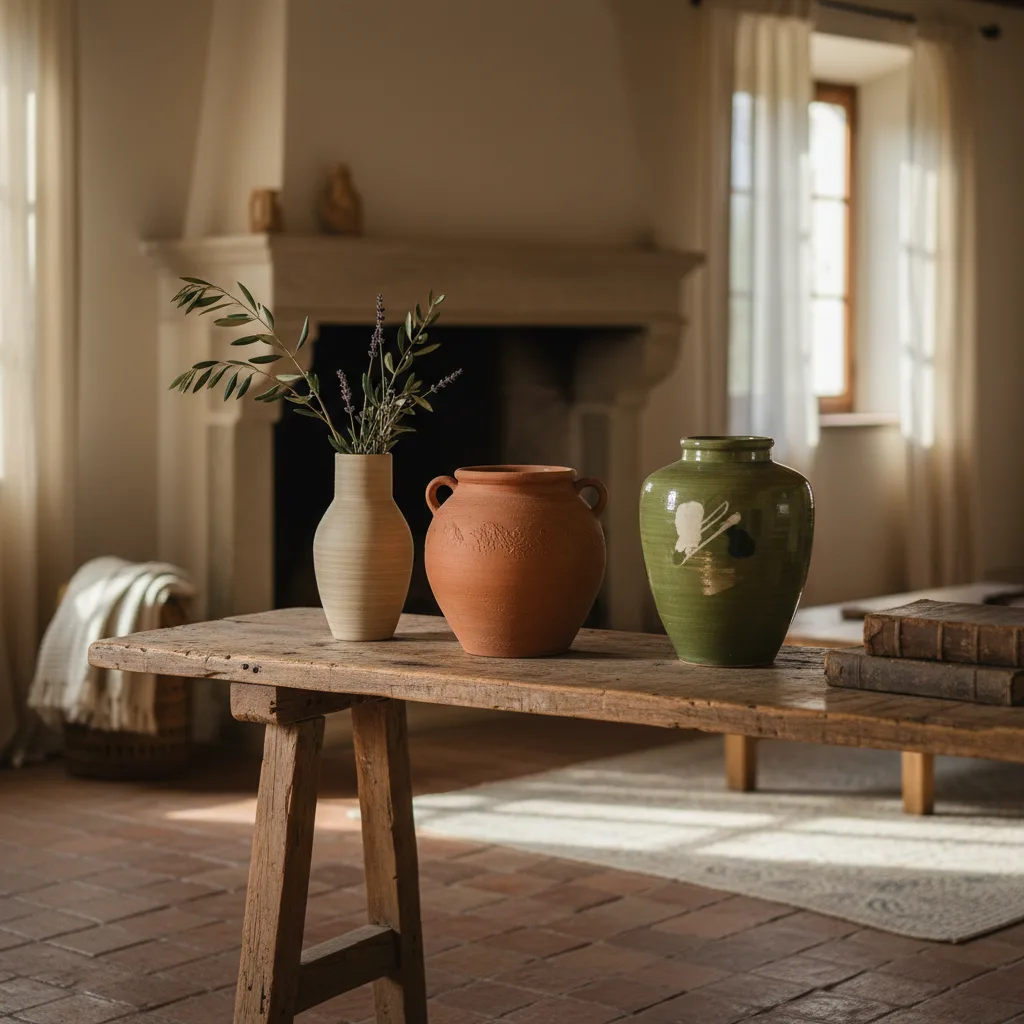
Three vases of the same size in a straight row. It is a classic that seems safe and turns out boring. When you group vases, the eye needs to travel across the composition: something tall, something medium, something low. That difference in heights creates visual rhythm and stops the grouping from looking like a factory batch.
The rule that works best: an odd number (three is ideal), different shapes (one cylindrical, one rounded, one with a narrow neck) and an element that ties the group together — it can be the material, the colour palette or the finish. If all three are white ceramic but with different textures and silhouettes, the set has cohesion without monotony.
| Element | Bad example | Good example |
|---|---|---|
| Quantity | 2 identical and symmetrical | 3 in staggered heights |
| Shapes | All cylindrical | Cylindrical + rounded + narrow neck |
| Heights | Same height (25 cm) | 15 cm + 25 cm + 35 cm |
| Colour | Three unrelated colours | Same tonal family, different intensity |
| Texture | All smooth | Smooth + textured + glazed |
ceramic vases with varied textures
Ignoring the relationship with the wall and the background
A white vase against a white wall disappears. A dark vase in an unlit corner becomes a shapeless blob. The background matters as much as the piece. Before placing a vase, look at what is behind it: the wall colour, whether there is a picture, whether natural light comes in from one side.
The contrast does not have to be extreme. It is enough for there to be a tonal difference that lets the vase stand out against its background. A terracotta-toned ceramic vase against a warm-white wall works. That same vase against a wall of the same tone blends in and loses all its decorative potential. If the background does not flatter it and you cannot paint, try placing the vase in front of a mirror or next to a plant that gives it natural contrast.
Overcrowding the surface with too many pieces
This mistake is not exclusive to vases, but vases make it worse because they have volume. When you fill a shelf, a console or a ledge with vases, candles, frames, plants and books until there is no room for a pin, no object stands out. The eye does not know where to settle and the overall feeling is one of clutter, even if each piece is beautiful on its own.
The solution lies in editing. A surface needs negative space — empty areas that let the objects breathe. As a practical rule: leave at least 30-40% of the surface free. If you have three vases and two frames on the same shelf, try removing one of each and see the difference. Almost always, fewer pieces placed with intention beat many pieces piled up without judgement.
Forgetting the functionality of the space
A spectacular vase in the centre of the dining table looks gorgeous… until you serve dinner and there is no room for the serving dish. A tall vase on the kitchen island gets in the way every time you prepare something. Decorating also means thinking about how the space is used day to day.
Before fixing a vase's position, ask yourself a simple question: is it going to be in the way when I use this furniture for what it is meant for? On the dining table, the vase should not exceed 25 cm in height (so it does not block the view between guests) or take up more than the centre. On the kitchen worktop, it only works if there is an area you do not use for cooking. And on a shelf you reach for often, a fragile vase in the front row is a breakage waiting to happen.
Buying vases and saving them for «when I have flowers»
The last mistake is the quietest. You buy a beautiful vase and store it in the cupboard waiting until you have fresh flowers. Weeks go by, then months, and the vase is still in the dark. It is like buying a picture and leaving it propped against the storeroom wall.
A good vase does not need flowers to work. In fact, the most established trend in contemporary décor is to use decorative vases without flowers as sculptural pieces in their own right. A ceramic vase with an interesting shape, a textured finish or a colour with character is décor in itself. Take it out of the cupboard, place it where the light hits it and let it be what it is: a beautiful object that deserves to be seen.
Quick checklist: before placing a vase
- Is the vase proportional to the furniture it goes on? (max. 1/3 of the furniture's height)
- Does it contrast with the background or blend into it?
- Is it away from walkways and the risk of knocks?
- Does the surface have at least 30-40% free space?
- Does it avoid blocking the furniture's function (eating, cooking, reaching)?
- If it is on the floor, does it measure at least 60 cm and have open space around it?
- Is it part of a group with staggered heights (if it is not standing alone)?
Accessories that complete a decorative composition alongside the vases
Frequently asked questions
Where is the best place to put a large vase at home? In a clear corner of the living room, next to an entryway console or flanking a fireplace. What matters is that it has open space around it and that it is away from traffic areas. If it measures more than 60 cm, it can go straight on the floor; if not, it needs a piece of furniture to give it height.
How many vases can be grouped together without looking cluttered? Three is the number that works best in a grouping. Five can work on wide surfaces (a long ledge, a large sideboard). More than five in the same visual spot usually feels overcrowded. The key is not the exact number but the variation in heights and the open space between pieces.
Does an empty vase look good or does it need flowers? An empty vase looks perfectly fine if it has an interesting shape, texture or colour in its own right. Handcrafted ceramic, blown glass or pieces with matte finishes work especially well without any contents. It is not a container waiting to be filled: it is a self-sufficient decorative piece.
How tall should a vase be for the dining table? No more than 25 cm if you are going to use it for meals. Above that height, the vase blocks the view between guests and creates an awkward barrier. For hallway or side tables where you do not sit down, the height can be greater without any problem.
Ceramic or glass for decorative vases? It depends on the effect you are after. Ceramic brings warmth, texture and presence even when empty. Glass gives lightness and transparency, but loses impact without contents. For purely decorative use (without flowers), ceramic usually works better. For arrangements with water and fresh flowers, glass has the practical advantage. You can go deeper into the comparison in our guide to ceramic or glass vases.