Decorative fruit bowl or tray: which piece to choose for your kitchen
You're redecorating the kitchen —or you simply want the worktop to stop looking like a storeroom— and you run into the same question half the world has: do you need a classic kitchen fruit bowl or a decorative tray that gathers everything together with more style? The question seems minor, but the piece you place in that central spot will set the visual tone of the whole room. And what works in a magazine kitchen doesn't always work in yours.
What nobody tells you is that it isn't about choosing one or the other in the abstract, but about understanding the role each piece plays in your particular way of cooking, eating and entertaining. A decorative fruit bowl and a tray solve different problems. Sometimes they even complement each other. Let's break the dilemma down with a clear head.
What problem each piece solves (and it isn't the same one)
A fruit bowl has a clear purpose: to keep fruit visible, ventilated and within reach. When fruit is on display, you eat more of it —this isn't an opinion, it's basic human behaviour—. But a good decorative fruit bowl goes beyond function: it adds vertical volume, colour that shifts with the season and an organic focal point in a space usually dominated by straight lines and appliances.
A decorative tray, on the other hand, solves the problem of horizontal clutter. It gathers scattered objects (oil, salt, spices, a candle) and gives them a visual boundary that turns chaos into composition. It doesn't hold a single starring element the way a fruit bowl does; its charm lies in orchestrating several. If you want to explore everything a tray can do, take a look at the 5 ways to use decorative trays that hadn't occurred to you.
The essential difference is this: the fruit bowl is a star in its own right; the tray is the stage director. If your worktop needs a point of attention, the fruit bowl wins. If it needs order with style, the tray wins. And if you have room for both, the combination is more powerful than either one on its own.
Materials that matter: ceramic, glass, metal and wood
The material of the piece isn't just an aesthetic question —it affects durability, maintenance and how the piece ages in your kitchen—. And in a room where there's steam, grease and splashes, choosing the right material saves you headaches.
Ceramic
The ceramic fruit bowl is a classic for good reasons. It's heavy enough not to move around, it stands up well to daily use, and the glaze gives it a finish that improves with time rather than degrading. In the Italian table tradition, ceramic is the material par excellence: each piece has its own character, small variations in tone that make it unique. For trays, glazed ceramic is ideal if you want to clean it easily after an oil or coffee spill.
What you should keep in mind: ceramic doesn't forgive drops. If you have small children or a kitchen where everything moves fast, consider placing it in a protected spot. And if you want to know how to care for ceramic pieces in the long term, the guide on ceramic centrepieces and their care applies in exactly the same way to fruit bowls and trays.
Glass and crystal
A glass fruit bowl adds visual lightness and lets the colour of the fruit be the absolute star. It works especially well in bright kitchens with light-coloured worktops. For trays, glass is less practical —fingerprints show and anything you set down clinks—, but on a sideboard or a kitchen island where the use is more contemplative than functional, it can be an elegant choice. The comparison between ceramic and glass gives you more context on how these materials interact with light and space.
Metal
Stainless steel and matt-finished metal are contemporary options that work very well in modern-line kitchens. Wire-mesh fruit bowls have a real practical advantage: air circulation prolongs the life of the fruit. The drawback is that fingerprints show on polished finishes, so if you go for metal, look for a matt or brushed finish.
Wood and bamboo
They bring immediate warmth. A wooden fruit bowl in a white-toned kitchen creates a natural contrast that needs nothing more. For trays, treated wood is perhaps the most versatile material: it doesn't break if it falls, it doesn't make noise, and it ages with a patina that adds rather than subtracts. Bamboo is lighter and has a sustainable edge that resonates with anyone looking for responsible materials.
How to choose according to your type of kitchen
There's no universal piece. What works in a 20 m² kitchen open to the living room doesn't fit a 6 m² galley kitchen. Here's a quick guide based on the real space you have.
| Type of kitchen | Recommended piece | Reason |
|---|---|---|
| Kitchen open to the living room (central island) | Decorative ceramic or glass fruit bowl | The island needs a focal point with volume; the fruit bowl adds colour and verticality |
| Small or galley kitchen | Rectangular tray | Gathers objects in little space and creates visual order without taking up too much |
| Spacious kitchen with a long worktop | Both: fruit bowl + tray | You have surface for two zones: one functional-decorative (fruit bowl) and one for grouping (tray) |
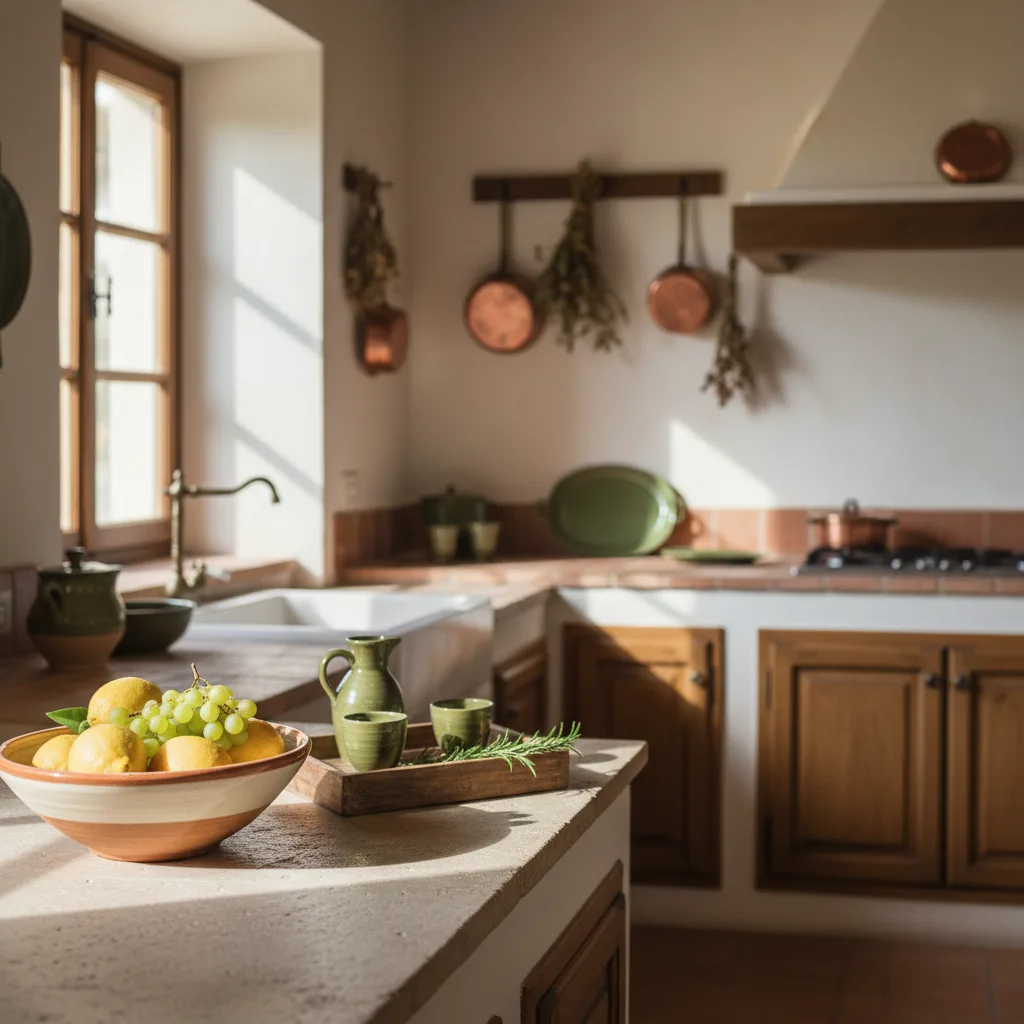
| Rustic or Mediterranean kitchen | Handcrafted ceramic fruit bowl | The material reinforces the style; the fruit provides the colour the space calls for |
| Modern minimalist kitchen | Clean-line tray + low bowl as a fruit bowl | Avoids excessive volumes; clean lines and few objects |
| Kitchen with little storage | Tiered fruit bowl (2-3 levels) | Makes use of vertical space to free up the worktop |
Proportion is key: a fruit bowl that's too big on a narrow worktop creates visual overload. And a tiny tray on a wide island looks lost. The rule of proportion and height that applies to centrepieces is exactly the same one you need here: the piece should take up between a third and half of the width of the surface it sits on.
The fruit bowl as a centrepiece: a use that gets forgotten
This is where the decorative fruit bowl shows its real versatility. It doesn't have to live exclusively on the worktop. A well-chosen ceramic fruit bowl —with the right proportion and a finish that converses with your tableware— works as a centrepiece on the everyday dining table. Seasonal fruit changes the colours without you having to do a thing: lemons and oranges in winter, peaches and plums in summer, pomegranates and grapes in autumn.
It's a living centrepiece, one that evolves on its own. And unlike flowers, which last a week, the fruit you can eat. There's something deeply Italian about this idea: the table as a place of real abundance, not artificial decoration. If you're looking for more inspiration on what to put as a centrepiece without falling into clichés, the fruit bowl is one of the most honest options you'll find.
For it to work as a centrepiece, keep height in mind. A fruit bowl that's too tall on a table for four blocks the visual conversation. Look for medium-profile pieces (between 10 and 15 cm tall without the fruit) and let the stacked fruit provide the volume. The result is organic, colourful and ever-changing —exactly the opposite of those centrepieces that gather dust for months.
The tray in the kitchen: beyond serving
If the fruit bowl shines as the star, the tray is the piece that organises the supporting cast. In the kitchen, a decorative tray has at least three practical functions that justify its presence beyond the aesthetic.
Grouped condiment zone. Olive oil, vinegar, flaked salt, pepper. When they're loose on the worktop they look as if they were left there by accident. When they're on a tray, they look like an intentional still life. It's the difference between a kitchen that works and a kitchen that also has personality.
Coffee or tea station. The coffee maker, a couple of cups, the sugar bowl. Everything gathered on a tray creates a themed corner that invites a ritual. If this idea interests you, the article on how to create a coffee corner with trays and bowls develops it in depth.
Portable serving surface. The tray's ultimate functional advantage is that it moves. You prepare an appetiser in the kitchen, set it up on the tray and carry it to the table or the living room without making three trips. It's practical hospitality, not static decoration.
When to choose one, when to choose the other (and when to choose both)
After all of the above, the decision becomes simpler if you ask yourself three specific questions.
Do you eat fruit every day? If the answer is yes, a decorative fruit bowl isn't an indulgence —it's a tool that reminds you to eat better and, along the way, adds natural colour to the kitchen—. If fruit isn't part of your routine, the fruit bowl will end up empty and sad, and a tray will give you more real return.
Is your worktop a chaos of loose objects? If the main problem is visual clutter, the tray is your priority. It groups, defines and tidies without requiring you to store anything in a cupboard. The change is immediate and the effort minimal.
Do you have enough surface for two pieces? If the answer is yes —a central island, an L-shaped worktop with free space—, the combination is the most complete option. The fruit bowl provides the vertical focal point with colour; the tray, the horizontal composition with order. Together they create two zones of interest that make the kitchen look considered, not improvised.
And a note on style: if you're going to combine both pieces, choose materials that converse with each other. Ceramic with ceramic in tones from the same family. Or ceramic with wood if you're after a warm contrast. Avoid mixing shiny metal with rustic ceramic on the same worktop —the clash of registers creates visual noise—. The article on how to choose the perfect centrepiece for your dining room explores this logic of complementary materials in more depth.
Quick checklist before you buy
Before deciding, run through these points. It won't take more than a minute and it'll save you a return.
- Have you measured the available space on the worktop? (real free width, not estimated)
- Does the piece take up between a third and half of the surface where it will go?
- Does the material withstand the kitchen environment? (steam, grease, light knocks)
- Does the style converse with the rest of your kitchen or compete with it?
- Will it have real use (fruit, grouping objects) or only decorative?
- If it's a fruit bowl: does it have good ventilation for the fruit?
- If it's a tray: can you lift it comfortably with objects on top?
- Is the finish easy to clean? (glaze, treated wood, matt metal)
Frequently asked questions
Does a ceramic fruit bowl keep fruit fresh better than a plastic one? Ceramic does not release substances on contact with food and does not retain odours the way plastic can over time. What's more, because it is heavier and more stable, the fruit moves around less and takes fewer knocks. The main preservation advantage, however, comes from fruit bowls with good air circulation —regardless of the material—.
Can I use a fruit bowl as a centrepiece in the dining room? Yes, and it's a Mediterranean tradition with centuries of history. A medium-profile fruit bowl (10-15 cm tall) filled with seasonal fruit works as a living centrepiece that changes colour effortlessly. Just make sure the overall height (fruit bowl + fruit) doesn't block the line of sight between diners.
What size tray do I need for the kitchen worktop? It depends on the use. For a condiment station, a tray 25-30 cm long is enough. For a complete coffee corner, you'll need between 35 and 45 cm. The general rule is that the tray should not exceed half the free width of the worktop.
Fruit bowl or tray if I have a very small kitchen? In small kitchens, a rectangular tray is usually more practical because it makes use of the linear space of the worktop without adding vertical bulk. If you still want fruit on display, a wall-hanging fruit bowl or a single-tier, low-profile model can be the solution.
Is it worth investing in a piece of Italian design for the kitchen? A well-made piece of Italian ceramic —like those by Brandani— is not an expense: it's an investment in something you use every day and that improves with time. The difference from a generic piece shows in the finish, in the weight, in the way the glaze ages. And in the kitchen, where everything is used and touched, that difference is felt every day.
Complementary pieces to round out a kitchen with Italian personality: centrepieces, bowls and accessories that converse with the fruit bowl and the tray.