7 common mistakes when choosing a table centerpiece
Choosing a centerpiece seems simple until you set it down and something just doesn't work. It's too tall, too small, doesn't go with anything, or simply gets in the way at dinner. The curious thing is that almost always the same mistakes come up, and most of them have nothing to do with personal taste, but with questions of proportion, material and common sense that nobody explains to you in the shop.
If you've spent a while searching for that centerpiece that completes your dining room without stealing the spotlight from everything else, this guide will spare you a few stumbles. We'll go over the seven most common mistakes —with real examples— and, what really matters, how to avoid each one.
Not respecting proportion with the table
This is mistake number one and the most widespread. A beautiful centerpiece can become a problem if it doesn't relate to the size of your table. The piece eats up the space available for plates and glasses, or the opposite: it ends up so tiny it looks lost in the middle of a two-metre tabletop.
The practical rule is simple: the centerpiece shouldn't take up more than a third of the width or more than a third of the length of the surface. If your table is 90 cm wide, the centerpiece shouldn't exceed 30 cm in diameter. On large rectangular tables you can play with elongated arrangements, but the proportion principle stays the same.
There's a nuance many people overlook: proportion isn't only about surface area, but also about visual volume. A low, wide bowl takes up less perceived space than a narrow but tall vase, even if its footprint on the table is similar. If you want to dig deeper into the rules of proportion, height and function, you'll be interested in the rule of 3 for centerpieces.
Choosing the wrong height
The second most common mistake: a centerpiece so tall that diners have to peer around it to see each other's faces. It's a classic with large vases and tall candelabra. The conversation breaks down, the table loses its naturalness and you end up moving the piece aside by the first course.
The benchmark professionals use is that a centerpiece for everyday use shouldn't exceed 25-30 cm in height. If it's for a special occasion and the table is spacious, you can go up to 40 cm, but only if the diners don't end up facing each other at close range. On small round tables, where everyone looks at one another, the maximum height drops to around 20 cm.
There's an exception for very tall, narrow centerpieces —candelabra-style, over 50 cm— that leave the sightline clear underneath. They work at banquet tables or celebrations, not on the everyday dining table. If your table is round or rectangular, the height criterion changes slightly.
Ignoring functionality
A centerpiece isn't just decoration: it's a piece that lives alongside plates, glasses, napkins, bread baskets and, sometimes, children stretching out their arms. The mistake of prioritising aesthetics alone and forgetting functionality is more common than it seems.
What does functional mean in a centerpiece? That it won't tip over easily, that it has no uncomfortable sharp edges, that you can move it with one hand when you need space, and that it's easy to clean. A ceramic centerpiece with a wide, stable base is far more practical than one of thin glass on a narrow stem, however visually striking the latter may be.
If you have small children or host guests often, think about pieces you can clear away in five seconds without staging a logistical drama. Ceramic bowls with a heavy base are an option that combines decorative presence with real durability. And if you want concrete ideas on what to put out, take a look at what to use as a centerpiece: the cliché-free guide.
ceramic centerpiece with a wide base
Repeating the same material as the table
This mistake is subtle but has a huge impact on the visual result. If your table is dark wood and you place a dark wooden bowl on top, the piece merges with the surface. It doesn't stand out, it adds no contrast, it sparks no interest. It's like hanging a brown picture on a brown wall.
The key lies in the interplay of materials: ceramic on wood, glass on stone, metal on marble. The contrast of textures is what gives the centerpiece its own presence without needing to resort to garish colours. A piece of Italian artisan ceramic on an oak table creates a far richer visual dialogue than two elements of the same material competing to go unnoticed.
| Table material | Recommended material for the centerpiece | Why it works |
|---|---|---|
| Light natural wood | Glazed ceramic, glass | Texture contrast, gloss vs. matte |
| Dark wood | White ceramic, gold metal | Luminosity, stands out against a dark background |
| Glass | Rustic ceramic, stone | Visual weight, keeps everything from looking fragile |
| Marble | Coloured ceramic, natural fibres | Warmth against the coldness of marble |
| Melamine / lacquered | Artisan ceramic, wood | Organic texture against a smooth surface |
The difference between a table that looks "staged" and one that simply has things on it lies, almost always, in this contrast of materials. If you're torn between ceramic and glass for your table, each material has its advantages depending on the style of your dining room.
Overdoing the decorative elements
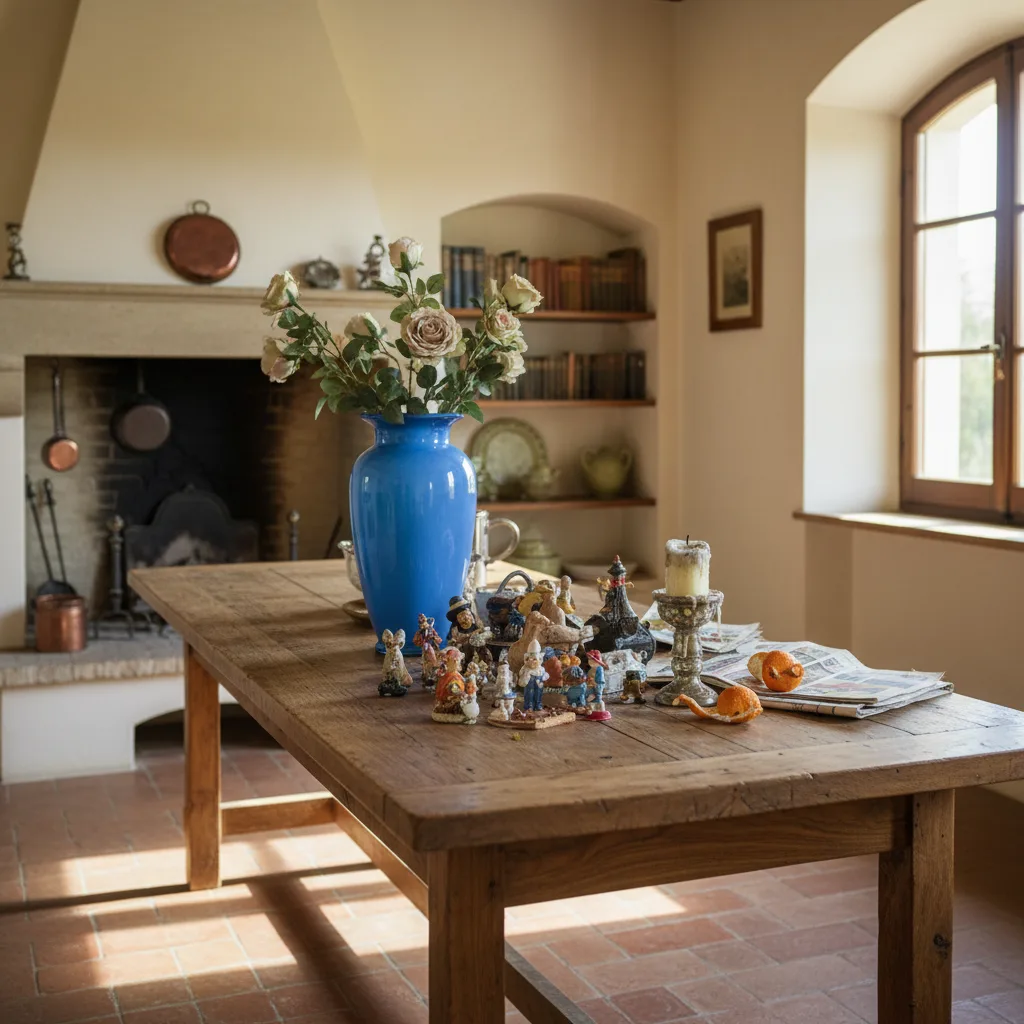
More isn't better. This mantra is often forgotten when the time comes to decorate the dining table. A vase with flowers, two candles, a tray, a bowl of fruit and three little figurines: the result isn't a well-decorated table, but a cluttered display window with no room left to eat.
The mistake of overloading has a direct solution: choose one lead element and accompany it, at most, with one or two discreet complements. A powerful ceramic centerpiece doesn't need candles around it or figurines to keep it company. Shared prominence ends up diluting the effect of every piece.
A good test: if you have to move more than one piece to set the table, you probably have too many. The rule of 3 for centerpieces helps you find that balance between presence and free space. Think of the table like a well-plated dish: empty space is just as important as what's on top.
centerpiece that works on its own, with no accompaniment
Not adapting the centerpiece to the occasion
A mistake that's less noticeable but marks the difference between a correct table and a table with personality. Using the same centerpiece for a Sunday breakfast, a dinner with friends and Christmas lunch is like wearing the same outfit to the beach and to a wedding.
You don't need ten different centerpieces. But it is worth having at least two registers: one for the everyday —functional, sturdy, easy to clean— and another for special occasions —with more presence, perhaps more delicate or with seasonal elements such as candles or seasonal flowers.
Seasonality is a resource few people take advantage of. In spring, a low bowl with fresh herbs. In autumn, a ceramic piece in warm tones. At Christmas, an arrangement with candles and natural elements. If the idea inspires you, take a look at these centerpiece ideas with flowers and candles or these Christmas centerpiece ideas with an Italian touch.
Buying without seeing the whole picture
The last mistake is the most common in online shopping (and in physical stores too): choosing a centerpiece you like in isolation, without thinking about how it will look on your particular table, with your tableware, your tablecloth and the light of your dining room. A centerpiece doesn't exist in a vacuum: it's part of a whole.
Before buying, ask yourself these questions:
- What colour is my table and my usual tableware?
- What's the maximum height my dining room allows without feeling oppressive?
- Do I use a tablecloth, a table runner or a bare table?
- Do I have other decorative pieces on the table or will this be the only one?
- Who sits at this table? Children, frequent guests, adults only?
A useful trick: before deciding, place an object of similar size and height (a box, a book, a food container) in the centre of your table for a couple of meals. If it doesn't get in the way and the proportion seems right, you've got the exact size reference you need. Then choose the material and style knowing the dimensions work.
If you need a more complete guide to the selection process, the article how to choose the perfect centerpiece for your dining room covers the whole journey, from proportion to the styles that last the longest.
Quick checklist: avoid the 7 mistakes at a glance
Before buying your next centerpiece, run through this list:
- Proportion: it takes up no more than 1/3 of the width and length of the table
- Height: it doesn't exceed 25-30 cm for everyday use
- Functionality: it's stable, easy to move and easy to clean
- Material contrast: it doesn't repeat the table's material
- Restraint: it's the lead element, not just one more among ten ornaments
- Versatility: it works for everyday use or I have an alternative for occasions
- Context: I've visualised (or simulated) it on my real table before buying it
If your current centerpiece meets at least five of these seven points, you're on the right track. If it fails on three or more, it's worth rethinking. Sometimes changing a single piece is enough to make the whole table work.
Complementary pieces that help you compose a balanced table without falling into the mistakes in the article.
Frequently asked questions
What is the ideal size for a table centerpiece?
A centerpiece shouldn't take up more than a third of the width or the length of the surface. For a table 90 cm wide, that means a maximum of 30 cm in diameter. On large tables, you can use elongated arrangements while respecting the same proportion.
What is the maximum height a table centerpiece should have?
For everyday use, between 20 and 30 cm is the professional benchmark. Beyond that, the centerpiece starts to block the view between diners. For special occasions with spacious tables you can go up to 40 cm, but only if the diners aren't facing each other at close range.
Can I use the same centerpiece all year round?
You can, but your table will gain a lot if you adapt the piece or the arrangement to the season. You don't need ten different centerpieces: with two registers —one functional for everyday use and another with more presence for occasions— you cover most situations.
Which material is best for a dining table centerpiece?
It depends on the material of your table. The key is contrast: ceramic on wood, glass on stone, metal on marble. What you should avoid is repeating the same material and the same texture as the table surface, because the piece loses its visual presence.
Is it a mistake to use fresh flowers as a centerpiece?
It isn't a mistake in itself, but bear in mind that flowers require frequent maintenance, can drop petals and pollen, and some have intense scents that interfere with the meal. If you love flowers, pair them with a solid base —a ceramic bowl, for example— that also works without them.
Related articles on the same topic:
- How to choose the perfect centerpiece for your dining room
- The rule of 3 for centerpieces: proportion, height and function
- 10 modern centerpiece ideas for 2026
Discover also: