New Year's Eve table centrepieces: atmosphere without the clutter
New year's eve table decoration has a problem that returns every 31st of December: the temptation to turn the table into a showcase of glitter, tinsel and everything that sparkles. The result is usually a surface with no room for the prawn platter, where two people sitting opposite each other can't look one another in the eye. The line between festive and overdone is finer than it seems, and crossing it comes down to a couple of ornaments too many.
There's another way to welcome the new year at the table. One that bets on pieces with real weight, materials you can feel under your fingers —ceramic, glass, linen— and a colour palette that doesn't need to compete with the lights on the tree. What you'll find here are concrete ideas for putting together a New Year's Eve centrepiece that creates atmosphere without stealing space or attention from what really matters: the dinner, the conversation and the toast.
Why New Year's Eve calls for a different approach than Christmas
If you already put together a centrepiece for Christmas Eve, the temptation is to leave it as is for the 31st. But New Year's Eve has its own personality, and the table should reflect it. The Christmas Eve dinner tends to be family-oriented, warm, with traditional touches. New Year's Eve is something else: freer, more grown-up, with licence for a hint of glamour that would feel out of place at Christmas.
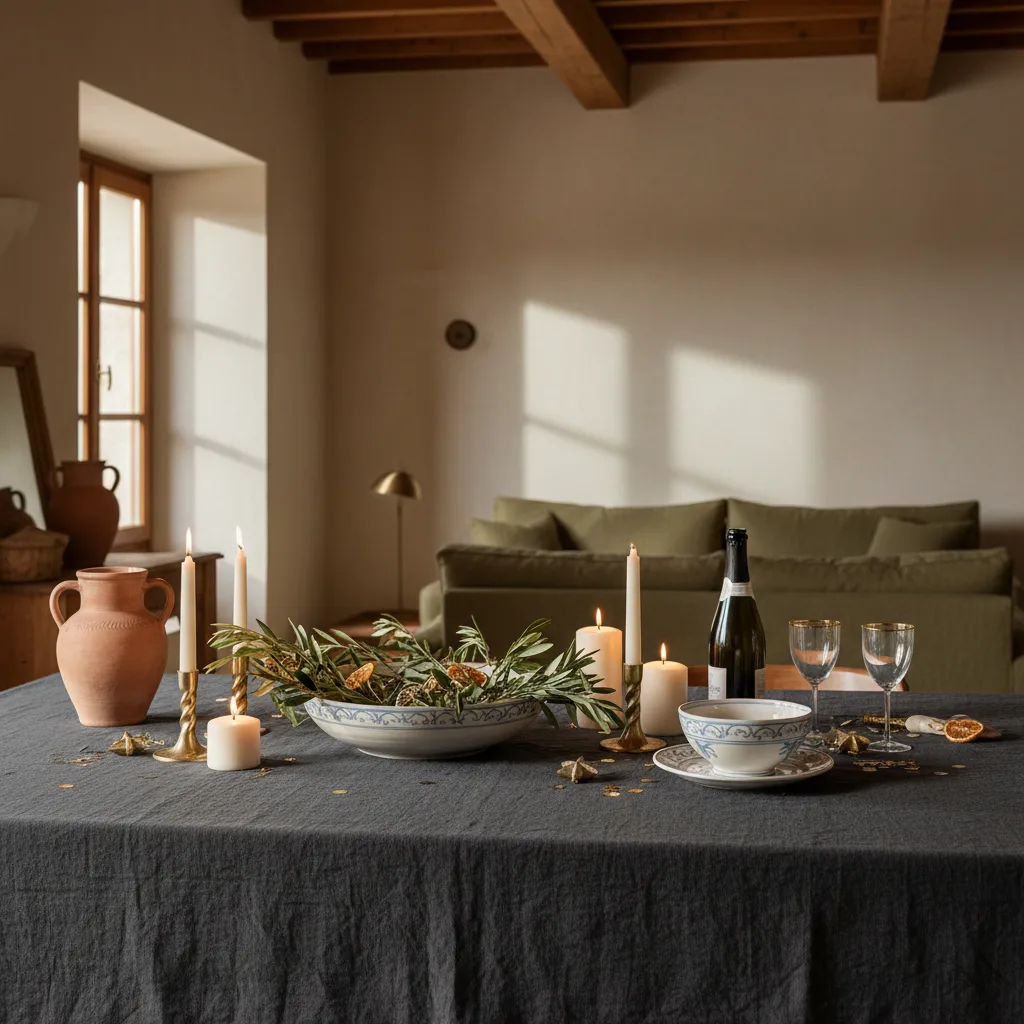
That doesn't mean covering the table in sequins. It means you can allow yourself a bolder palette —black and gold, charcoal grey with metallic flashes, white and silver—, materials with a little more restrained shine and a centrepiece that speaks of celebration, not tradition. The difference is subtle but it sets the tone for the night: this isn't just another family dinner, it's the close of one year and the opening of another.
In Italy, the last dinner of the year is lived with that blend of elegance and spontaneity. A few pieces, good glassware, a centrepiece that stays out of the way and a table where the dishes —the lucky lentils, the cotechino, the sparkling wines— have all the space they need.
The colour palette that works (and the one that overwhelms)
Choosing your colours before buying a single piece saves you from the most common mistake of the night: the rainbow table. When every element is a different colour, the result always looks improvised, no matter how expensive the pieces are.
Combinations that work
| Palette | Effect | Ideal for |
|---|---|---|
| Black + gold | Classic glamour, sophistication | Dinners for two or small groups |
| White + silver | Cool brightness, Nordic elegance | Large tables, spaces with plenty of light |
| Charcoal grey + matte gold | Modern, restrained, with character | Anyone wanting to escape the classic black and white |
| Dark green + gold | A natural transition from Christmas | Anyone who doesn't want to take down all the Christmas decorations |
| Cream + copper | Mediterranean warmth, a cosy tone | Long dinners with lingering conversation |
What's best avoided
Red and green together work at Christmas, but on New Year's Eve they give the feeling of "I already saw this three days ago." An excess of silver —tablecloth, dinnerware, centrepieces, napkin rings, everything in silver— produces a cold effect that doesn't invite you to stay. And loose glitter, however festive it looks in the photo, ends up in the food, in the glasses and on the guests' jumpers.
The rule is simple: choose two colours and one metallic accent. Everything you put on the table should live within that palette. If a piece doesn't fit, don't use it no matter how much it sparkles.
Low centrepiece: the piece that takes charge without getting in the way
The height mistake is probably the most common one on end-of-year tables. A tall centrepiece —a film-set candelabra, a tower of baubles or a vertical floral arrangement— stops diners from seeing each other. And if there's one thing that matters on New Year's Eve, it's being able to look each other in the eye at midnight.
A low ceramic centrepiece solves this at the root. A wide bowl with floating candles, a ceramic tray to group loose elements together, or a low fruit bowl with decorative spheres and a central candle: any of these options provides a focal point without raising a barrier.
Proportion matters. If your table is 90 cm wide, the centrepiece shouldn't exceed 30 cm in diameter —a third of the width—. This leaves room for plates, glasses and bottles without anyone having to perform a juggling act. If you need to brush up on proportions, the rule of 3 for table centrepieces: proportion, height and function has a guide that applies to New Year's Eve and to any other dinner.
Candles: the soul of the end-of-year table
There's no elegant New Year's Eve without candles. Artificial light —however warm the bulb— can't replicate what a real flame does over a glass goblet, over the ceramic of a bowl or over the skin of the person across from you. Candles transform any table, but on New Year's Eve they're essential.
The key is in how you present them. Three loose candles on the table look improvised. Three candles in glass or ceramic holders, grouped with intention, look like a centrepiece in their own right. The difference isn't about budget, it's about the support.
Which candles to choose for the New Year's Eve table
White or ivory candles are the universal wildcard: they go with any palette and don't compete with the colours of the dinnerware. If you're after a touch of character, candles in a gold or champagne tone add warmth without overwhelming. Avoid scented candles on the dining table: the aroma interferes with the food and, if the dishes deserve attention —which on an end-of-year dinner they should— your sense of smell needs to be free.
Height matters. If the candles are level with the faces of seated diners, they dazzle and bother. The solution: low, thick candles (pillar style) or tall, narrow candles whose flame sits above eye level. The middle ground doesn't work.
If you already have candles sorted for Christmas and want to reuse them, just change the holders. A dark ceramic candle holder where there used to be a white one completely transforms the perception, without spending on new candles.
Trays as a visual organiser: the practical solution
A decorative tray placed in the centre of the table is a device that solves two problems at once: it visually organises the arrangement and lets you remove the whole centrepiece in a single gesture when it's time to serve dinner.
On the tray you can group candles, a sprig of eucalyptus, a couple of discreet baubles in a metallic tone and, if you like, a natural pine cone or a personal touch such as small cards with the diners' names. The contents change, but the tray rules: it defines the perimeter of the centrepiece and keeps the elements from scattering across the whole table.
decorative Italian ceramic tray
This device is especially useful on long tables, where a single centrepiece can look unbalanced. Two matching trays with symmetrical arrangements —or one central tray and two candle holders at the ends— distribute the visual weight in a balanced way. If you want to explore more possibilities, decorative trays: 5 ways to use them you hadn't thought of expands the concept well beyond New Year's Eve.
The details that elevate the table without adding noise
The difference between a "decorated" table and a "stylish" one usually lies in the details that don't shout. They're the elements that don't take centre stage but, if you remove them, are missed.
Napkins with intention
A fabric napkin —not paper— folded with a simple knot and a sprig of rosemary or a thin ribbon in a gold tone conveys care with no apparent effort. On the New Year's Eve table, the napkin is a chance to add texture and colour without taking up extra space. Linen, thick cotton or even fine velvet work better than any patterned napkin.
Charger plates as a canvas
A matte gold or bronze-coloured charger plate completely changes the perception of the dinnerware sitting on top of it. If your dinnerware is white or neutral, the charger plate provides the metallic accent New Year's Eve calls for without having to resort to overloaded centrepieces. It's the most discreet investment on the table, with the greatest impact.
To dig deeper into how the base pieces transform the whole, napkins, tablecloths and charger plates: the base that changes your table gives you a complete overview.
Glassware that takes part
On New Year's Eve the glasses aren't an accessory: they're an active part of the scene. If you can only invest in one new element for the end-of-year night, make it the glasses. Glass goblets with a gold rim, cut crystal that multiplies the candlelight, or simply clean, well-proportioned flutes. They don't have to be from the same set. In fact, mixing glasses with subtle differences in shape creates a table with more personality than an identical set.
Quick checklist: build your New Year's Eve centrepiece in 15 minutes
If dinner is tonight and you need to sort the centrepiece without fuss, this sequence works:
- Choose the base: a tray, a low bowl or a decorative mirror
- Place two or three candles of different heights with their holders
- Add a green element: a sprig of eucalyptus, fresh rosemary or a magnolia leaf
- A metallic accent: a gold bauble, a small star or a pine cone lightly sprayed gold
- Check the height: if, when seated, you can't see the person opposite, remove the tallest element
- Verify the space: a dinner plate, a glass and a bottle must fit without brushing the centrepiece
Fifteen minutes. No last-minute shopping, no craft tutorials, no hot glue.
What the Italians do differently at the end-of-year table
In Italy, the San Silvestro dinner —as they call New Year's Eve— has its own traditions, but the attitude towards the table is the same as at any other Italian celebration: the food is the star and the decoration accompanies it.
Lentils with cotechino, zampone, sparkling wines: everything needs a place on the table. That's why, in Italian homes, it's rare to see bulky centrepieces. The usual thing is a beautiful ceramic bowl —perhaps inherited, perhaps new— with some candles and little else. The beauty of the Italian table doesn't come from what's added, but from what is chosen not to put on it. That restraint is, paradoxically, what makes the table feel more celebratory.
It's the same philosophy that guides Italian design in objects for the home: every piece has to earn its place. If it doesn't serve an aesthetic or practical purpose, it's surplus. When you apply that judgement to the New Year's Eve table, the result is a table where everything breathes, everything is visible and everything invites you to stay until the twelve chimes ring out.
If you want to take that philosophy beyond a single night, how to set an authentic Italian table (without the clichés) explains the principles that work all 365 days of the year.
Complementary pieces to round off the New Year's Eve table with coherence: glassware, charger plates and textiles that dialogue with the centrepiece.
Frequently asked questions about New Year's Eve centrepieces
Can I reuse my Christmas centrepiece for New Year's Eve? Yes, but with some tweaks. Change the palette: remove the Christmassy reds and greens and replace them with metallic tones —gold, silver, copper—. Add taller or different candles and take away the most "Christmassy" elements such as red ribbons or Santa figures. With two or three changes, the same bowl or tray works for a completely different night.
What is the maximum height a New Year's Eve centrepiece should be? If you are seated and can't see the eyes of the person across from you, the centrepiece is too tall. As a guide, a centrepiece under 25 cm tall usually works on most standard tables. Tall, narrow candles are the exception: their flame sits above eye level and doesn't get in the way.
Gold or silver for New Year's Eve? It depends on the overall tone of your table. Gold brings warmth and works best with warm-toned dinnerware (cream, ivory, terracotta). Silver is cooler and pairs better with pure whites and greys. If in doubt, matte gold is the most versatile: it doesn't shine too much and goes with almost everything.
Is it worth investing in pieces made specifically for New Year's Eve? The best pieces for New Year's Eve aren't "for New Year's Eve": they're timeless pieces —a ceramic bowl, some glass candle holders, a beautiful tray— that work all year round and that, at the end of the year, with candles and a couple of details, are transformed. Investing in one good piece you use for twelve months is smarter than buying decorations that only come out of the cupboard one night a year.
How do I keep the New Year's Eve table from looking cluttered? The rule of two colours and one metallic accent is a good filter. If every element you put on the table fits within that palette, it's hard for the result to feel excessive. Also, before you call the table finished, take one piece away. There's almost always something extra, and the table almost always looks better with one element less.
Related articles you might be interested in:
- How to choose the perfect centrepiece for your dining room — the fundamentals that apply on New Year's Eve too.
- Christmas table centrepiece: 8 Italian ideas with personality — if you're after Christmas inspiration with the same approach.
- What to use as a table centrepiece: the no-clichés guide — ideas that work all year round.
- 5 mistakes when setting the table for a special dinner — to avoid the most common slip-ups on your end-of-year table.