Christmas table centerpiece: 8 Italian ideas with personality
Every December the same scene plays out: you open Pinterest, search for «christmas table centerpiece» and come across thousands of images that all look alike. Glitter, oversized red bows, tinsel that already carries a wave of nineties nostalgia. The result usually looks lovely in the photo and is hard to recreate on the real table where six people are going to eat, with a roasting dish and a bottle of wine that needs room.
There's another way to think about Christmas at the table. In Italy, Christmas Eve dinner —the cena della Vigilia— and the Christmas lunch revolve around food, conversation and a table that supports without competing. A few pieces, well chosen, with materials that feel authentic. That's what we're going to explore here: eight ideas for Christmas centerpieces with Italian character, designed to work on your actual dining table, not just in a magazine photo.
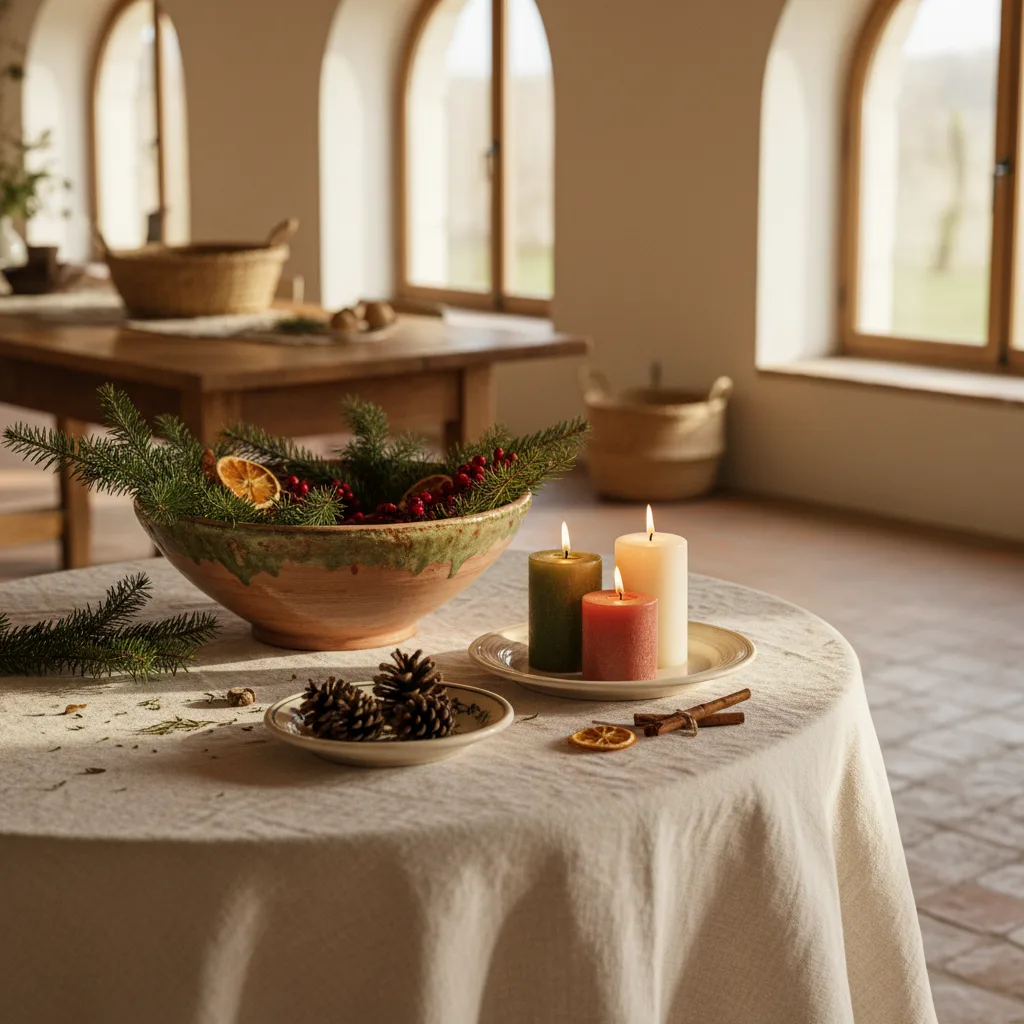
Why an Italian Christmas feels different at the table
Before getting into the specific ideas, it's worth understanding what gives an Italian Christmas table that certain something. It's not a question of money or the number of decorations. It's a philosophy: the table is the setting for the gathering, not the star. The star is whoever sits down.
In the Italian tradition, the centerpiece exists to bring warmth and a focal point, but never to stop people from seeing your face from across the table. The pieces are usually low or medium in height, the materials have real weight —ceramic, glass, wood— and the colors are limited to two or three shades that converse with the tableware. No Christmas rainbow.
This restraint isn't austerity. It's judgement. And it's exactly what turns a table laden with dishes into a table you actually want to sit at.
Idea 1 · Ceramic bowl with natural greenery and pinecones
The simplest option, and the one that works best when you don't want to overthink it. A wide, low ceramic bowl —centerpiece or large salad-bowl style— becomes the base for everything. Inside: fresh fir or eucalyptus branches, three or four pinecones and, if you like, a few sprigs of red berries.
The trick is in the bowl. If it's textured artisan ceramic, in an earthy tone or off-white, the result is immediate: the greenery contrasts with the surface of the bowl and the whole composition looks intentional without any effort. Avoid plain plastic bowls or shiny metallic ones. Ceramic brings a visual weight that anchors the whole thing.
This idea works especially well on rectangular tables, where the bowl can be placed slightly off-centre, flanked by a couple of candles. If you're unsure about proportions, take a look at the rule of 3 for centerpieces — it'll save you the classic mistake of choosing a centerpiece that's too tall for the table.
Idea 2 · Decorative tray as the base of a composition
In Italy, a tray isn't just for serving. It's a decorating device that visually organises any composition. A decorative ceramic or wooden tray, placed in the centre of the table, lets you group several elements without them looking messy: a thick candle, a sprig of rosemary, a pinecone, a couple of understated baubles.
The practical advantage is obvious: when it's time to serve the first course, you lift the whole tray and set it down on the counter. You don't have to remove loose pieces one by one. After dinner, you put it back. This, which seems like a minor detail, is what separates pretty decoration from decoration that genuinely lives alongside the meal.
decorative Italian ceramic tray
If you'd like to dig deeper into what a good tray can do, in decorative trays: 5 uses you hadn't thought of you'll find ideas that go far beyond Christmas.
Idea 3 · A trio of candles with glass or ceramic holders
Candles are the soul of any Christmas table, but the difference between a table with generic candles and a table with well-presented candles is enormous. The key isn't the candle itself, but the holder.
Three clear glass or neutral-toned ceramic candle holders, placed in a line or an asymmetric triangle, create a point of light that transforms the atmosphere without anything else. The candles can be white, ivory or honey-toned. Forget scented candles for the dinner table: the aroma competes with the food and, at an Italian dinner where the dishes matter, that's a mistake.
The height of the candles matters. At tables where there's conversation (that is, all the ones worth having), the candles should sit below eye level when you're seated, or else be tall and slim enough for the flame to rise above everyone's heads. The middle ground —candles at face height— dazzles and gets in the way.
Idea 4 · Low centerpiece with seasonal fruit
This is an idea that comes straight from the Italian table tradition and that almost no one recreates outside Italy. A low ceramic fruit bowl or centerpiece, with real seasonal fruit: mandarins with their leaves, halved pomegranates, muscat grapes. No plastic or imitation fruit.
The result is surprisingly elegant. The orange of the mandarins, the deep red of the pomegranate and the dark green of the leaves create a natural Christmas palette that needs no glitter or added decorations. What's more, the fruit can be eaten during the after-dinner chat, which connects the decoration with the table's purpose: to feed and to share.
If you have a decorative ceramic fruit bowl, this is its moment to shine. And if you're torn between a fruit bowl and a tray, this comparison will help you decide.
Idea 5 · Low vase with cotton branches and eucalyptus
Dried cotton and preserved eucalyptus are two elements that work on their own, but together they create a Christmas centerpiece with a warmth that's hard to match. The texture of the cotton brings softness and a wintry touch without resorting to artificial snow, and the eucalyptus adds that greyish green that goes with any palette.
The ideal container is a low, wide-mouthed ceramic vase —not a tall, narrow-necked vase, which would throw the proportions off. If the vase has a matte finish in white, cream or stone grey, the whole thing conveys serenity. This composition has an added advantage: it lasts all of December with no need for water or maintenance. You set it up at the start of the month and it holds until Epiphany without losing an ounce of presence.
For more ideas on how to use vases in décor without relying on fresh flowers, decorative vases without flowers: the 2026 trend is a read that fits perfectly.
Idea 6 · Table runner with scattered pieces
On long Italian tables —those solid wood tables with room for grandparents, cousins and neighbours— the centerpiece isn't a single object, but a composition that runs the length of the table. A natural linen runner as the base, and on top of it, a sequence of elements arranged with apparent casualness: a candle holder here, a pinecone there, a sprig of fir, a small bowl of olives or nuts.
This idea is perfect if your table is rectangular and relatively long. The key is for the elements to share a colour palette (no more than three tones) and to leave enough space between them so the table can breathe. If everything is crammed together, the effect is lost. If there's too much distance, it looks as if you forgot to decorate.
It's probably the most Italian option of all: generous hospitality but without artifice. A table that says «there's room for everyone here» without needing a sign.
Idea 7 · Centerpiece with a low candelabra and greenery
A candelabra doesn't have to be that ornate object you associate with castles or period dramas. A low ceramic or iron candelabra with a matte finish, for two or three candles, surrounded by a light wreath of natural greenery (fir, rosemary, bay), is one of the most photogenic centerpieces you can put together, and one of the easiest to maintain.
The secret is restraint. The candelabra is the structure, the greenery is the dress, and the candles are the light. Nothing more. If you feel the urge to add baubles, bows or figurines, resist it. The beauty of this composition lies in its simplicity, and every extra element takes away rather than adds.
This option works just as well on round tables as on rectangular ones. If you're not sure which table shape most influences the choice of centerpiece, this article on round vs rectangular tables clears up the doubts.
Idea 8 · The single piece that needs no accompaniment
Sometimes, the best Christmas centerpiece is a single piece with enough presence that it needs nothing around it. An Italian ceramic centerpiece with relief, a sculptural bowl, a thick glass vase with a single fir branch. A piece with its own character that converses with the tableware and with the candlelight you already have spread across the table.
This option is the most minimalist and, paradoxically, the one that requires the most judgement. Because when there's only one object, that object has to be good. Not just any bowl will do: it has to have proportion, texture, a finish that invites you to touch it. It's the difference between a centerpiece that goes unnoticed and one that prompts a genuine «where's this from?».
If this approach appeals to you, how to choose the perfect centerpiece for your dining room gives you the keys to getting that single piece right —the one that becomes the anchor of the whole table.
Quick checklist: your Christmas centerpiece with Italian judgement
Before you set anything up, run through this list. If you tick at least five of these points, your table is going to have that something you're after.
| Criterion | ✓ / ✗ |
|---|---|
| The central piece is ceramic, glass or wood (a material with real weight) | |
| It doesn't exceed 25-30 cm in height (or the candles sit above eye level) | |
| You use a maximum of 3 colour shades | |
| There's at least one natural element (greenery, pinecone, fruit, branch) | |
| The centerpiece can be removed easily when the food arrives | |
| It doesn't compete with the dishes for attention | |
| The composition leaves room for glasses, bread and bottles | |
| You've resisted the temptation to overdo it: less is more |
What to avoid in a Christmas centerpiece (the most common mistakes)
Just as important as knowing what to put on the table is knowing what to leave off. These are the mistakes that the SERPs, the magazines and experience all agree on:
Centerpieces that are too tall. If your guests have to lean around to see each other, the centerpiece has failed at its basic job. The table is for conversation, not for hide-and-seek.
Too much shine. A single gold bauble can be elegant. Twelve gold baubles, three sparkly garlands and a glitter-covered candle holder are a bazaar window display. Shine works in homeopathic doses.
Scented candles. We've said it already, but it's worth repeating. At a table where people are going to eat, the only fragrance should be that of the food. Save scented candles for the living room after dinner.
Elements that fall apart. Artificial snow, confetti, loose glitter… It all ends up on the plates, in the glasses and on people's clothes. Unless you want to spend Christmas Eve with a vacuum cleaner, avoid it.
For more table mistakes in special settings, 5 mistakes when setting the table for a special dinner expands on the topic beyond Christmas.
Pieces that complement the centerpiece to round out a coherent Italian Christmas table.
Frequently asked questions about Christmas centerpieces
How tall should a Christmas centerpiece be so it doesn't get in the way? The general rule is that it shouldn't exceed 25-30 cm in height if it includes opaque elements (bowls, pinecones, dense branches). Tall, slim candles are the exception because the flame sits above eye level and the body of the candle is slender enough not to block the view.
Can you make a Christmas centerpiece with pieces you already have at home? Absolutely. A ceramic bowl you use every day, a low vase from the living room, candle holders you already own… Christmas doesn't require buying specific pieces. What makes it special is how you combine what you have with seasonal elements: natural greenery, candles, fruit. A good ceramic piece is versatile all year round.
Which colors work best for an elegant Christmas table? Warm neutral tones (off-white, cream, stone grey) combined with natural greenery and a single accent color —deep red, matte gold, mandarin orange— give an effortlessly sophisticated result. Avoid more than three main shades: chromatic coherence is what separates an elegant table from a chaotic one.
How do you keep natural branches fresh throughout Christmas? Fir and preserved eucalyptus hold up well for two or three weeks without water. If you use freshly cut branches, mist them with a spray bottle every couple of days and keep them away from direct heat sources (radiators, fireplaces). Dried cotton branches and pinecones need no maintenance at all.
Is it better to have a single centerpiece or several elements spread out? It depends on the shape of your table. On round or square tables, a single centerpiece works best because the focal point is natural. On long rectangular tables, a composition spread along the table runner creates more dynamism. What matters is that there's coherence of style and palette across all the elements.