Minimalist vs maximalist table centerpiece: which is your style
You're looking for an original table centerpiece and end up caught between two worlds. On one hand, Pinterest shows you uncluttered tables with a single perfect vase. On the other, Instagram fills your feed with overflowing compositions of flowers, candles, ceramic and fruit piled up as if the table were a Renaissance still life. Minimalism versus maximalism. Less is more versus more is more. And you, in the middle, not knowing which of the two fits your real dining room —the one with crumbs at three in the afternoon and where the kids do their homework.
The good news: you don't have to pick a side. But you do need to understand what lies behind each style in order to make conscious decisions instead of copying photos that work in homes that aren't yours.
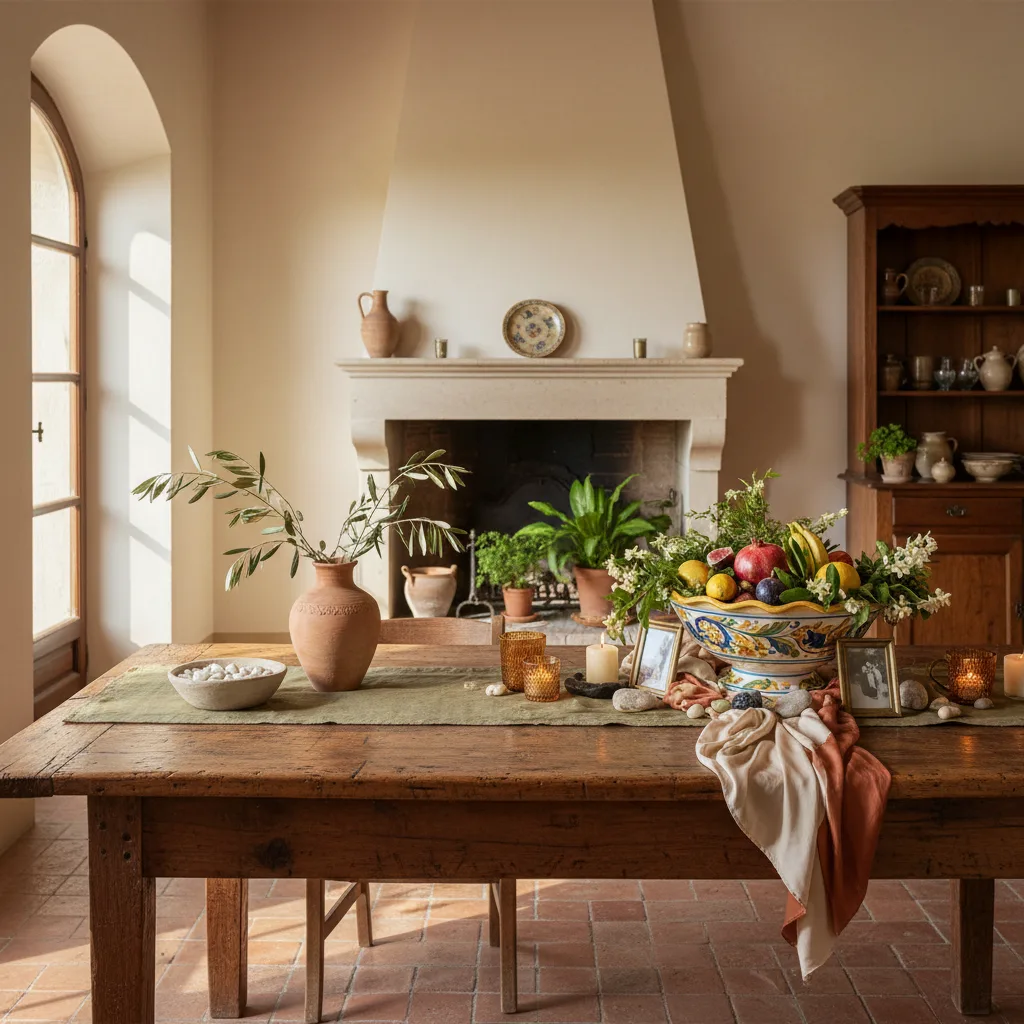
What a minimalist centerpiece really means
Minimalism applied to the table isn't putting out fewer things out of laziness. It's a conscious aesthetic decision: every piece you place has a reason to be there and none is superfluous. Empty space isn't absence, it's part of the composition. And that requires, paradoxically, more judgment than filling the table with objects.
A minimalist centerpiece works with one or two quality pieces: a ceramic vase with a single branch, a bowl with an interesting finish that works when empty, a thick candle on a flat plate. The colors are neutral or tonal —whites, creams, soft grays, muted terracotta—, and the materials speak for themselves: matte ceramic, blown glass, unvarnished wood, natural stone.
The trap of minimalism on the table is that any mediocre piece is left exposed. There aren't five objects competing for attention: there are one or two, and if they're generic or poor quality, it shows instantly. That's why true minimalism isn't the cheapest style, but the one that demands the most of each individual piece. An Italian ceramic centerpiece with handcrafted texture and an organic shape holds the spotlight on its own. A smooth, mass-produced bowl does not.
What a maximalist centerpiece really means
Maximalism isn't mess. That's the most common confusion and the one that ruins the most tables. A maximalist centerpiece is an abundant but intentional composition, where the objects converse with each other: they complement one another in color, texture and height. There are layers, there is density, there is visual generosity. But there is logic.
Think of an Italian Sunday table: an overflowing ceramic fruit bowl, a pair of lit candles, a bunch of market flowers stuffed into a vase with no formal arrangement, a small bowl of olives. There's no decorator behind it, but there is a tradition of abundance that works because everything on the table has life and use. Maximalism isn't assembled, it's accumulated with purpose.
In practical terms, maximalism on the table works with groupings: several objects of different heights gathered in a defined area, usually on a tray or a table runner that acts as a stage. The colors can be bold —intense greens, terracottas, burgundies, deep blue—, the textures mix freely and the materials coexist: ceramic with glass, metal with wood, linen with velvet. The result is a table that looks lived-in, generous, full of personality.
The trap of maximalism is chaos. Without an axis to organize the composition —a color that repeats, a line of heights that rises and falls, a dominant material—, the table goes from abundant to disordered. Maximalism needs editing just as much as minimalism needs quality.
The table that clears it up: minimalism vs maximalism on the table
Before deciding, it helps to see the differences side by side. Not to choose one and discard the other, but to understand what each approach asks for.
| Aspect | Minimalist | Maximalist |
|---|---|---|
| Number of pieces | 1-3, with space between them | 4-8, grouped with intention |
| Color palette | Neutrals, tonal, monochromatic | Contrasts, warm or saturated colors |
| Materials | Matte ceramic, glass, stone, wood | Free mix: ceramic, metal, textile, glass |
| Height of the pieces | Low or medium, uniform | Varied, with play of levels |
| Empty space | A protagonist, part of the design | Reduced, density is part of the appeal |
| Maintenance | Low (fewer pieces to clean/move) | Medium-high (more objects, more dust, more managing) |
| Main risk | Looking cold or empty | Looking messy or overloaded |
| Best for | Small tables, daily use, Nordic dining rooms | Large tables, special dinners, Mediterranean dining rooms |
| Investment | Few pieces, but of high quality | More pieces, medium-high quality spread out |
How to know which one fits you (without a personality quiz)
Articles about decorating styles tend to drift into magazine-style quizzes: "If you prefer A, you're a minimalist; if you prefer B, a maximalist." Reality is more nuanced. Your table style depends on concrete factors you can assess right now.
The size of your table rules
An 80 cm wide table can't take a maximalist centerpiece without the diners feeling crowded. The centerpiece —whatever the style— shouldn't take up more than a third of the width. On small tables, minimalism isn't an aesthetic preference: it's a functional necessity. On large tables of 120 cm or more, minimalism can work, but it can also leave the table looking empty if the chosen piece doesn't have enough presence.
If you have a round table, the center is the natural focal point and accommodates more generous compositions. If it's rectangular and long, a single centered piece gets lost: you need repetition (serial minimalism) or grouping (contained maximalism).
Your daily routine matters more than your taste
You love the idea of a maximalist table with six perfectly placed pieces. But you eat breakfast in fifteen minutes, you have lunch out three days a week and you dine in front of the TV. Are you really going to set up and take down that composition every day? The style you choose has to survive your real life, not just the Sunday photo.
If your table is in heavy use, a centerpiece you can clear away in a single gesture —a bowl, a tray— is more honest than an elaborate composition that ends up permanently shoved into one corner. If you have a more ceremonial table that's only used for dinners with guests, you can afford the maximalist production because you're not going to dismantle it every morning.
The style of your dining room already has an opinion
It's not about everything matching to the millimeter, but a Nordic dining room with straight-lined furniture and light colors naturally calls for a restrained centerpiece. A Mediterranean dining room with solid wood, warm colors and generous textiles feels incomplete with a single white vase in the center. The space already suggests the volume; you just have to listen.
The third way: the balance nobody names
Most real dining rooms are neither purely minimalist nor purely maximalist. They're something in between that has no glamorous name but works. A mixed approach that starts from a clean base —few objects, well chosen— and adds layers depending on the occasion.
In practice, this means having a permanent base piece —a ceramic bowl, a tray, a fruit bowl with character— and adding seasonal or occasion-based elements around it. During the week, the bowl with a few oranges. On the Saturday friends come over for dinner, the bowl plus candles, plus a short bunch of market flowers. Christmas: the bowl fills with pinecones and a candelabra is added. The base is minimalist; the layers are maximalist. And the transition is natural.
This approach has an advantage that neither extreme offers: flexibility. You don't need to redesign your table every season nor settle for the same composition all year. The base piece is the smart investment —that's where it's worth choosing quality Italian ceramic, something with texture and presence that works alone and with company—, and everything else is added or removed depending on the moment.
If you'd like to dig deeper into what exactly to put out, the guide on what to use as a centerpiece develops the options by type of object with real judgment.
Mistakes that recur in both styles
Neither minimalism nor maximalism is immune to bad results. These are the most common slip-ups, regardless of the side you choose.
In minimalism
Confusing minimalism with emptiness. A table with nothing on it isn't minimalist, it's an undecorated table. Minimalism needs at least one piece with enough presence to anchor the gaze. If your centerpiece goes unnoticed, it isn't discreet: it's irrelevant.
Choosing generic pieces. With just one object on the table, quality is left exposed. A mass-produced vase with no texture or personality doesn't convey "less is more"; it conveys "I didn't put any time into this." The difference between a minimalist centerpiece that works and one that doesn't usually lies in the piece, not the idea.
In maximalism
Not defining a point of connection. Five objects with nothing in common —no color, no material, no scale— aren't maximalism, they're a jumble. Every maximalist composition needs at least one common thread: a tone that repeats, a dominant material, a tray that groups everything. Without that axis, abundance loses its meaning.
Filling for the sake of filling. There's a difference between a generous table and a table where the plates don't fit. If diners have to push aside decorative pieces in order to eat, you've crossed the line. Maximalism on the table has a physical limit that maximalism on a shelf doesn't: people need to eat there.
For a more complete list of common slip-ups, the article on mistakes when choosing a centerpiece reviews the most frequent ones with concrete solutions.
Key pieces according to your style
You don't need an endless list of products. You need to know what type of piece solves each style and why.
If you go the minimalist route, invest in a single ceramic piece with interesting texture and shape. A low centerpiece with an irregular glaze, a vase with clean lines but with presence, a bowl with the warmth of something handmade. Make it work when empty. Make it so it needs nothing else to justify its place on the table.
If you prefer maximalism, start with a tray or large plate as a base, and build from there. You need at least three different heights in your composition: something low (bowl, plate), something medium (candle, small vase) and something tall (candelabra, vase with branches). Decorative trays are the best-kept secret of orderly maximalism.
If you're after balance, the base piece is the central investment. An Italian ceramic bowl that works alone during the week and as the anchor of a larger composition on the weekend. The rest —candles, flowers, seasonal elements— are rotating accents that don't need to be expensive or permanent.
Accents for building both minimalist and maximalist compositions
Frequently asked questions
Does a minimalist centerpiece look good on a large table? It can, but the piece needs enough presence not to get lost. A 15 cm vase on a 2-meter table looks insignificant. If you go for minimalism on a large table, choose a piece of generous scale (30-40 cm in diameter) or repeat the same element two or three times along the table to create rhythm without overloading.
Can you mix minimalist and maximalist elements? It's what most people do in practice, even if they don't put a name to it. A restrained base —a single material, neutral colors— combined with touches of abundance —fresh flowers, seasonal fruit, the odd candle— is a balance that works in almost any dining room without forcing a pure style.
Which style is better for everyday tables? Minimalism or the mixed approach. A centerpiece you can clear away in a single gesture to set the plates, that requires no constant maintenance and that won't be damaged by daily use. The proportion and height rule helps you get the measurements right.
Does maximalism work all year round or only for special occasions? It works all year round if you know how to edit it. Summer maximalism is not winter maximalism: the materials, colors and natural elements change with the season. What stays is the structure of the composition —the base tray, the heights, the grouping— and what rotates is the content.
Which material is best for a versatile centerpiece? Ceramic, without a doubt. It's the material that moves best between both styles: a handcrafted ceramic piece works as a lone protagonist (minimalism) and as the anchor of a larger composition (maximalism). It's durable, never goes out of fashion and gains character over time. Caring for ceramic is minimal if you choose quality pieces.
Related articles: