Table centrepiece with flowers and candles: step-by-step guide
A good table centrepiece with flowers and candles turns any dinner into something memorable. You don't need to be a florist or spend a fortune: it's enough to understand proportions, choose the right materials and follow a logical order. The problem is that most tutorials stop at the obvious — pretty flowers, lit candles, a photo for Pinterest — without explaining why some arrangements work while others end up looking like the display window of a craft shop.
This guide takes you from choosing the base to the final assembly, with principles you can adapt to a dinner with friends, an anniversary or a Christmas table. No shortcuts or magic recipes: step by step, and with purpose.
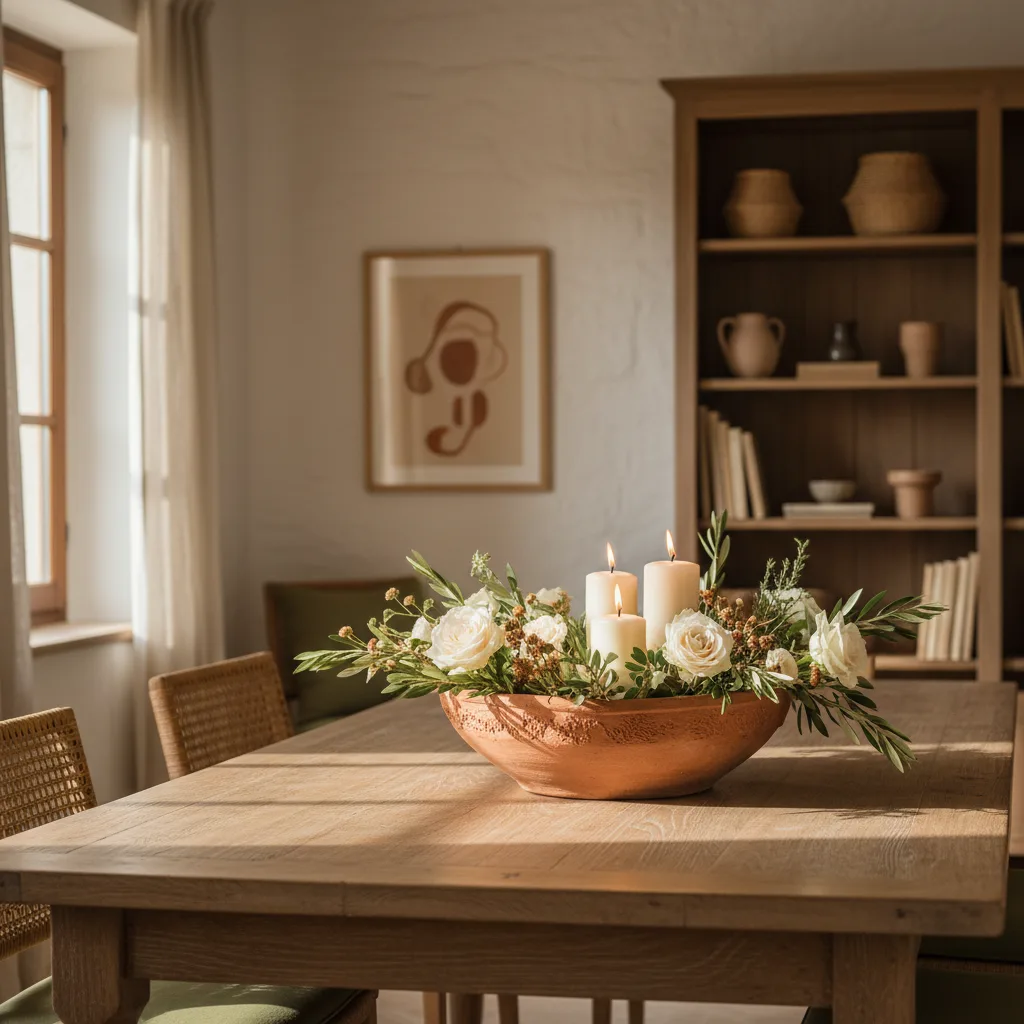
What you need before you start: materials and base
Before you touch a single flower, you need to define the centrepiece's base. The base is no minor detail: it sets the entire style. A low ceramic bowl will give a very different result from a long tray or a clear glass vase.
Essential materials
| Element | Function | Recommended options |
|---|---|---|
| Base/container | Structure and style | Ceramic bowl, decorative tray, low glass vase |
| Flowers | Volume, colour, life | Fresh seasonal, dried (baby's breath, lavender), green branches |
| Candles | Warm light, atmosphere | Pillar candles (thick), floating, tealights in holders |
| Filler elements | Texture and support | River stones, moss, wet floral foam |
| Optional extras | Personality | Jute twine, seasonal fruit, olive branches |
The key is not to buy everything at once without a plan. First define the style — rustic, minimalist, Mediterranean — and then choose materials that belong to the same visual family. A bowl of Italian ceramic with clean lines calls for simple flowers and unadorned candles. A vintage wooden tray takes more layers and textures.
Step by step: building the table centrepiece
This is where most people dive in without a method and end up with something messy. Follow this sequence and the result will have visual coherence from the very first attempt.
Step 1 — Choose and prepare the base
Place the base in the centre of the table and check that it doesn't exceed a third of the total width. A 90 cm wide table needs a centrepiece no more than 30 cm in diameter. If you're using floral foam, cut it to fit inside the container and soak it for at least 20 minutes.
Step 2 — Place the candles first
Candles are the most rigid element: you can't move them once the arrangement is built without taking everything else apart. Set the main candle (the tallest) slightly off-centre — not right in the geometric middle — and the secondary ones (lower) to create a visual triangle. The difference in heights creates depth.
Step 3 — Add the structural greenery
Before the coloured flowers, place green branches or foliage to create the overall silhouette. Eucalyptus, rosemary, olive or fern are options that add volume without competing with the main flowers. Insert the stems at an angle, not vertically, so the arrangement opens out naturally to the sides.
Step 4 — Add the main flowers
Now for the coloured flowers. Cut the stems to different heights (the rule of 3 for table centrepieces works perfectly here). Place them grouped by type, not scattered randomly. Three roses together have more impact than three roses spread across the arrangement. Work in odd numbers: 3, 5 or 7 stems per group.
Step 5 — Fill gaps and finish
Review the arrangement from the eye level of someone seated — which is how your guests will see it. Fill gaps with smaller flowers (baby's breath, wild chamomile) or textural elements like moss or stones. Make sure the candles remain accessible so you can light them without burning your fingers among the branches.
Proportions that work (and the ones that don't)
The most common mistake isn't choosing the wrong flowers: it's ignoring proportions. A centrepiece that blocks the view between diners, or that looks tiny and lost on a large table, fails to do its job, however beautiful the individual pieces may be.
The maximum height of a centrepiece for a dinner should sit below the seated eye line — around 30-35 cm at most. For a buffet table or sideboard where no one sits opposite, you can go up to 50-60 cm with no problem.
In terms of width, the complete arrangement (base + flowers that extend out) shouldn't exceed a third of the table's width. This leaves enough room for plates, glasses and for guests to pass the serving dish without going around an obstacle. If your table is long and rectangular, consider an elongated centrepiece or several small focal points instead of a single imposing piece in the middle.
The relationship between the size of the candles and the flowers also matters. Candles that are too tall with low flowers create an unnatural "chimney" effect. Aim for the top of the main flowers to sit at the same height as, or slightly above, the flame of the tallest candles.
Variations by season and occasion
There's no single type of table centrepiece with flowers and candles. The same principle adapts to very different contexts if you change the materials and the palette.
Spring-summer
Fresh seasonal flowers: peonies, ranunculus, wild daisies. Soft or vivid colours depending on the tone of the dinner. White or off-white candles. A transparent base (glass) so the stem is visible, or a table centrepiece with Mediterranean lines in neutral tones. Fresh greenery (eucalyptus, mint) adds visual freshness.
Autumn-winter
Dried flowers, cotton branches, preserved magnolia leaves. Warm colours: terracotta, burgundy, mustard. Thick candles in amber or terracotta tones. A ceramic base in earthy tones. You can add pine cones, cinnamon sticks or nuts without slipping into explicit Christmas décor.
Romantic dinner
Less is more. One or two thick pillar candles, loose petals around the base, two or three long stems in a slim vase. A palette limited to two colours at most. The table for a special dinner needs open space so the arrangement can breathe.
Celebration or wedding
Here you can turn up the density: more flowers, more candles (tealights scattered around), more layers. If you have the budget, repeat the same design in miniature as an individual centrepiece for each table. Consistency across all the tables matters more than the spectacle of a single one. For elegant wedding table centrepieces, the key is repetition with subtle variations.
Mistakes that ruin the result
After seeing hundreds of table centrepieces (good and not so good), these are the slip-ups that come up again and again:
-
Mixing too many styles in the same arrangement. A rustic beeswax candle doesn't sit well with an ultra-modern chrome vase. Choose one line and stick to it.
-
Ignoring the smell. Intense scented candles next to fresh flowers create an olfactory mix that can be unpleasant during the meal. Use unscented candles, or ones with a very mild fragrance, if the flowers already have a scent of their own.
-
Not thinking about safety. Dried flowers near a real flame are a risk. Always keep a minimum of 10 cm between any flammable material and the wick. LED candles are an honest alternative — good-quality ones with a warm flicker create a very similar effect.
-
Overloading. If you can't see the person opposite, or if there's no room left for the plates, the centrepiece has stopped being décor and become an obstacle. Fewer pieces, well chosen, always beat a thoughtless pile-up.
-
Forgetting maintenance. Fresh flowers need clean water every day. If you set up the centrepiece the night before the dinner, check that the stems haven't dehydrated. An arrangement with wilted flowers conveys the opposite of what you're after.
If you want to go deeper into what to put as a table centrepiece beyond the classic flowers-and-candles combination, that guide gives you options without the usual clichés.
Dried vs fresh flowers: when to use each
The trend for dried flowers isn't a whim: they have real advantages for permanent table centrepieces. They don't need water, they don't wilt before the dinner and they last months without losing their shape. Baby's breath, dried lavender, thistles, craspedia (yellow billy balls) and cotton branches are the most versatile.
But they don't suit every occasion. For a special dinner where you want freshness and a subtle scent — freshly cut peonies, garden roses, jasmine — nothing replaces a fresh flower. The investment is greater and the lifespan short, but the sensory impact is unmatched.
An intermediate option that works very well: a base of dried or preserved foliage (preserved eucalyptus, for example) combined with three or four fresh seasonal stems that you refresh each week. That way you keep the structure and only change the accent of colour. The decorative bowl as a permanent base handles the structural part, and you just add the living element.
How to adapt the centrepiece to the type of table
A round table is not the same as a rectangular one, and the centrepiece should respond to that geometry. On a round table, the centrepiece works as a single focal point: a circular or spherical arrangement, visible equally from all angles. On a long rectangular table, a single centrepiece leaves the ends orphaned — better to use a runner of elements (several points of candles and flowers distributed along the length) or an elongated horizontal arrangement.
For small tables (four diners), a single element of modest diameter is enough. For tables of eight or more, consider dividing the arrangement into two or three cores connected visually by loose tealights between them.
Extras that complete the table set around your flower and candle centrepiece
Frequently asked questions
Which type of candles is safest for a table centrepiece with flowers? Thick pillar candles (column type) are the most stable and the least risky, because the wick stays protected by the wax itself as it burns down. If you'd rather eliminate any risk altogether, LED candles with a warm flicker offer a very convincing visual effect and are ideal if there are dried flowers or children at the table.
How long do fresh flowers last in a table centrepiece? It depends on the type of flower and the room temperature, but under normal conditions (a cool interior, clean water) you can expect between 4 and 7 days. Cut the stems on a diagonal before arranging them and change the water every two days to maximise their lifespan.
Can you make a table centrepiece with flowers and candles without floral foam? Yes. You can use river stones or decorative gravel in the bottom of the container to hold the stems in place, or a grid made with clear adhesive tape across the mouth of the vase. Floral foam is practical but not essential, and some people avoid it for sustainability reasons.
Which flowers work best with lit candles? Fresh flowers with firm stems and petals that don't dehydrate quickly: roses, carnations, chrysanthemums, succulents. Avoid very delicate flowers (poppies, cosmos) that drop petals in the rising heat of the candles. Dried flowers should always be kept a safe distance from the flame.
Can I reuse the centrepiece base for different occasions? That's precisely the advantage of investing in a good base. A quality ceramic bowl or tray works as a permanent canvas: you change the flowers and candles with the season or the event, but the centre piece stays. It's the logic of buying less but better.