Tablescaping: the new trend and how to apply it at home
If you've been searching for table décor ideas for your living room for a while and feel that everything you find is either too cold (a Swedish furniture catalogue) or too over-the-top (an American magazine wedding), you're probably missing a concept that ties it all together: tablescaping. It's the word English speakers use for something Italians have been doing all their lives without giving it a name: turning the table into a landscape, into a scene that says something about you and about how you welcome the people you love.
It's not an influencer invention. It doesn't require an outrageous budget. And, above all, it isn't about replicating a Pinterest photo piece by piece. Tablescaping is a method — with clear principles and plenty of room for your personality — that turns any meal into a visual and emotional experience.
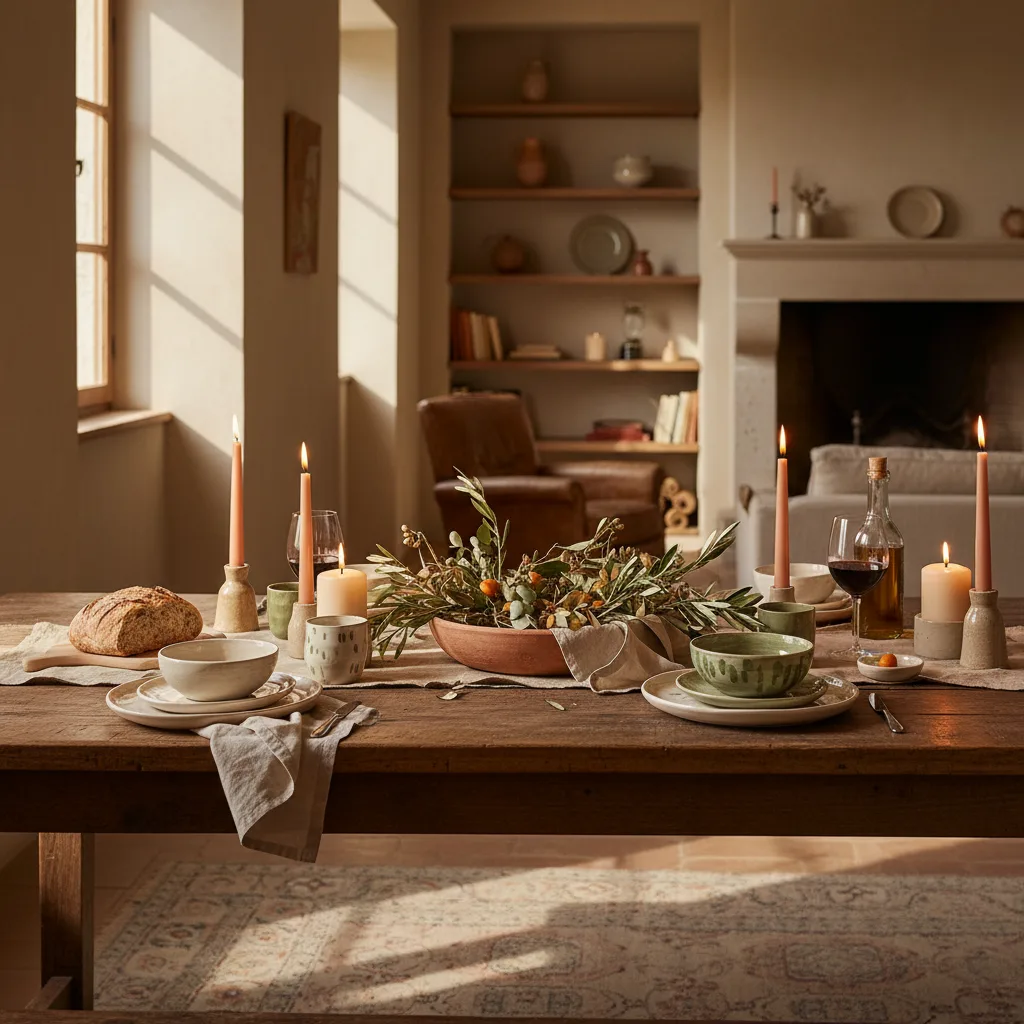
What tablescaping is (and what it isn't)
The word comes from fusing table and landscape. Literally: creating a landscape on the table. But that literal translation falls short. Tablescaping is the art of composing the table by combining tableware, glassware, textiles, lighting and decorative details to create a coherent experience — an atmosphere that says something before the first course even arrives.
The difference from classic table setting is important. Table setting is based on protocol: where the fork goes, how many glasses, how far from the edge. It has fixed rules and a functional purpose. Tablescaping starts from those rules but uses them as a structure, not a corset. It adds narrative, colour, texture and personality. It's the difference between setting the table correctly and setting the table with intention.
What tablescaping is not: a contest of accumulation. The most striking tables on social media aren't always the most successful in person. A table where there's no room for elbows, where the flowers hide your companion's face, or where there are so many layers that no one knows which plate to use, is not tablescaping. It's a photo prop. And that's exactly what we want to avoid here.
Why tablescaping has moved from Instagram to real life
Five years ago, tablescaping was almost exclusively the territory of wedding planners and décor accounts with thousands of followers. The tables that were shared were spectacular but impossible to replicate: hundreds of fresh flowers, rented tableware, professional lighting. Lovely to look at, impossible to live with.
What has changed is the approach. The 2026 trend isn't about staging a photo shoot every time you have dinner. It's about applying principles of visual composition to everyday life with the pieces you already have — or with a few well-chosen additions. Tablescaping has been democratised because people have understood that they don't need thirty David Austin roses for their table to have character. Sometimes all it takes is a linen tablecloth, three candles of different heights and a ceramic bowl with seasonal fruit.
There are several factors behind this evolution. The first is cultural: after the pandemic, hosting at home stopped being a social obligation and became something people want to do well. The second is aesthetic: platforms like Pinterest and Instagram have trained the collective eye, and now many homes aspire to a table that feels cared for without being pretentious. The third is practical: Italian design brands like Brandani have brought pieces with character to accessible prices, making the barrier to entry much lower than it was a decade ago.
The five principles of tablescaping that really work
I'm not going to give you a list of "buy this and that". Tablescaping doesn't work like that. What does work is internalising five principles you can apply with any budget, any style and any table size.
Define a starting point (not a theme)
The most common beginner's mistake is wanting to "set a themed table": the Provençal table, the Japanese table, the rustic table. That usually ends up looking like a costume. Instead of a theme, choose a starting point: a colour, a piece you love, a feeling. It could be the sage green of a ceramic bowl you bought on holiday. Or the texture of a linen napkin you inherited. Or simply the idea of "I want this dinner to feel warm". That starting point is your compass — everything else is built in keeping with it, without every element having to shout the same story.
Work in layers (layering)
This is the technical heart of tablescaping. A table with personality is built in successive layers, each one adding texture, colour or function. The logical order is this:
| Layer | Function | Example |
|---|---|---|
| Textile base | Provides background colour and texture | Linen tablecloth, table runner, placemats |
| Base tableware | Functional structure of the table | Charger plate + dinner plate + soup plate if needed |
| Glassware | Transparency and verticality | Wine glasses, water glasses, even carafes |
| Detail textile | A touch of colour and personal feel | Cloth napkins with a ring or tied with twine |
| Centrepiece and lighting | Visual focus and atmosphere | Low centrepiece, candles of different heights |
| Final details | Personality and finishing touch | A sprig of rosemary, a name card, loose fruit |
The key to layering isn't to add more, but for each layer to bring something different. If the tablecloth already provides colour, the tableware can be neutral. If the tableware is the star, the centrepiece steps into the background. It's a conversation between elements, not a monologue.
Control the heights
A flat table is a boring table. Tablescaping plays with different heights to create visual rhythm: tall candles in the centre, low bowls at the sides, glasses that add verticality, a candelabra that marks a focal point. The practical rule is that no element in the centre should exceed 30–35 cm if you want diners to see each other's faces while talking. Anything that adds height should be transparent (crystal, glass) or narrow enough not to block the line of sight.
Limit the colour palette
Three colours maximum. That's the rule that separates an elegant table from one that looks like a bazaar. Choose a dominant tone (the one that covers the most surface — usually the base textile), a secondary tone (tableware or napkins) and an accent (flowers, coloured candles, a ceramic detail). If your tablecloth is natural, your tableware white and your accent terracotta, you have an impeccable Mediterranean palette without ever consulting a Pantone chart.
The 2026 trend points to natural palettes — sage greens, warm beiges, terracotta, off-whites — with occasional accents in livelier tones like cobalt blue or burgundy. Nothing garish, everything organic.
Don't forget the senses you can't see
Tablescaping isn't only visual. A well-composed table also takes into account touch (the texture of linen, the weight of ceramic in your hand) and smell (gentle scented candles, fresh herbs in the centre). Sound matters less, but the absence of music isn't neutral either: the clink of crystal glasses and flowing conversation are part of the sensory experience of a cared-for table.
A tip that comes straight from Italian tradition: if you use scented candles, keep them gentle and make sure they don't compete with the aroma of the food. Rosemary, citrus, wood — scents that accompany without imposing. Avoid candles with sweet or intense fragrances near the food.
How to apply tablescaping to a weeknight dinner (without losing two hours)
This is where theory meets reality. Because setting a spectacular table for twelve guests on a Saturday is one thing, and elevating a Tuesday night when you come home tired from work and are about to have dinner with your partner or family is quite another.
The express version of tablescaping works with three moves:
First move: the base. Swap the oilcloth or the plastic placemat for a cloth one. A linen table runner already folded in a drawer transforms the visual perception in five seconds. No need to iron — the soft creases of linen are part of its charm.
Second move: tableware with intention. Don't eat off the first plate you pull from the cupboard. If you have ceramic pieces with personality — a bowl with an irregular glaze, a plate with a textured rim — use them daily, don't save them for "when guests come". Italian ceramic tableware was designed to be used, not to wait behind a display cabinet.
Third move: a simple centrepiece. A lit candle. A small bowl with three lemons. A sprig of eucalyptus in a slim vase. You don't need a floral arrangement — you need a focal point that says "this table has been cared for".
Three moves, five minutes. And the difference between eating and dining.
Tablescaping the Italian way: what changes when you apply the Mediterranean filter
The tablescaping you see on American or Nordic accounts tends towards millimetre-perfect precision. Everything is measured, everything matches, everything is calculated. It's beautiful, but it often feels cold — like an exhibition table where no one dares to rest an elbow.
The Italian version of tablescaping — the one we at Vita Italian Living find most honest — works the other way around. It treats imperfection as a value. The handmade ceramic plate whose glaze has a variation in tone. The linen tablecloth that hangs slightly askew. The fruit that isn't symmetrically arranged in the fruit bowl. That imperfection isn't carelessness, it's life. It's the sign that this table is used, enjoyed, lived in.
Italians have been practising tablescaping for centuries without calling it that. When a nonna in Le Marche sets the table for Sunday with the lifelong tablecloth, the Deruta ceramic plates and a bunch of rosemary from the garden, she's doing tablescaping. She just doesn't add a hashtag.
What you can import from that tradition into your living room:
- Natural materials always: ceramic, linen, wood, glass. Synthetic materials break the magic no matter how well they imitate.
- Fewer pieces, more character: a single well-chosen ceramic vase is worth more than five decorative objects with no story.
- Food as decoration: in Italy, the dish of pasta, the bread on an olive-wood board, the fruit in a ceramic bowl are part of the table landscape, not something hidden away until it's time to serve.
- Generosity without excess: the Italian table invites you to sit because it has space, it breathes, it doesn't overwhelm. If your centrepiece leaves no room to set down the dinner platter, it's too big.
Common mistakes when you're starting out with tablescaping
After seeing hundreds of tables online and in real homes, these are the mistakes that come up most often — and the easiest to fix.
Copying instead of interpreting. Seeing a beautiful table on Instagram and buying exactly the same pieces rarely works, because your table is a different size, your dining room has different light and your life a different rhythm. Take inspiration from the principles (layers, palette, heights) and adapt them to your own.
Overloading the centre. The centrepiece is the soul of tablescaping, but if it takes up more than a third of the table's width, you're taking space away from what matters: the food and the conversation. A low, restrained centrepiece always beats an elaborate arrangement.
Forgetting functionality. Your table has to be for eating, not just for photographing. If guests don't know which glass to use, if the napkin can't be unfolded without knocking over a candle, or if the centrepiece smells of industrial lavender while you serve a risotto, something has gone wrong.
Using only new pieces. The tables with the most character mix new pieces with inherited ones, bought with found. A Brandani Italian ceramic bowl next to grandmother's crystal glass and the linen napkins bought at a market in Sineu. That mix is what makes the table yours and not a catalogue's.
Not adapting to the number of diners. Tablescaping for two isn't the same as for eight. With fewer people, you can afford more detail at each place setting. With more, simplify the centrepiece and let the whole speak through each diner's individual pieces.
Your first tablescaping: a quick checklist
If you've never set a table with intention and want to start today, this list gives you the minimum viable version:
- Choose a base textile (tablecloth, table runner or cloth placemats)
- Take out your favourite tableware — the kind you save for special occasions, use it today
- Place a low centrepiece: a candle, fruit, dried flowers or a pretty bowl
- Add cloth napkins (folded simply, no origami)
- Check that you can see your companion without moving anything in the centre
- Light the candle, dim the general lighting a little if you can
- Sit down and enjoy — that's part of tablescaping too
You don't need more to start. Over time, you'll add layers, try combinations, discover which pieces work on your table and which don't. Tablescaping isn't a destination — it's a path of continuous improvement that begins with one simple decision: today I'll eat better.
Accents that complete the tablescaping without overloading it: each piece adds a different layer.
Frequently asked questions about tablescaping
Is tablescaping only for formal dinners? No. Tablescaping applies to any meal: a Sunday breakfast, a quick weeknight dinner, an afternoon snack with friends. The key isn't the occasion, but the intention. Even a simple coffee with a pretty bowl and a cloth napkin is already a minimal form of tablescaping.
Do I need to buy new tableware to do tablescaping? Not at all. Tablescaping works best when you mix what you already have with the odd new piece that adds character. Start with what's in your cupboard: that inherited tableware, the glasses you bought on that trip, the half-used candles. What matters is composing with intention, not buying for the sake of buying.
How much should I spend to get started? There's no minimum. A linen table runner (€15–25), a couple of candles and a ceramic bowl you already own can be enough for your first tablescaping. If you want to add Italian pieces with character, brands like Brandani offer centrepieces and decorative bowls from €20–30 that transform any table.
Can I do tablescaping on a small table? Yes, and often it's easier. On small tables, less is literally more: a minimal centrepiece, well-chosen tableware and a candle can be all you need. The limited space forces you to edit, which is precisely the hardest principle of tablescaping.
Is tablescaping the same as a traditional table setting? Not exactly. Table setting focuses on the correct placement of cutlery, glasses and plates according to protocol. Tablescaping includes that but goes further: it adds visual composition, narrative, colour and texture. It's setting the table with an aesthetic eye, not just a functional one.
— the principles of the Italian table that feed Mediterranean tablescaping
- Setting the table for guests: the order no one explains to you — if you want to master the functional basics before adding decorative layers
- 5 mistakes when setting the table for a special dinner — so your tablescaping doesn't fail at the basics
- Spring table setting: palette and key pieces — seasonal inspiration for your next tablescaping
- How to choose the perfect centrepiece for your dining room — the piece that carries the most weight in any table composition
- Decorative trays: 5 ways to use them you hadn't thought of — a key piece for organising your tablescaping
- What to use as a centrepiece: the cliché-free guide — if you're looking for ideas that go beyond flowers