Why Italians Eat Better (and It's Not Just the Food)
There's something about a set table in Italy that changes the experience of eating. It's not just the tomato, or the pasta, or the olive oil. It's the way everything is laid out, shared and lived. For 78% of Italians, sitting down at the table involves decisions that go far beyond the menu: they touch the emotional sphere, family identity and a way of understanding hospitality that is passed down from generation to generation.
And it's no coincidence that Italy has put its gastronomy forward as a candidate for UNESCO Intangible Heritage status, not for the recipes, but for the ritual of sharing the table. The Italian Minister of Agriculture summed it up like this: "We're not nominating a way of cooking, we're nominating a rite." A rite that has a great deal to do with the objects, the time and the attention we devote to that moment of the day.
This article explores what makes the Italians' relationship with their table different—and what you can bring to yours without having to move to Tuscany.
The table as a ritual, not a chore
In much of Europe—and certainly in Spain—eating has become a chore. A lunchbox in front of the computer, a tray on the sofa, a sandwich eaten standing up in the kitchen. That slide exists in Italy too, but the cultural resistance is stronger. Eating is still an act with structure, and that structure begins before the first course arrives.
83% of Italians surveyed by the Doxa-Coop Observatory state that eating well means respecting the customs and traditions of the table. They don't talk about expensive ingredients or chef techniques. They talk about sitting down, setting the table, serving in an orderly way, conversing while eating. It's a subtle but enormous difference: where we see a task (setting the table), they see a gesture of affection toward those who are about to sit down.
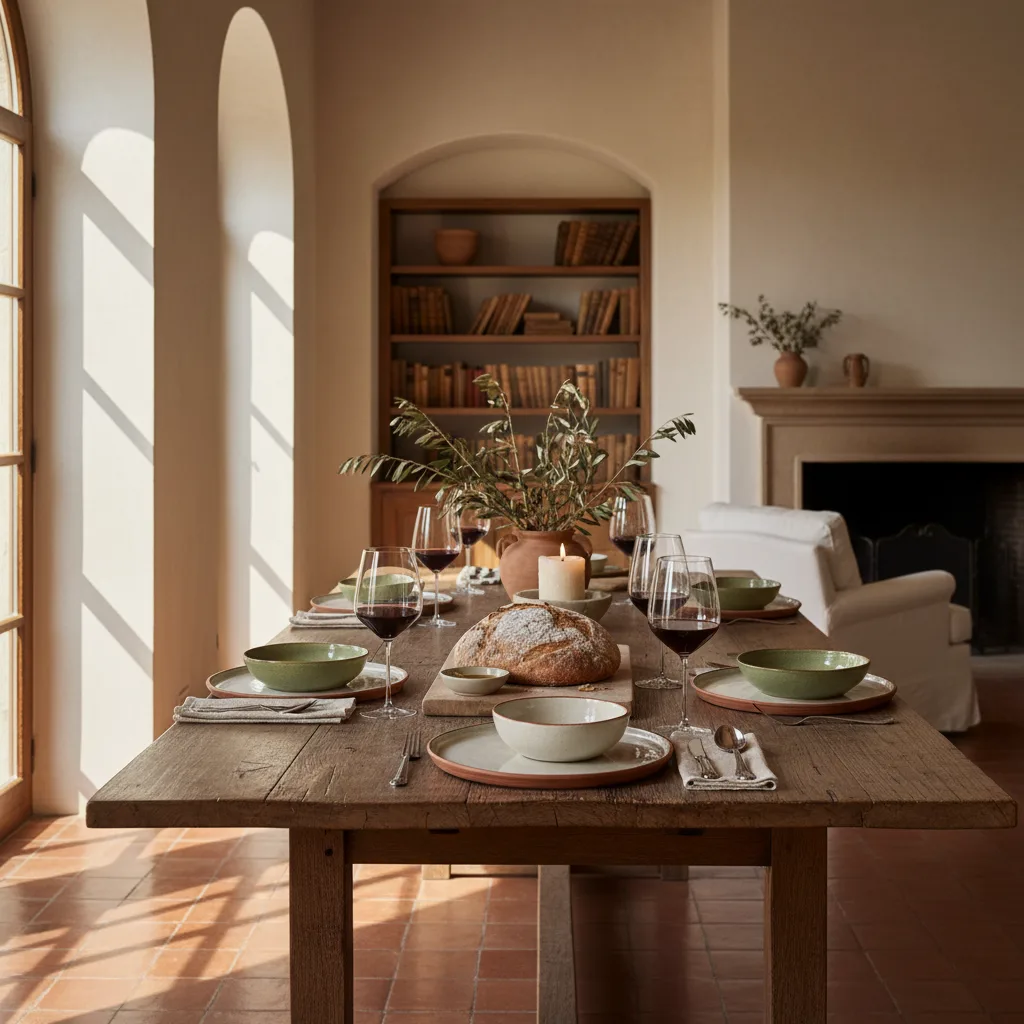
That mindset explains why in an average Italian home you'll always find a tablecloth—even an everyday one—cloth napkins, plates that aren't the supermarket's and a centerpiece someone has placed with intention. It's not pretentiousness. It's habit. And habits, when they're good, show in how you feel when you sit down.
The structure of the meal: why order matters
An Italian meal isn't one big single dish. It's a sequence designed so that the body and the conversation move at the same pace. Antipasto, primo, secondo, contorno, dolce, caffè. They aren't always all served—a midweek lunch might be just a primo and fruit—but the logic of the sequence holds: start light, build up, close.
That structure has a practical effect on the set table. You need different plates for different moments. A single flat plate won't do for everything. And because you need different pieces—a deep bowl for the pasta, a flat plate for the secondo, a bowl for the salad, a cup for the caffè—the table fills up with objects that have a function and a character of their own.
That's where Italian design finds its natural meaning. Brands like Brandani have spent more than 75 years designing pieces that respond exactly to this logic: ceramic bowls in sizes conceived for each use, plates with personality that don't hide away in a cupboard, and centerpieces that complete the scene without stealing the spotlight from the plate.
The three elements that are never missing
There's an unwritten rule on Italian tables that deserves attention: three elements are always present, without exception.
| Element | Real function | What it communicates |
|---|---|---|
| Bread | Accompanies, cleanses the palate, finishes off sauces (the famous scarpetta) | Generosity — there's always extra bread |
| Water | Always in a glass jug or bottle, never straight from the tap into a plastic cup | Care in the presentation, even in the basics |
| Wine | Red or white depending on the dish, served naturally | The table is a space for enjoyment, not just for feeding yourself |
Notice that none of the three is a sophisticated ingredient. They are everyday elements. What makes them something special is how they're presented: the bread on a board or in a cloth-lined basket, the water in a jug someone has chosen, the wine in glasses—never in water tumblers. The difference lies in the objects, not in the budget.
And that's exactly what you can replicate at home. You don't need to cook like a Sicilian nonna. You need a decorative tray for the bread, a jug with character and glasses you're not afraid to use every day. The Italian set table isn't for special occasions: it's the everyday occasion treated with respect.
Time as the invisible ingredient
Ask any Italian what makes a good meal different from an ordinary one and they probably won't talk about culinary techniques. They'll talk about time. Time to cook without rushing, time to eat without watching the clock, time to linger at the table after the last course.
In Italy, Sunday lunch is still an event that can last three hours. Not because there are seven courses, but because between courses there is conversation, there is wine poured slowly, there are children who get up and come back, there are stories told for the umpteenth time. The concept of sobremesa—which, curiously, has no direct translation into Italian, even though they practice it with more conviction than anyone—is proof that the table doesn't end when the meal does.
That long stretch of time has a consequence for the physical setting: the table has to be pleasant to stay at. A well-chosen centerpiece, candles lit when the light fades, a vase with fresh flowers or sprigs of rosemary—none of that is superfluous decoration. It's what turns a functional surface into a place where you want to be.
What you can bring to your table (without moving to Italy)
The good news is that you don't need an Italian passport to eat better. What defines the Italian table experience are conscious decisions anyone can make. Here are the most important ones, translated into the real life of someone who lives in Spain and wants to elevate their everyday without complicating things.
Set the table even when you eat alone
The first shift in mindset is to stop reserving the set table for guests. In Italy, laying out a beautiful plate to have dinner alone on a Tuesday isn't eccentric: it's normal. Take out the good plates. Use a cloth napkin. Put out a simple centerpiece even if it's just a bowl of lemons. The act of preparing the table for yourself changes the way you perceive the meal.
Invest in pieces you use every day
The most common mistake is buying expensive tableware that gets stored away "for when guests come" and using bland plates every day. The Italian philosophy is exactly the opposite: pieces with character are for everyday use. An Italian ceramic plate with texture and color doesn't cost much more than an industrial one, but it transforms every meal into something worth your attention.
Spend two extra minutes on the presentation
We're not talking about plating like a Michelin-starred restaurant. We're talking about putting the bread on a board instead of leaving it in the bag. Serving the water in a jug instead of putting out the plastic bottle. Using a ceramic fruit bowl as an improvised centerpiece. Two minutes that change the experience of the next thirty.
Respect the sequence
You don't have to prepare five courses. But you can separate moments: a simple starter (some olives, a few tomatoes with oil), a main course, something sweet at the end. That sequence creates rhythm, conversation and a pause. It's the opposite of a single dish wolfed down in ten minutes.
Objects tell stories (and Italians know it)
There's an aspect of Italian table culture that often gets overlooked: the emotional relationship with objects. In many Italian homes, the soup tureen is grandmother's. The coffee set is the one bought on a trip to Faenza. The crystal glasses are the wedding gift. Every piece has a story, and that story is told at the table.
That's the difference between a table set with generic objects—functional but mute—and a table set with pieces that mean something. It's not a question of price. It's a question of intention when choosing. When you choose a piece of authentic Italian design, you're not buying a plate: you're choosing an object that will be present at your meals for years, that will accumulate memories, that someone will inherit or remember.
Brandani, for example, has spent 75 years making tableware in Italy. When you put one of those pieces on your table, you're not putting out a kitchenware item: you're connecting with a design tradition that understands the table is the center of domestic life.
Italy before UNESCO: the table as heritage
In 2025, Italy officially submitted its bid for Italian cuisine to be recognized as Intangible Cultural Heritage of Humanity by UNESCO. But the interesting thing is what exactly they're nominating. It's not the recipes. It's not the pizza or the pasta. It's the act of sitting down together at the table.
The bid, launched under the motto "Sunday lunch — Italians at the table," recognizes that what makes Italian gastronomy unique isn't just what is cooked, but how it is shared. The Italian Minister of Culture defined it like this: "The history of food is the history of civilization and culture." And the mayor of Naples added that the Sunday meal "unites generations and communities" through gestures, rituals and ancestral knowledge.
For those of us who love the set table, this bid is a validation of something we sensed: that preparing a table with care isn't an aesthetic whim. It's a cultural act. And that the objects we choose for our table—the plates, the bowls, the trays, the vases—are an active part of that act.
Checklist: your most Italian table in 5 steps
- Put out a tablecloth or placemat — even an everyday one. Natural linen is the most Italian and the easiest to maintain.
- Water in a jug, never in a plastic bottle — a glass or ceramic jug changes the perception of the whole table.
- A centerpiece with intention — a bowl of fruit, a low vase with flowers, a tray with bread. Something that says "I prepared this for you."
- Use the good plates — the ceramic ones, the colorful ones, the ones with texture. Don't store them away: use them.
- Stay at the table — after the last bite, serve a coffee, light a candle, keep talking. The table doesn't end with the meal.
Complementary pieces to complete a set table with Italian character: trays for bread, fruit bowls as an improvised centerpiece, glasses and table textiles.
Frequently asked questions
Is it true that in Italy people always eat with a tablecloth? Generally, yes. Even at casual midweek meals, many Italian families use a tablecloth or placemats. It doesn't have to be an embroidered linen tablecloth: a simple cotton tablecloth or a linen placemat does the job. The idea is that the table should be "dressed," not bare.
What's the difference between the Italian and the French set table? The French table tends to be more formal and protocol-driven (strict order of cutlery, fine tableware, rigid etiquette rules). The Italian one is equally well cared for but more relaxed and hospitable: it prioritizes abundance, conviviality and warmth over technical perfection. There is more bread on the table, more improvisation and more room for an unexpected guest.
Do I need Italian tableware to have an Italian table? Not necessarily, but it helps. Italian ceramic pieces are designed with the logic of Italian food: sizes, proportions and finishes conceived for how people actually eat in Italy. Brands like Brandani design from that tradition, and it shows in how the pieces work on a real table.
Can I apply the Italian table style if I live alone or as a couple? Absolutely. The Italian set table doesn't require eight diners. Even for one person, the gesture of laying out a beautiful plate, serving water from a jug and sitting down without rushing transforms the experience. It's more an attitude than a protocol.
Do Italians use a centerpiece every day? Many do, though not always an elaborate one. A bowl of fruit, a low vase with market flowers or simply a beautiful bottle of olive oil fulfill that role. The key is that there is something in the center that says: this table has been prepared.