Spring table setting: palette and key pieces
Spring table decoration has one huge advantage over any other time of year: everything you need already exists just outside your window. The colours, the textures, the inspiration. The problem is rarely a lack of ideas, but rather too many. Too many options, too many references on social media, too many photos of impossible tables that look like they were styled by a ten-person team with an unlimited budget.
This article is about the opposite: a real spring table setting, with specific pieces, a defined palette and an approach you can apply in fifteen minutes before your guests arrive. No emergency trips to the florist, no last-minute shopping. With what you already have and, at most, one or two well-chosen pieces that make the difference.
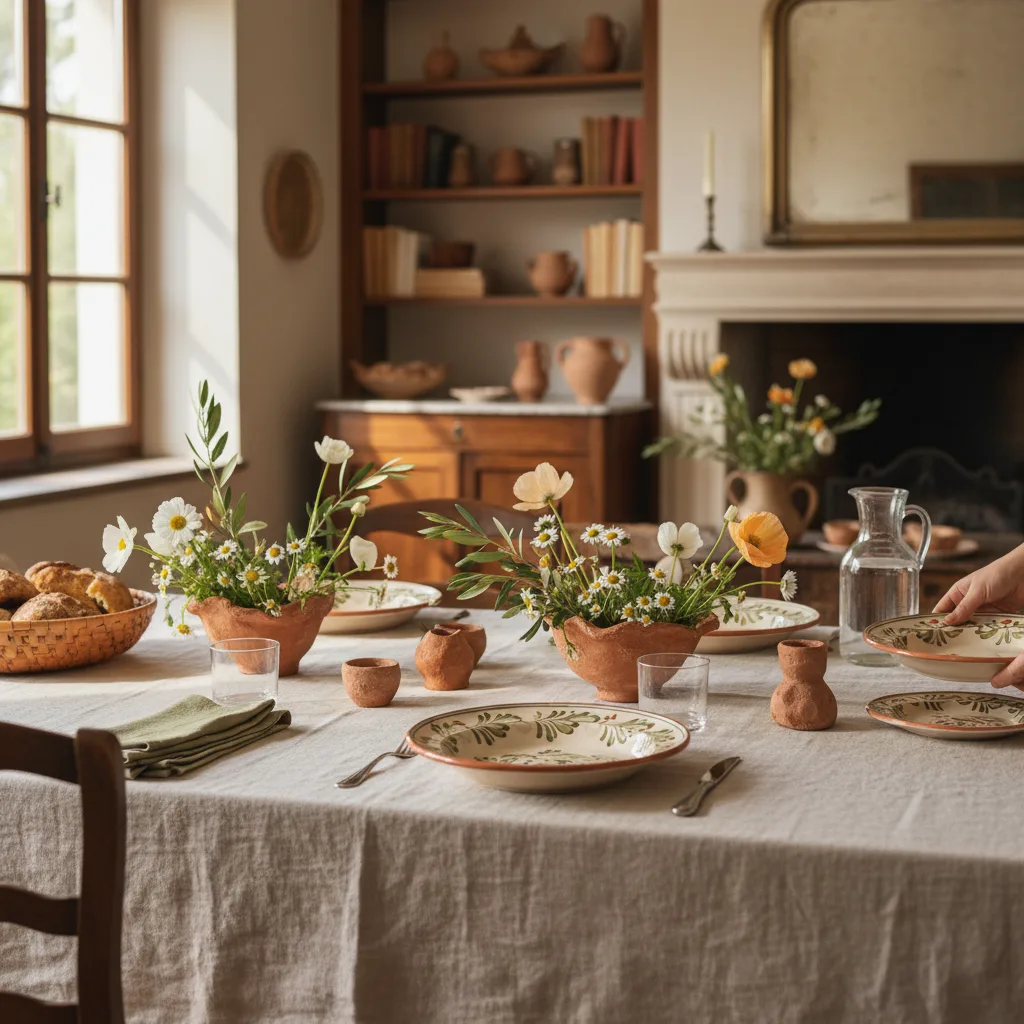
The spring palette that works (and the one that doesn't)
There's a common trap when thinking about spring colours: mistaking "spring" for "children's Easter". Bubblegum pinks, saturated yellows and intense lilacs may work in a shop window, but on a real table with real food they tend to compete with the dishes rather than complement them.
The palette that works best for spring table decoration moves across three registers:
Warm neutrals as a base. Raw linen, off-white, sand, cream. The tablecloth or the placemats set the canvas. A light, understated background lets everything else speak.
One soft leading tone. Sage green, light terracotta, aqua blue, buttery yellow. Just one. Not three. A single tone that appears on napkins, in the centrepiece or on the tableware — but not on all of them at once.
Minimal living accents. This is where fresh flowers, a coloured glass or a bowl of fruit come in. The living touch brings contrast precisely because everything else is calm.
Specific combinations you can copy
| Base | Leading tone | Living accent | Result |
|---|---|---|---|
| Raw linen + white tableware | Sage green (napkins) | Sprigs of fresh rosemary | Elegant Mediterranean |
| White tablecloth + cream ceramic | Soft terracotta (glasses or bowl) | Orange ranunculus | Modern Tuscan |
| Raffia placemats | Aqua blue (tableware) | Fresh lemons | Bright coastal |
| Natural twine + wood | Buttery yellow (candles) | Wild daisies | Italian countryside |
The key is proportion: 70% of what you see is neutral, 20% is your leading tone and the remaining 10% are those living accents that add sparkle. If you flip the proportions, the table turns into a shop window instead of a place to eat.
The pieces that define a spring table
It's not about buying new tableware every season. It's about knowing which piece makes the seasonal difference and which ones are the permanent backdrop.
The tablecloth or the textile base
In spring, textiles drop a notch in formality compared to winter. Crumpled linen, table runners in natural fibres or even a bare table with raffia placemats say "spring" without needing any flowers. If you use a tablecloth, let it hang generously — at least 50 centimetres on each side — because a short tablecloth elevates nothing.
A tip few guides give: the table runner doesn't have to go down the centre. Placed diagonally or slightly off-centre, it creates a more dynamic composition and leaves more free surface for the tableware.
The tableware: ceramic as the star
Spring is the season of ceramic. Against the formal shine of winter porcelain, ceramic pieces with matte finishes, irregular edges or reactive glazes bring that artisanal touch that connects with nature. A cream dinner plate with subtle relief, a deep bowl in moss green, an oval platter with a wavy edge — those are the pieces that transform the table.
You don't need a complete set in a new colour. It's enough to introduce two or three pieces that dialogue with your everyday white tableware. Mixing pieces — combining plates from different collections — is precisely one of the most established trends of recent years, and spring is the perfect time to experiment.
Glassware: the detail that raises the level
If you could change only one thing about your usual table to make it shout "spring", swap in coloured glasses. A wine glass in light green, in amber or in dusty pink elevates the whole composition effortlessly. It's the piece with the best investment-to-visual-impact ratio on the entire table.
The centrepiece: less is more (really)
In spring, the ideal centrepiece isn't an opulent floral arrangement. It's something low, natural and that doesn't get in the way of conversation. Options that work:
- A low vase with freshly cut wild flowers (daisies, lavender, flowering rosemary).
- A decorative tray with short candles, a small bowl of water and a floating flower.
- Three elements grouped in a triangle: a candle, a small vase and a bowl of seasonal fruit.
The rule of proportion and height we already explained in another article applies especially here: nothing above eye level when you're seated.
Mistakes that ruin a spring table
After seeing hundreds of tables on social media and in real homes, these are the slip-ups that keep coming up:
Too many colours at once. Spring invites colour, yes. But if your tablecloth is floral, your napkins are in another print and on top of that you add flowers in a third colour, the result is visual noise. Choose a maximum of three tones and repeat them.
Flowers that are too tall or too formal. A florist's bouquet wrapped in cellophane sitting in a tall vase is not a centrepiece — it's an obstacle. Spring flowers call for informality: cut from the garden, from the market, popped into a low ceramic vase or even a kitchen jug.
Forgetting functionality. The table is for eating. Every decorative piece you add takes away space for plates, platters and glasses. Before placing an element, ask yourself: is there room for the pasta platter? If the answer is no, take something away.
Copying a Pinterest photo without adapting it. That perfect table for twelve diners with eucalyptus cascading over the edges may not work on your table for four. Always adapt the scale.
How to set the table in 15 minutes: a practical order
If you have the right pieces, setting a beautiful spring table takes no more than a quarter of an hour. This is the order that works best:
First, the base. Tablecloth, placemats or table runner. Decide whether you want full or partial textile coverage. Smooth it out or leave the natural creases — in spring both options work.
Second, the tableware. Dinner plate, dessert plate on top if there's a starter, bowl if it's an informal meal. Everything centred on the seat.
Third, the glassware and cutlery. Glasses top right, cutlery in position. There's no need to lay out the whole arsenal: just what you'll actually use.
Fourth, the napkins. This is your chance for colour. Folded simply — no origami, no complicated rings. A loose knot with a sprig of rosemary is enough and looks authentic.
Fifth, the centrepiece. The last thing you place, because that way you see how much real space you have left. Adjust its size and position according to the gaps.
Pieces that work in spring and the rest of the year
The smart investment in tableware isn't buying seasonal pieces you store away for eleven months. It's choosing versatile pieces that switch register with a simple change of napkin or flowers. These are the ones that pay off most:
- White or cream tableware with texture. Works in any season. In spring you combine it with colour; in winter, with dark tones.
- Ceramic bowls in various sizes. They serve as a centrepiece, as a fruit bowl, as a salad bowl. A well-chosen ceramic bowl is the most versatile piece in your kitchen.
- A low, wide-mouthed vase. For short flowers in spring, for pinecones in autumn, for candles in winter.
- Glassware with a subtle colour. They work all year round because the colour is soft, not themed.
Italian inspiration: why spring at the table is experienced differently
In Italy, the spring table isn't decorated — it's lived. It's not an aesthetic exercise separate from the food: it's the food itself that decorates. A plate of pasta al pesto is already green; a caprese already brings the red and the white; a limoncello in a pretty glass is already the colour accent.
That philosophy — where the table piece accompanies the food instead of competing with it — is what defines Italian table design. Pieces with their own character but without excessive prominence. Ceramic with personality that doesn't shout, that lets the plate of food be the real centre.
It's also the reason Italian table pieces tend to work so well in spring: their natural palettes (terracotta, olive green, cream, washed-out blue) are exactly the tones this season calls for.
Complementary pieces to complete the spring table without repeating what you already have.
Frequently asked questions
What are the best colours for a spring table? Warm neutrals as a base (linen, cream, off-white) combined with one soft leading tone: sage green, light terracotta, aqua blue or buttery yellow. Avoid overloading with more than three different colours.
Do I need to buy new tableware for spring? No. The smartest strategy is to have a neutral base set (white or cream) and add two or three seasonal pieces — a coloured bowl, some glasses, some napkins — that transform the whole without replacing it.
Which flowers work best as a spring centrepiece? Wild or garden flowers cut short: daisies, lavender, ranunculus, flowering rosemary. The key is that they stay low (so they don't block the conversation) and feel informal.
Can I mix pieces from different tableware sets on the same table? Yes, and in fact it's on trend. The key is that they share a colour palette or a finish (for example, all matte, or all with an organic edge). Mixing with intent gives personality; without intent, it gives chaos.
How much should a tablecloth hang over the sides? At least 50 centimetres on each side for an elegant result. A short tablecloth that barely covers the surface takes presence away from the whole composition.