The Christmas Table Setting: the Italian Version
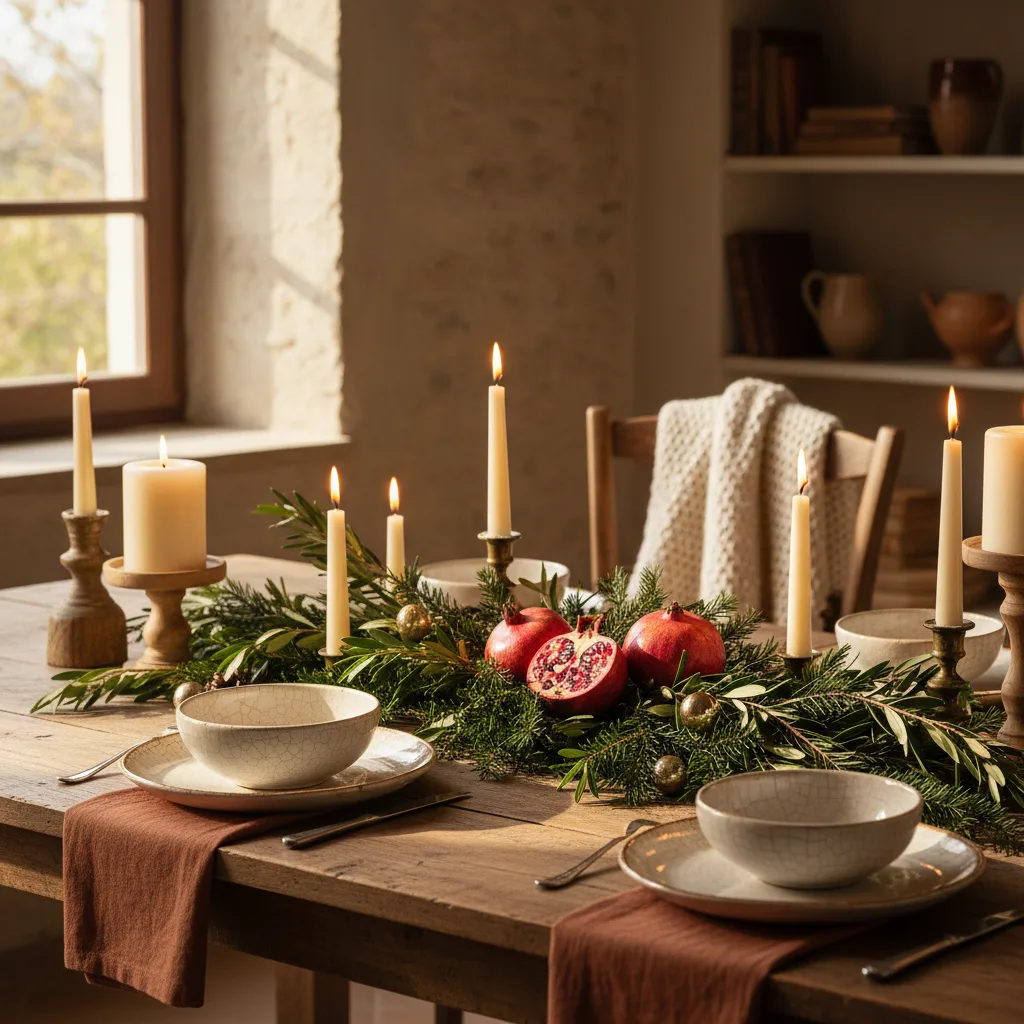
When you think of Christmas table setting ideas, the same old images probably come to mind: gold glitter, red paper napkins printed with a Santa Claus and a centrepiece that looks like a shopping-mall display. It works — but it doesn't move you. The Italian version of the Christmas table takes a different path. Less ornament, more intention. Less props, more hospitality. A table where what matters is that people feel comfortable, eat well and stay late.
In Italy, the Christmas table isn't "decorated": it's apparecchiata — set, prepared, dressed with care. It's an act that takes hours, that means bringing out the good tableware, choosing a tablecloth that rises to the occasion and thinking about every detail as if each guest were a guest of honour. Here's how to bring that philosophy into your home without falling into clichés and without needing an extravagant budget.
Italian Christmas is lived at the table (literally)
To understand how to set a Christmas table in the Italian style, you first have to understand what happens around that table. In Italy, Christmas isn't one dinner: it's several. On the night of 24 December the Cena della Vigilia — the eve dinner — is celebrated, traditionally based on fish and without meat, following the Catholic custom of eating di magro. It's a long menu: antipasti, primo, secondo and dolce. It can last three hours without anyone glancing at the clock.
On 25 December comes the Pranzo di Natale, the Christmas lunch, where meat does take centre stage, along with roasts, filled pastas and the desserts that define each region: panettone in Milan, pandoro in Verona, struffoli in Naples, panforte in Siena. And on the 31st, the Cenone di Capodanno closes the cycle with lentils (a symbol of prosperity) and cotechino. Three big tables in one week. Three occasions to do it well.
This explains why Italians invest in table pieces that last: they don't bring them out once a year, but use them, enjoy them and care for them as part of a ritual that repeats. Good tableware isn't there to gather dust in the cabinet. It's there to come out every time the table deserves it — and in December, it deserves it almost every night.
The colour palette: out with the bargain-bin gold
The most common mistake in Christmas table decoration is wanting the table to "look like Christmas" by force of saturating colours. Gold over here, bright red over there, silver on the napkins, neon green in the centrepiece. The result is a table that shouts instead of welcoming.
The Italian version is far more restrained. The palette is decided before anything is placed on the table and kept consistent across every layer: tablecloth, tableware, napkins, centrepiece, candles. Two or three tones at most. That chromatic discipline is what separates a table with personality from a table with decorations on top.
These are the palettes that work best for a Christmas table with an Italian accent:
| Palette | Base tones | Accent | Feel |
|---|---|---|---|
| White and winter green | Off-white, ivory | Fir green, olive green | Clean, fresh, elegant |
| Terracotta and cinnamon | Sand, warm beige | Terracotta, cinnamon, sienna | Warm, organic, Mediterranean |
| Deep red and cream | Cream, natural linen | Garnet, burgundy (not Santa red) | Festive without stridency |
| Neutrals with a gold accent | White, pearl grey | Old gold, matte brass | Sophisticated, wintry |
Notice one detail: none of these palettes includes shiny gold, mirror silver or supermarket Christmas red. The Italian Christmas red is garnet, burgundy, claret. The gold is matte, aged, brass. The difference is subtle but it completely defines the result. As we explain in the guide on how to choose the centrepiece for your dining room, visual consistency is half of a job well done.
Table linen: the invisible layer that changes everything
In an Italian home, the tablecloth is not optional at Christmas. It's the sign that the table is dressed for something important. And here's a principle worth taking to heart: the tablecloth doesn't have to be Christmassy. In fact, the best tablecloths for Christmas aren't.
A linen tablecloth in ivory, raw or off-white works in December just as it does in May. What changes the table by season isn't the tablecloth, but what goes on top: the napkins, the centrepiece, the accent colours. If you invest in a good neutral-base linen tablecloth, it serves you for every celebration of the year. It's a piece that pays for itself table after table.
Fabric napkins are non-negotiable if you want a table with presence. On Christmas Eve, the options that work best are plain ones in the accent colour you've chosen: burgundy on a raw tablecloth, forest green on white, terracotta on sand. Folded into a simple rectangle on the plate — or inside a water glass if you want a slightly more theatrical touch — and, if you fancy it, fastened with a sprig of rosemary, a cinnamon stick or a piece of jute twine with a small pine cone.
What doesn't work: gold plastic napkin rings, paper napkins with Christmas prints or clear plastic placemats. If something reminds you of a tourist-restaurant menu, it doesn't belong on this table.
The tableware: bring out the good set (and mix it with judgement)
This is the night. If you have a good set of tableware stored away "for special occasions", Christmas is that occasion. Don't leave it in the cabinet waiting for a day that never comes. Italians understand that tableware exists to be used — and that using it well is an act of respect towards those who sit at your table.
The most versatile base for a Christmas table is white or neutral-toned ceramic. Not because it's boring, but because it lets the rest of the elements — napkins, centrepiece, food — do their job without competing. A white plate with an irregular edge, a glaze with an artisanal texture, a slightly organic shape: that's what marks the difference between industrial tableware and tableware with character.
A trick Italians have mastered, and which we already mentioned in the article on an authentic Italian table without clichés: mixing pieces with judgement rather than making everything uniform. A white flat plate as a base, a ceramic dessert plate in a different tone or texture on top, a small soup bowl in a third finish that shares the colour family. That conveys a home built over time, not a last-minute purchase.
If you also want stemware that rises to the occasion, clear, fine glass always beats tinted or decorated glass. A beautiful glass needs no adornment: its shape and transparency are enough. On the Italian table, the glass is functional first and decorative second — and so it should be on yours.
The centrepiece: natural, low and scented
The Christmas centrepiece is where most people overdo it. Baubles, glitter, figurines, fake snow, ribbons. The result: a centrepiece that takes up half the tabletop and makes it impossible to see the person across from you.
The Italian rule is simple: the centrepiece should be no taller than 25 centimetres. If your guests have to lean to see each other, you've done something wrong. And if the centrepiece takes up more than 20% of the table's surface, you're sacrificing space for serving dishes, bread and bottles — which is what really matters at a Christmas dinner.
The best Italian-style Christmas centrepieces use natural elements that smell good, have texture and don't look like they came from a pound shop:
- Real fir branches laid horizontally along the table (not in a vase), interspersed with pine cones and low natural-wax candles.
- Halved pomegranates alongside rosemary sprigs and candles — a southern Italian classic that adds colour without artificiality.
- Citrus: blood oranges, mandarins with leaves, Amalfi lemons. Placed in a wide, low ceramic bowl, with cinnamon sticks and star anise.
- Grouped candles at different heights in ceramic or glass holders, surrounded by dried moss or eucalyptus branches.
If the table is rectangular, spread two or three low compositions along it rather than a single central point. If it's round, a single composition in the centre is enough — as we detail in the guide to centrepieces for round vs rectangular tables. And if you want more depth on proportions, the rule of 3 for centrepieces is your reference.
The lighting: real candles, no flickering LEDs
Light is what turns a meal into a dinner. In Italy, the Christmas table is lit with candles — not with LED strips, not with little lights that flicker imitating a candle (fooling no one), not with floor lamps pointed at the table like an interrogation.
The plan is simple: lower the room's general light and let the candles do the work. Three or four candles of different heights spread across the table — in ceramic or glass holders, or simply on a little dish — create the kind of light that makes the food look better, faces look kinder and conversation flow without the stress of overhead lighting.
Natural-wax candles (soy, beeswax) are preferable to paraffin ones: they smell better, drip less and leave no toxic residue on the table where you're going to eat. The ideal colour is white, ivory or honey — consistent with the neutral palette. Red Christmas candles look good in a film; in real life, they dye the dripping wax red and stain the tablecloth.
A detail that adds a lot: if you have a large decorative tray, use it as a base to group candles with green branches. It works like a micro-stage within the table and lets you move the whole arrangement at once if you need space for the serving dishes.
The details that complete the table (without overloading it)
The difference between a correct table and a memorable one lies in three or four small details that show someone has thought of everything. They're not compulsory — the table works without them — but when they're there, you notice.
Bread in a real bread basket. In Italy, bread isn't served in a paper bag or cut in the kitchen. It's brought to the table in a bread basket — ceramic, lined wicker, wood — and each guest helps themselves. It's a gesture of generosity and trust that sets the tone of the dinner. A ceramic fruit bowl can do that job perfectly if you don't have a bread basket.
Water and wine on the table, not in the kitchen. Wine bottles without a sleeve, without a plastic cooler. A glass or ceramic jug for water, not the supermarket plastic bottle. It seems a minor detail, but it transforms how the table is perceived.
Hand-written place cards. If there are more than six of you, a small card with each guest's name — handwritten, not printed — turns the table into something personal. In Italy, especially at formal southern dinners, each person's seat is decided in advance. It's not rigidity: it's thoughtful hospitality.
A dessert that shows. The panettone or pandoro isn't cut in the kitchen: it's placed whole on the table, on a beautiful platter, and cut in front of everyone. It's a moment of culinary theatre that Italians take particular care with. If you want to go a step further, accompany it with a decorative salad bowl of seasonal fruit — grapes, pomegranates, mandarins — as a visual finale.
The Italian Christmas table checklist
Before you sit down, run through this list. It's not a rigid protocol — it's a minimum guide so nothing important is left out.
- Colour palette defined (2-3 tones max) and consistent across every layer
- Fabric tablecloth (linen, thick cotton) — never plastic or paper
- Fabric napkins in the accent colour, folded simply
- Good tableware out of the cabinet — mixed with judgement if needed
- Clear glass stemware (not plastic, not tinted)
- Low centrepiece (< 25 cm), natural, scented
- Real candles lit and general lighting dimmed
- Bread in a basket, water in a jug, wine in an uncovered bottle
- Enough room for serving dishes, plates and elbows — the table isn't a shop window
What NOT to do (the anti-checklist)
Just as important as knowing what to put out is knowing what to avoid. These are the mistakes that turn a promising Christmas table into a shopping-mall display:
Loose glitter on the table. It sticks to the food, the hands, the clothes and the plates. It's impossible to clean and ruins any attempt at elegance.
Decorative figurines between the plates. Porcelain reindeer, snowmen, tiny Santas. If it doesn't serve a function (holding a candle, containing something), it shouldn't be on the table where you eat.
Table runners with sequins or Christmas prints. They're the textile version of glitter: they draw attention for the wrong reasons and become aesthetically dated every 25 December.
Mixing three different styles. If half the table is rustic (pine cones, wood, jute) and the other half is glamorous (gold, crystal, sequins), the result is visual confusion. Choose one path and stick to it. If you're torn between minimalism and abundance, the article on minimalist vs maximalist centrepieces helps you decide.
How to adapt the table if your budget is tight
You don't need to buy a new set of tableware to have an Italian Christmas table. What you need is to use well what you have and add, at most, two or three pieces that make the difference.
If your tableware is white and simple, you already have the best base. If your glasses are clear glass, perfect. What you're probably missing is the accent: a coloured fabric napkin (from €2-3 each in cotton fabric), some natural-wax candles (under €5) and natural elements you can gather or buy for very little — fir branches, pine cones from the park, mandarins from the fruit bowl.
The investment that gives the most return is a ceramic piece that works as a centrepiece and serves beyond Christmas: a wide bowl, a tray, a fruit bowl. In January it'll be your living-room fruit bowl. In May, your spring centrepiece. In December, your Christmas piece again. That's how Italians build a table with personality: not by buying disposable Christmas decorations, but timeless pieces dressed for the season.
Italian ceramic pieces that complement the Christmas table and work the rest of the year as decoration or service.
And after Christmas?
A well-thought-out Italian-style table has a virtue that a table full of Christmas decorations doesn't: it adapts. If you've chosen quality neutral pieces — a linen tablecloth, ceramic tableware, a decorative bowl — all you have to do is change the centrepiece and the napkins to have your New Year's Eve table ready. Swap the fir branches for taller candles, change the garnet napkins for black or pearl grey, and the same table that shone on Christmas Eve shines again on the 31st. We cover it in detail in elegant New Year's Eve centrepieces.
That's the Italian philosophy applied to the table: invest in what lasts, decorate with what changes. The ceramic pieces, the linen table linen, the glass stemware stay with you for years. The branches, the candles, the citrus are what mark the season. That's how you build a table with a story of its own — not a table that's set up and taken down like a stage set.
See the Italian Christmas table
Frequently asked questions about the Italian Christmas table
What colours do Italians use on the Christmas table? The most common tones on Italian Christmas tables are white, ivory, deep red (garnet or burgundy, not bright red), forest green and warm neutrals such as sand or beige. Gold is used sparingly and in a matte or aged finish, never shiny. The key is consistency: two or three tones at most, repeated across tablecloth, napkins and centrepiece.
How many courses does an Italian Christmas dinner have? The traditional structure of the Cena della Vigilia (24 December) and the Pranzo di Natale (25 December) includes four courses: antipasto (starters), primo (pasta or soup), secondo (main course — fish on Christmas Eve, meat on Christmas Day) and dolce (dessert). In practice, many Italian families serve several dishes within each course, so a Christmas Eve table can easily include six or seven different dishes over the course of the evening.
Is it compulsory to use a tablecloth on the Italian Christmas table? It's not a written rule, but in Italian tradition a table dressed with a fabric tablecloth is a sign that the occasion matters. A linen tablecloth in a neutral colour (ivory, raw, off-white) is the most practical option: it works at Christmas, in summer and at any dinner that deserves more than a bare table.
What centrepiece do Italians put on the table at Christmas? In Italian homes, Christmas centrepieces tend to be low, natural and scented: fir branches, pine cones, citrus (mandarins, oranges), natural-wax candles and, in the south, halved pomegranates with rosemary. The important thing is that they don't block conversation or take up space needed for the food.
Can I set an Italian Christmas table with pieces I already own? Yes. The key isn't buying new Christmas decorations, but making good use of the pieces you have — white tableware, glass stemware, a beautiful bowl — and adding only the seasonal accent: coloured fabric napkins, candles and natural elements. If you want to bring in a new piece, choose something timeless (a bowl, a tray, a ceramic centrepiece) that you also use outside December.
Mini SEO checklist
- Keyword "christmas table setting ideas" in H1 and in the first 120 words
- Correct slug:
/blog/mesa-puesta-navidad-version-italiana - Meta title: 49 characters (≤ 60)
- Meta description: 153 characters (145-160)
- 8 suggested internal links integrated into the body
- JSON-LD BlogPosting included
- JSON-LD FAQPage included
- JSON-LD BreadcrumbList included
- CTA aligned with the funnel (TOFU: explore, get inspired, discover pieces)
- 3 PRODUCT_CARDs integrated contextually
- PRODUCT_GRID_MENTIONED and PRODUCT_GRID_CROSSSELL included
- NEWSLETTER_BLOCK in mid position
- STICKY_CTA configured
- FAQ with 5 real questions
Internal links integrated into the article
- how to choose the centrepiece for your dining room — anchor: "how to choose the centrepiece for your dining room"
- an authentic Italian table without clichés — anchor: "an authentic Italian table without clichés"
- centrepieces for round vs rectangular tables — anchor: "centrepieces for round vs rectangular tables"
- rule of 3 for centrepieces — anchor: "rule of 3 for centrepieces"
- ceramic bowl — anchor: "ceramic bowl" / "ceramic bowls"
- minimalist vs maximalist centrepieces — anchor: "minimalist vs maximalist centrepieces"
- elegant New Year's Eve centrepieces — anchor: "elegant New Year's Eve centrepieces"
- decorative tray — anchor: "decorative tray"
- decorative salad bowl — anchor: "decorative salad bowl"
- ceramic fruit bowl — anchor: "ceramic fruit bowl"