Setting the table for guests: the order nobody explains
You're having people over and you want the table to live up to the occasion. You know the forks go on one side and the knives on the other, but beyond that, everything gets blurry. What goes first, the tablecloth or the centrepiece? Do the glasses sit in a row or on a diagonal? And the napkin, on top of the plate or to the left? Knowing how to set the table for guests isn't about rigid etiquette: it's about understanding a logical order that makes everything flow — the placement, the serving and, above all, the conversation.
This article gives you that order step by step. No pomp, no embassy rules. Just what you need so that your table set for guests really works and, along the way, has that touch of personality that makes someone say "it looks lovely."
Why the order matters (and it's not about etiquette)
There's a practical reason behind every table rule that has been handed down over the centuries. It's not about rigidity or aristocratic etiquette. It's that, when you follow a logical order, you set the table in half the time, you don't have to move pieces around to fit others in, and the result is visually balanced without any effort.
Think of it this way: if you place the glasses before the plates, you'll end up moving fragile glassware every time you adjust a piece of cutlery. If you put the centrepiece last, you'll have to reach over everything you've already set out. The order isn't decorative — it's functional. And when the functional side is sorted, the beauty appears on its own.
What's more, a well-set table conveys something your guests perceive even if they can't put a name to it: care. You don't need luxury tableware or inherited linens. What makes the difference is that each piece is where it should be, with room to breathe and a clear intention.
The placement order step by step
Here's the sequence used by hospitality professionals, and it works just as well at a table for four as at one for twelve. There's no need to memorise it: once you try it, it becomes automatic.
Step 1 — The tablecloth (or the table runner)
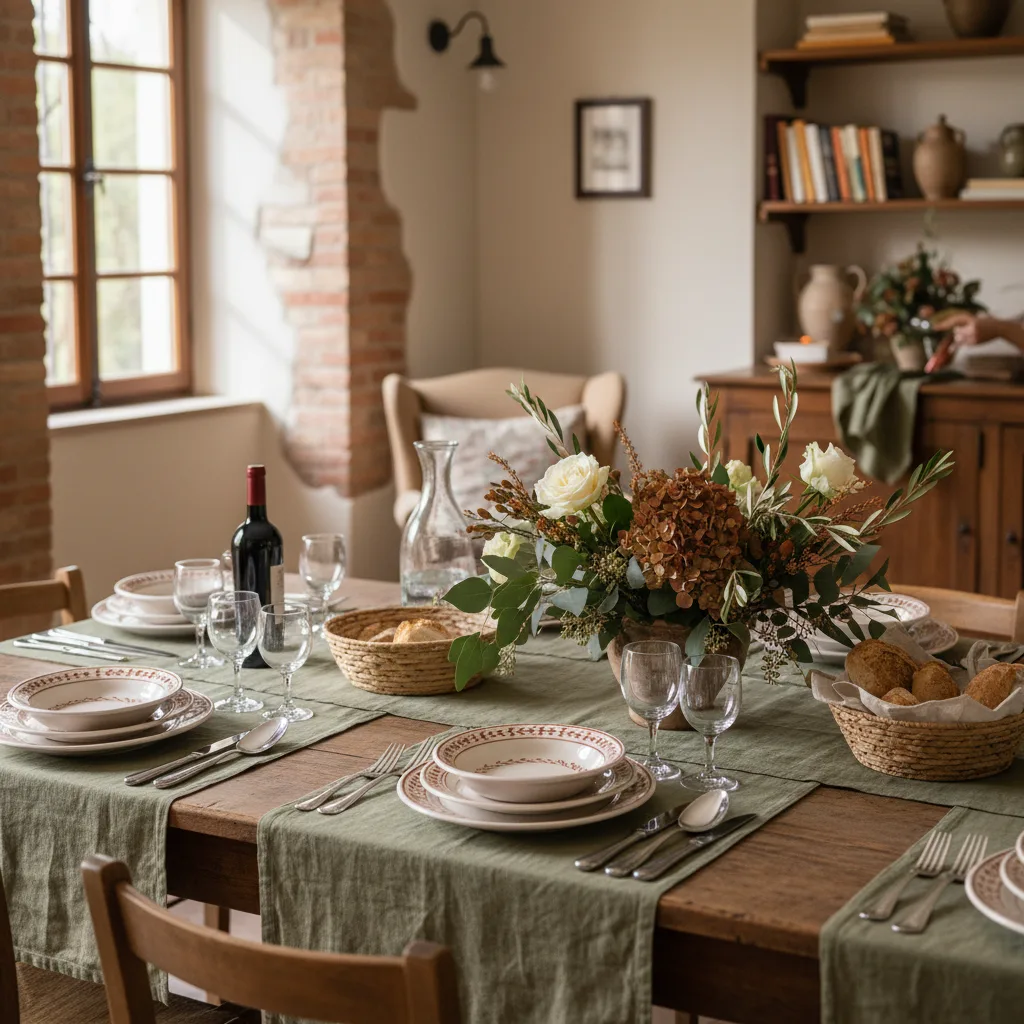
It all starts with the base. The tablecloth should be clean, ironed and well centred, with an even drop on all four sides — ideally hanging about 30 centimetres. If you prefer something less formal, a linen table runner over bare wood is an option that works really well and adds a Mediterranean touch without any fuss.
A detail that's often overlooked: the colour and texture of the tablecloth shape everything that comes after. A white tablecloth calls for tableware with character. An earth-toned tablecloth allows for more neutral pieces. Decide on the base before you take out the plates.
Step 2 — The centrepiece
Yes, it comes before the plates. It's counterintuitive, but it makes complete sense. If you place the centrepiece while the surface is clear, you can adjust its size and position without obstacles. Afterwards, the plates are arranged on either side, keeping the proportions right.
The golden rule: the centrepiece should never stop guests from seeing one another. If you use flowers, keep them low. If you use candles, keep them under 25 centimetres tall unless the candlestick is very slender. A low ceramic centrepiece solves this with no fuss and adds texture without stealing the spotlight from the food.
Step 3 — Charger plates and dinner plates
The charger plate goes centred in front of each chair, about two centimetres from the edge of the table. It's the visual reference for each setting. The dinner plate goes on top. If there's soup or a cream as a starter, the soup bowl goes on top just before serving — never put it out from the start if it's going to be a while before it's served.
The minimum distance between settings is 60 centimetres. Any less and elbows clash, cutlery gets confused and the experience suffers. If your table is small, it's better to lay one place less than to cram your guests in.
Step 4 — Cutlery
The classic rule works and there's no reason to complicate it:
| Position | Item | Detail |
|---|---|---|
| Left of the plate | Forks | From the outside in, following the order of use |
| Right of the plate | Knives and spoon | Knife with the blade towards the plate, soup spoon furthest out |
| Above the plate | Dessert cutlery | Fork pointing right, spoon pointing left |
If the dinner has only two courses and dessert, you don't need more than one fork and one knife on each side. The less cutlery, the cleaner the table and the less overwhelming it is for the guest who isn't up on etiquette.
Step 5 — Glasses and glassware
The glasses are placed at the top right of the plate, just above the knives. The classic order, from left to right: water glass (the largest), red wine glass and white wine glass. If you're only going to serve one type of wine, a water glass and one wine glass are enough.
Set them on a descending diagonal or in a straight line — both options are correct. The important thing is that they stay grouped together and don't intrude on the space of the guest next door.
Step 6 — Napkin
The cloth napkin goes to the left of the forks or on the charger plate. Avoid elaborate figures like swans or fans: a napkin neatly folded into a rectangle or a triangle conveys far more elegance than forced origami. If you want a personal touch, a napkin ring with a sprig of rosemary or a small handwritten name is enough.
Step 7 — Bread, salt and extras
The bread plate goes to the left, above the forks. The salt and pepper are shared between two guests — place them between the two settings. Oil cruets, vinegar bottles or gravy boats go in the centre, within reach of everyone but without competing with the centrepiece.
Formal table vs. casual table: what really changes
The difference between a formal table and a casual one isn't in the number of pieces. It's in the intention and in three specific decisions.
At a formal table, you use a full tablecloth, a charger plate, two or three glasses, dessert cutlery from the start and a cloth napkin on the plate. The centrepiece tends to be more restrained and symmetrical. Lighting matters: candles always, direct light never.
At a casual table — a Saturday with friends, a long Sunday lunch — you can do without the charger plate, use a single type of glass, put the napkin on the left and leave the centrepiece looser: a large ceramic bowl with fruit, for example, or a decorative tray with candles and plants.
What doesn't change in any case: a clean tablecloth, cutlery in its place and enough space between settings. Those three things separate a table set with thought from a table set in a hurry.
The details that elevate the table (without complicating things)
Once the order is sorted, there are four details that turn a correct table into a table with personality. They don't take more time — just a little attention.
Colour temperature. If your tableware is white or neutral, add warmth with the tablecloth, the napkins or the centrepiece. A touch of terracotta, sage green or deep blue keeps the table from looking like a hospital. Italian ceramics with vivid glazes solve this in a single piece: just one plate with character already changes the whole picture.
Varied height. A table where everything is at the same level is visually flat. Combine low elements (plates, a bread tray) with mid-height elements (glasses, a small vase) and something tall (candles in a candlestick, a bottle of wine with presence). That variation in height is what makes the table feel "alive," as explained in the rule of 3 for centrepieces.
Mixed materials. Ceramic with glass, linen with wood, metal with wicker. Everything doesn't have to belong to the same collection. In fact, a table where every piece is from the same set usually looks more impersonal than one with a considered mix. The key is to keep a coherent colour palette.
Empty space. Don't fill every centimetre. The table needs to breathe. There has to be free space between the centrepiece and the plates. Between the cutlery and the glasses, too. Emptiness isn't absence — it's what lets each piece be appreciated.
How to seat your guests (without the drama)
The order of the guests matters more than it seems. There's no need to follow diplomatic protocol, but there are a few guidelines that improve the dynamic of the dinner.
If there's a clear head of the table, the host or hostess sits there. The guest of honour — if there is one — sits to their right. From there, alternate profiles: seat people who don't know each other but could connect together, separate couples so they socialise with the rest and bear in mind who talks a lot and who is more reserved.
At round tables, the hierarchy dissolves, which is an advantage for informal dinners. Everyone can see everyone and the conversation flows as a group. If your table is rectangular and long, consider placing the hosts in the middle of the long sides rather than at the ends — that breaks the "meeting table" feel and creates a more enveloping atmosphere.
A practical tip: if you have more than six guests, put a small place card with the name at each setting. It avoids the awkward "where do I sit?" moment and, at the same time, adds a personal touch that's always appreciated.
Quick checklist before the guests arrive
Ten minutes before opening the door, run through this:
- Tablecloth wrinkle-free, well centred
- Centrepiece in place and at a good height (not blocking faces)
- Plates aligned, 2 cm from the edge of the table
- Cutlery in its place: forks to the left, knives to the right
- Glasses clean (no water marks) in position
- Napkins folded simply
- Enough free space between settings (min. 60 cm)
- Salt, pepper and bread within reach
- Water already on the table (in a jug, not a plastic bottle)
- Lighting adjusted: candles lit, overhead light dimmed
If all of this is in place, your table is ready. The rest — the food, the music, the conversation — is now up to you as the host. But the table has done its job.
Pieces that complete a table set with Italian personality: tableware with vivid glazes, designer glasses, charger plates that elevate each setting and a low vase for the centre.
Frequently asked questions
What is the correct order for placing cutlery on the table? Forks to the left of the plate and knives to the right, with the blade facing the plate. The soup spoon goes to the right of the knife. Dessert cutlery is placed horizontally above the plate: fork pointing right and spoon pointing left. Always work from the outside in, following the order of use.
Where are the glasses placed on the table? At the top right of the plate, above the knives. From left to right: water glass (the largest), red wine glass and white wine glass. At an informal dinner, a water glass and one wine glass are enough.
Does the napkin go on top of the plate or to the left? Both options are correct. At a formal table, the cloth napkin usually goes centred on the charger plate. At a casual table, to the left of the forks. What isn't correct is tucking it inside the glass — it's a banquet trick that feels forced at home.
How much space should you leave between each place setting on the table? A minimum of 60 centimetres between the centre of one plate and the centre of the next. If you have room, 70 centimetres is more comfortable. Less than 60 creates a cramped feeling and makes serving harder.
Can you mix tableware from different collections? Yes, and in fact a table with combined pieces usually has more personality than one with everything from the same set. The key is to keep coherence in the colour palette or in the material. Mixing handcrafted ceramics with blown glass, for example, creates a rich, balanced contrast.