How to Set an Authentic Italian Table (Without the Clichés)
There is one version of the Italian table setting we have all seen: a red-and-white checked tablecloth, a bottle of Chianti with a dripped candle, a little basket of breadsticks. It is charming, but it is not real. It is not how Italians eat at home when they host their friends on a Saturday night, nor how they set the table on a Sunday afternoon with the family.
The authentic Italian table has far more to do with attention to detail than with piling up themed objects. With choosing few pieces, but the right ones. With understanding that in Italy food is an act of hospitality and the table is the stage where it all happens.
If you have spent a long time looking for inspiration for your table and feel that everything you find is either too formal (royal-wedding protocol) or too cliché (postcard trattoria), this guide is for you. Let us get specific.
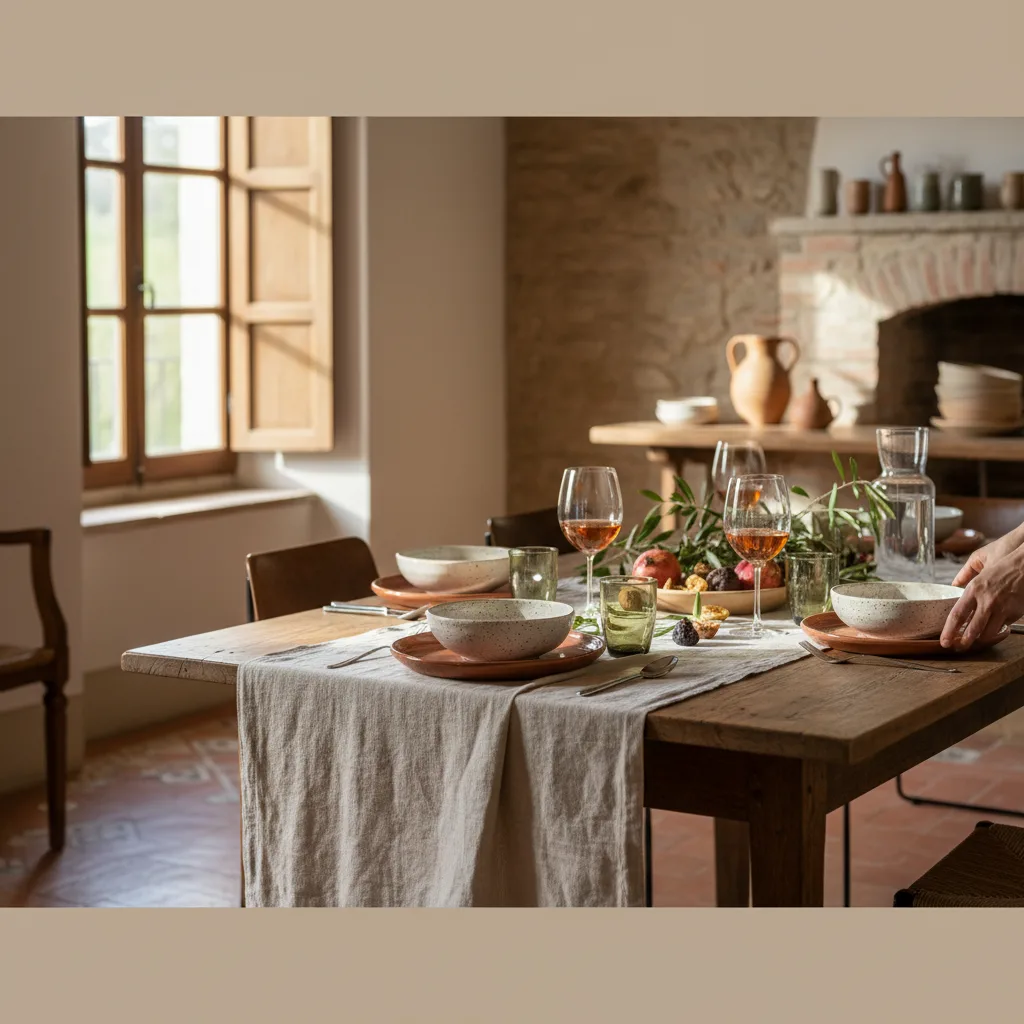
What makes a table Italian (and it is not the flag)
When you walk into an Italian home — not a tourist restaurant, but a real house in Tuscany, in Le Marche or in Puglia — the first thing you notice about the table is the absence of any apparent effort. Everything looks natural, as if it had landed there by chance. But it is not chance: it is judgement.
The Italian table is built on three principles that are rarely put into words but that any Italian host applies instinctively. The first is materiality: linen instead of polyester, ceramic instead of melamine, wood instead of plastic. Natural materials are not a decorative matter but a sensory one. The feel of a linen napkin, the weight of a handmade ceramic plate, the texture of an olive-wood board — all of that is part of the experience of eating.
The second principle is proportion. An Italian table is neither empty nor crammed. There is enough room for each guest to move comfortably, for the plates to breathe, for the centrepiece not to get in the way of face-to-face conversation. The rule is simple: if you have to move something aside to pass the bowl of pasta, there is too much on the table.
The third, and perhaps the hardest to copy, is relaxed intentionality. In Italy, the table is set with care but without rigidity. Napkins do not have to be folded into the shape of a swan. The cutlery does not need to be aligned to the millimetre. What matters is that every piece is there for a reason — functional or aesthetic — and that the whole invites you to sit down, to stay, to come back for more.
The foundation: table linens you can touch and feel
The tablecloth is the first visual and tactile contact with the table. On a real Italian table, the plastic tablecloth or oilcloth simply does not exist. Nor does the spotless white hotel tablecloth, except at a very formal dinner.
What does work is natural linen. A linen tablecloth in an ecru, sand, off-white or light grey tone is probably the most worthwhile investment you can make to transform your table. Linen has a texture that improves with washing, it absorbs well, it drapes elegantly and — this is important — it does not need to be ironed to perfection. The soft wrinkles of linen are part of its charm, not a flaw.
If a tablecloth feels like too much for everyday use, linen or heavy-cotton placemats serve the same function with less commitment. What matters is not covering the whole table, but that whatever you put under the plates has quality and is consistent with the rest.
As for napkins, the Italian rule is clear: cloth, whenever you can. They do not have to be linen matching the tablecloth — a cotton napkin in a tone that contrasts gently already lifts the table three levels above paper. Folded into a simple rectangle or rolled up with a sprig of rosemary. Nothing more.
Dinnerware: fewer complete sets, more pieces with character
This is where the Italian table differs most from the Spanish or Central European tradition. In many Italian homes there is no 72-piece dinner service bought all at once. What there is, is a collection built up over time: soup plates from one series, dinner plates from another, bowls found at a flea market in Deruta, a serving dish inherited from grandmother.
That mix is not carelessness, it is personality. And it is perfectly replicable if you understand the principle behind it: consistency of tone, not uniformity of design. You can combine pieces from different collections as long as they share a colour family or a similar finish. White ceramic with an irregular rim alongside cream ceramic with a matte glaze. A cobalt-blue soup plate with dinner plates in a bone tone. What does not work is mixing without any criteria: fine porcelain with coloured melamine, or rustic stoneware with ultra-modern designer glass.
Italian dinnerware tends towards the generous format. The plates are wide, the bowls are deep, the serving dishes are large — because they are meant for sharing, not for serving individual portions measured to the gram. If anything defines an Italian table, it is that the food arrives in the centre and everyone serves themselves.
Italian ceramic dinnerware with an artisanal finish
The order of the plates on the Italian table
If you want to go a step beyond "putting out pretty plates", Italian table protocol has its own logic — simpler than you might imagine:
| Element | Position | Italian note |
|---|---|---|
| Charger plate (sottopiatto) | The base, always present | Can be wood, ceramic or metal. It is not removed during the meal |
| Dinner plate | On top of the charger | For the primo (pasta, risotto) and the secondo |
| Soup plate | Brought in with the primo | Not set out from the start; it arrives with the pasta course |
| Bread plate | Top left | Smaller, sometimes replaced by a shared board |
| Cutlery | Fork on the left, knife on the right | The knife blade always facing the plate |
| Glasses | Top right | Water (larger) and wine (slightly lower) |
| Napkin | On the plate or to the left | Folded simply, never in elaborate shapes |
A detail many people are unaware of: in Italy, the soup spoon is not placed on the table unless there is soup on the menu. And the dessert fork is brought in with the dessert, not left waiting from the start. The table begins clean and adapts to the rhythm of the meal.
The centrepiece: natural, low and never in the way
The centrepiece is where the difference between a thoughtfully composed Italian table and a table decorated by accumulation shows most. In an Italian home, the centrepiece follows an unwritten rule: it should be beautiful enough that you look at it and low enough that it does not stop you seeing the person across from you.
Forget the metre-and-a-half-tall vertical floral arrangements. What works on an authentic Italian table are low centrepieces, often edible or mixed. A ceramic bowl with lemons and bay leaves. An olive-wood board with oil, bread and coarse salt. A trio of low candles surrounded by fresh rosemary. Seasonal fruit — figs, grapes, pomegranates depending on the time of year — arranged with no apparent order in a serving dish.
The key is that the centrepiece tells you something about the season, about what is going to be eaten, about the moment. It is not a fixed ornament that no one touches; it is a living part of the table. In Italy, it is perfectly normal for someone to pick a fig from the centrepiece during the conversation. That is hospitality, not mess.
If you want to dig deeper into proportions and heights for centrepieces, the rule of 3 for centrepieces will help you understand how to balance the elements without overcomplicating things.
Glasses, water and wine: the ritual you do not skip
On a table set the Italian way there is always — always — a water glass and a wine glass. Even if beer is being drunk. Even if someone does not drink alcohol. The water glass is the larger one and is set out first; the wine glass, slightly lower and to the right.
In Italy, water is served from a bottle (usually glass, not plastic on the table) and the wine is poured by the host, not by each guest for themselves. It is a gesture of courtesy that sets the rhythm of the meal. No one fills their glass to the top; a third is poured and then topped up. That detail says more about Italian style than any checked tablecloth.
If you are looking for glasses with character that do not look as if they came out of a generic hospitality catalogue, Italian-design glasses strike a balance between elegance and everyday usability that is hard to find in the big-box stores.
Lighting: candles yes, candelabras not (necessarily)
The light at an Italian dinner does not come from the ceiling. Or at least not only from the ceiling. Candles are an almost obligatory element from mid-afternoon onwards, but not the scented candles from the bathroom or the Victorian silver candelabras.
What works are simple, low candles: white votives in glass or ceramic holders, thick unscented pillars placed directly on the table (with a base to protect the tablecloth), or even small lanterns with a candle inside. Candlelight at an Italian dinner is not trying to create a "romantic mood" — it is trying to soften the shadows, make the food look more appetising and light up the guests' faces from below with warmth.
If you dine outdoors — terrace, garden, patio — warm bulb string lights are the perfect complement. In Italy you will see them at almost any outdoor dinner from May to October. No coloured or flashing lights: warm filament bulbs, full stop.
What NOT to put on an Italian table (a quick elimination guide)
Knowing what to leave out is just as important as knowing what to include. Here is a quick elimination list based on what you will never see on a real Italian table:
- Red-and-white checked tablecloth — it exists in tourist trattorias. In homes, no.
- Breadsticks in a little basket — grissini are eaten in Piedmont, but they are not a universal decorative element.
- Restaurant-style salt and pepper shakers — salt goes in a small bowl with a little spoon; pepper is ground fresh if needed.
- Artificial flowers — in Italy, if there are flowers, they are fresh. If there are none fresh, better green branches, herbs or nothing.
- Disposable tableware — not even at an informal barbecue. Real plates, metal cutlery, glass glasses. Always.
- A centrepiece that blocks faces — if you cannot see the person across from you, the centrepiece has failed.
- Too many decorative objects — the table is filled with food, not with ornaments.
How to adapt the Italian style to your home (without living in Tuscany)
You do not need a farmhouse overlooking an olive grove to set a table with Italian style. What you need is to apply the principles — materiality, proportion, intentionality — with the pieces you have or the ones you gradually add.
Start with one change at a time. If your current tablecloth is polyester, swap it for a linen one. If your plates are all identical and bland, introduce a couple of ceramic bowls with character. If you never put out a centrepiece, try a bowl with lemons. They are small, affordable changes, and the cumulative effect is enormous.
The second thing is to think of food as part of the decor. A dish of cherry tomatoes, a board with cheese and cured meats, a beautiful oil cruet with real oil — in Italy, food on the table is not just eaten: it is shown, shared, enjoyed with the eyes before the palate. That philosophy turns any Tuesday dinner into something special.
And the third: invest in a few good pieces rather than many mediocre ones. An Italian ceramic vase that you also use as a centrepiece. A serving dish that is as beautiful empty as it is full. A couple of charger plates that elevate whatever plate you set on top. That is the curation that makes a table Italian, wherever you live.
Quick checklist: your Italian table in 10 points
Before seating your guests, run through this list:
- Tablecloth or placemats in a natural fibre (linen, heavy cotton)
- Cloth napkins, folded simply
- A charger or base plate at each setting
- Dinner plate + soup plate only if there is a soup course
- Cutlery: fork on the left, knife on the right (blade facing inward)
- A water glass + a wine glass per guest
- Water in a glass jug or bottle (no plastic on the table)
- A low, natural centrepiece that does not block faces
- Low candles if it is dinner
- Bread on a shared board or an individual plate — never in a bag
Complementary pieces to complete an Italian table with coherence
Frequently asked questions about the Italian table setting
Is a charger plate mandatory for an Italian table setting? It is not mandatory, but it is very common. The charger plate (sottopiatto) protects the tablecloth, gives presence to each place setting and lets you play with combinations of materials (ceramic on wood, for example). If you can only add one new element to your table, the charger plate is probably the one with the most visual impact.
Can I mix dinnerware pieces from different collections? Yes, and in fact it is the most Italian thing you can do. The key is to keep a consistent tone: the pieces should share a colour family or a similar type of finish. Everything does not have to be identical; what matters is that the whole feels harmonious.
Which flowers are best suited for an Italian centrepiece? Wild or seasonal flowers: daisies, lavender, olive branches, flowering rosemary, small garden roses. What matters is that they are fresh, with short stems (so they do not block faces) and that they do not have a strong scent that competes with the food.
How do I set the table if I do not have room for everything? Prioritise the essentials: plate, cutlery, glass, napkin. The centrepiece can be minimal (a candle and a sprig) or simply the food in beautiful serving dishes. The Italian way is not about having lots of things, but about choosing the ones you do have with intention.
Is an Italian table setting only for formal dinners? Not at all. Most Italian families set the table with a certain care even for a weekday meal. The difference between everyday and a special dinner is in the details (candles, flowers, the good tablecloth), not in the principle: always real plates, always metal cutlery, always a table that invites you to sit down.