Wedding centrepieces: 15 elegant ideas
You are planning a wedding and the wedding centrepieces are that detail that seems minor until you sit down in front of an empty table and everything looks unfinished. The centrepiece sets the tone of the banquet: it says whether the celebration is intimate or grand, whether the style is country or ballroom, whether you have cared for every piece or let the florist decide for you. And most importantly: it is what your guests will have in front of them for hours, between courses, between toasts and conversation.
This guide is not a generic Pinterest catalogue. Here you will find 15 real ideas, organised by style, with practical criteria so you can choose knowing what works, what doesn't and why. From minimalist proposals to floral compositions with character, by way of Italian ceramic pieces that elevate any table without the need to overdo it.
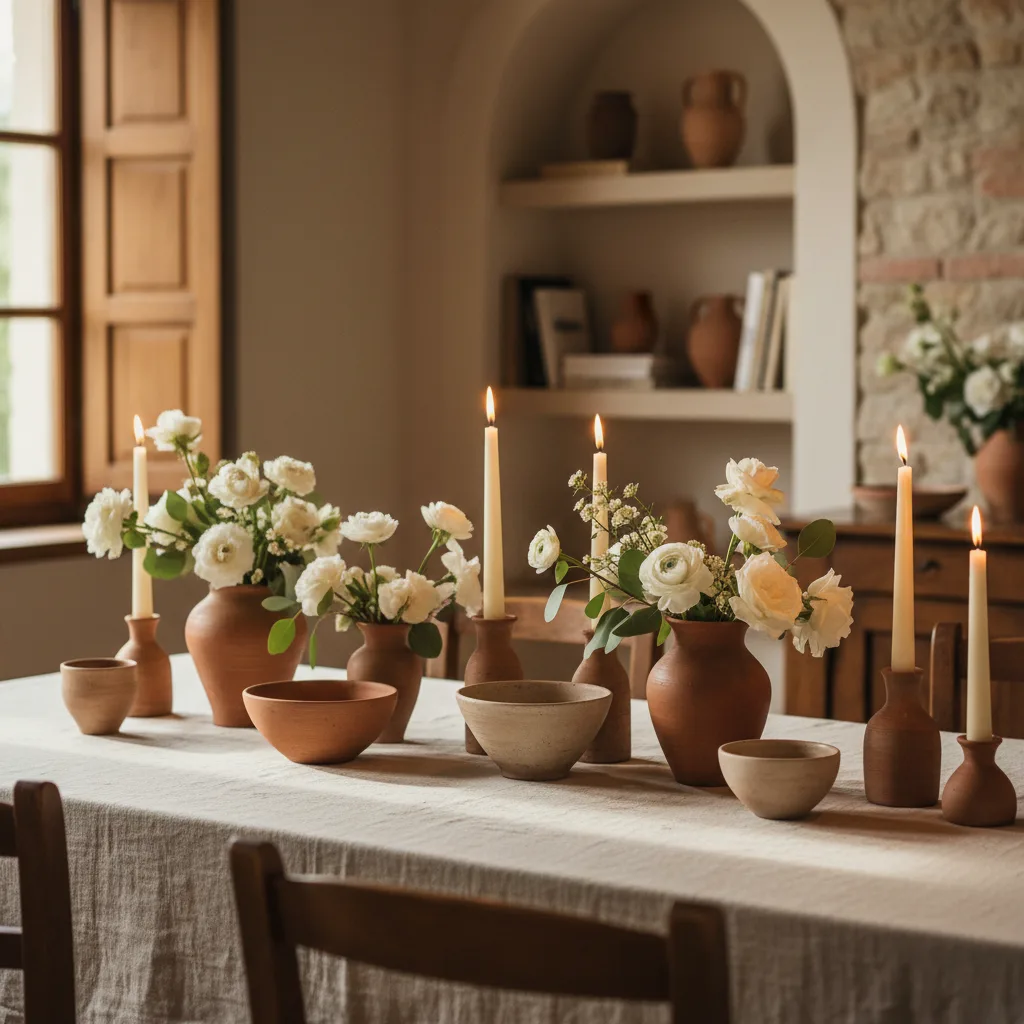
Why the centrepiece defines your wedding more than you think
There is a mistake that recurs at almost every wedding: spending weeks on the menu, the dress and the guest list, and sorting out the table decoration in a single afternoon. The result is usually a generic centrepiece that says nothing about the couple or the celebration.
The centrepiece fulfils three functions that go beyond the decorative. First: it establishes the visual scale of the banquet. A centrepiece that is too tall on a round table of eight people creates a physical barrier between guests, and one that is too small on a banquet table of twenty gets lost. Second: it reinforces the colour palette. If you have chosen sand and sage green tones for the stationery and the altar flowers, the centrepiece should continue that line without competing. Third: it sets the level of care. When a guest sits down and sees a piece with texture, with weight, with intention—a handcrafted ceramic bowl, a blown-glass vase—they perceive that every detail has been thought through.
The difference between a pretty wedding table and a memorable one usually lies in the quality of the pieces that hold it together. Not in the number of flowers, but in the container that holds them. Not in the number of candles, but in the candleholder that gives them context.
Minimalist ideas: less is (truly) more
Minimalism at weddings does not mean austerity or coldness. It means that every element that appears on the table has a reason to be there, and that whatever is superfluous has been removed with judgement.
A single vase with one branch
One of the most elegant and simplest proposals to execute: a clear glass or neutral-toned ceramic vase, with a single branch of olive, eucalyptus or cotton. Nothing more. It works especially well on long banquet tables, where you can repeat the same vase every metre and a half, creating a clean visual rhythm. The key is the quality of the vase: if it is generic, it looks empty; if it has character—an uneven glaze, glass with a bubble, an organic shape—it looks intentional.
A trio of candles at different heights
Three pillar candles of different sizes, grouped on a base plate or a low tray. No flowers, no greenery, nothing else. The trio of heights creates visual depth and, when lit as evening falls, completely transforms the atmosphere of the table. So it doesn't look improvised, the support matters: an Italian ceramic tray in a sand or terracotta tone gives it presence without competing with the candles.
A low bowl with seasonal fruit
It may sound unconventional, but a generous bowl with figs, pomegranates or Amalfi lemons is one of the most Italian—and most ancient—ways to decorate a celebration table. The fruit brings colour, volume and an organic touch that artificial flowers never achieve. Plus, once dinner is over, the guests can help themselves. Functional and beautiful: the combination that ages best.
Ideas with fresh flowers: the classic, done well
Flowers remain the most common choice for wedding centrepieces, and rightly so. The problem is not the flowers themselves, but how they are used: disproportionate arrangements, combinations that don't dialogue with the rest of the table, plastic containers that give away the budget.
Seasonal flowers in low ceramic bowls
The basic rule that many florists forget: the flowers should be in season. Peonies in June, hydrangeas in September, ranunculus in spring. Forcing flowers out of season pushes up the budget and shows in their freshness. Placed in low ceramic bowls—not in tall vases that block conversation—they create a garden-at-table-level effect that is elegant without being pretentious.
Wedding decoration experts agree on one principle: the height of the centrepiece should never prevent eye contact between guests. A low centrepiece, around 20-25 cm at most, keeps the table open and sociable. This is especially important on round tables, where the distance between guests is already greater.
Individual bud vases scattered across the table
Instead of one large centrepiece, several small bud vases—glass, glazed ceramic, even antique bottles—scattered across the table with two or three stems each. This trend, which wedding planners are strongly recommending for 2026, creates the effect of a gathered field laid across the table. The secret is that all the containers share the same visual family: same material or same palette, even if they vary in shape and size.
A floral garland as a table runner
For long banquet tables, a low garland of greenery—eucalyptus, rosemary, olive—with flowers interspersed replaces the classic centrepiece with a green runner that spans the entire length. It is spectacular, but it requires more floral investment. If you want the effect without doubling the budget, alternate stretches of garland with low ceramic centrepieces that visually extend the green line.
Ideas with ceramics and glass: pieces that last longer than flowers
This is where the choice of container stops being secondary and becomes the centrepiece in itself. A handcrafted Italian ceramic piece or a blown-glass vase needs no flowers to work: it has enough presence, texture and character on its own.
A ceramic centrepiece with an uneven glaze
Ceramic pieces with a handcrafted finish—glazes that vary slightly from one piece to another, organic edges, textured surfaces—bring something to the table that perfect glass cannot: warmth. A ceramic centrepiece in sand, cream or sage green blends with linen table settings and cotton napkins, creating a table that looks straight out of a Tuscan farmhouse. After the wedding, that piece goes home with you and works in your dining room for years.
Coloured glass goblets or vases
Coloured glass—amber, bottle green, cobalt blue—has come back strongly to celebration tables. A group of three or four glass goblets in complementary tones, with a floating candle or a short stem inside, creates a luminous effect when light passes through them. If your wedding is in the evening, this effect multiplies with the candlelight around it.
Mixed pieces: ceramic + glass + greenery
The winning combination for many Mediterranean-style weddings: a ceramic centrepiece as the base, a small glass vase with two or three stems, and loose sprigs of rosemary or lavender on the tablecloth. Three visual layers that complement one another without competing. The result is a table with depth, texture and a subtle scent that cut flowers don't usually provide.
Ideas by table type and space
Not all tables are the same, and the centrepiece that works on a round indoor table can get lost on an outdoor banquet table. Adapting the proposal to the table format is as important as choosing the flowers.
Round table: a single, well-proportioned centrepiece
On round tables of 8-10 guests, a single centrepiece works better than several scattered elements. The ideal proportion: the centrepiece should not take up more than a third of the table's diameter. A generous ceramic bowl with low flowers, or a composition of three candles with greenery, is usually the right scale. If your table is round and you don't know which proportion to choose, the one-third reference is a good starting point.
Banquet table: rhythm and repetition
Long tables call for repetition with variations. The same type of centrepiece—for example, a low ceramic vase—repeated every 1.2-1.5 metres, alternating with groups of candles or small bud vases. The visual rhythm guides the eye along the table and prevents "empty" zones and "overloaded" zones. It is the same rule of proportion and height that applies in a dining room, scaled up to the banquet format.
Outdoors and indoors: what changes
Outdoors, fresh flowers hold up less well if it's hot, and candles blow out in the wind. Practical solutions: hardier flowers (succulents, proteas, ornamental thistles), candleholders with a glass screen, and centrepieces with enough weight that a gust of wind won't knock them over. Ceramic is a better ally than fine glass outdoors precisely for that reason: it has more weight, more stability and won't chip with an accidental knock.
The colour palette: how to get it right without taking risks
The colour of the centrepiece should be an extension of the wedding's overall palette, not an independent decision. A simple way not to get it wrong: choose the centrepiece in a neutral tone (cream, sand, off-white, sage green) and let the flowers provide the accent colour.
| Wedding palette | Recommended centrepiece | Flowers / accent |
|---|---|---|
| White and green | White ceramic or clear glass | White roses, eucalyptus |
| Terracotta and sand | Unglazed terracotta ceramic | Peach dahlias, dried wheat |
| Blue and gold | Cobalt blue or amber glass | Blue hydrangeas, gold candles |
| Dusty pink | Cream ceramic or pink glass | Peonies, ranunculus |
| Sage green and linen | Matte green ceramic | Olive, rosemary, lavender |
For 2026, the trend points towards what wedding planners call "quiet luxury": serene palettes, layers of whites and neutrals, handcrafted ceramics and glassware that reflects light without drawing attention. The Pantone Colour of the Year 2026—Cloud Dancer, a luminous warm white—fits this direction.
If you want to go deeper into how to coordinate the centrepiece with the rest of the table, the guide on how to choose the perfect centrepiece for your dining room applies the same principles on a domestic scale.
Mistakes that ruin a wedding centrepiece
After seeing what works, a quick run-through of what doesn't—and what recurs at far too many weddings:
Centrepieces that are too tall on round tables. If the centrepiece exceeds 30 cm on a round table, your guests will be leaning to the sides to see each other while they talk. The conversation breaks down and the table feels divided.
Flowers that smell too strong. Oriental lilies, jasmine and gardenias have an intense scent that, in an enclosed space with food in front of you, can be uncomfortable. Opt for flowers with a soft scent or no scent: garden roses, hydrangeas, ranunculus.
Generic containers. A bargain-store glass vase costs little, but it also brings little. If you are investing in quality flowers, a carefully crafted menu and personalised stationery, the container that holds the centrepiece deserves the same attention. An authentic Italian ceramic piece is not an expense: it is an investment that goes home with you after the wedding and works in your home for decades.
Ignoring the logistics. Centrepieces have to be transported, set up and taken down. Very elaborate floral compositions need water, they wilt, and by the end of the night they are waste. Solid ceramic or glass pieces are stored, reused or given to guests as a keepsake.
Not doing a scale test. Before ordering 20 centrepieces, set one up on a table the same size as those at the banquet, with plates, glasses and cutlery in place. The catalogue photo always shows an empty table, but you need to know how it looks with everything on top.
Checklist: before deciding on your wedding centrepiece
- Have you checked the format of the banquet tables (round, banquet, mixed)?
- Does the centrepiece respect the one-third rule (taking up no more than 1/3 of the table's width)?
- Does the height allow eye contact between guests (max. 25 cm on round tables)?
- Are the flowers in season for your wedding date?
- Is the container of high enough quality to be reused afterwards?
- Is the centrepiece's palette coherent with the rest of the decoration?
- Have you done a real test with the full table (plates, glasses, cutlery)?
- Have you considered the conditions of the space (indoor/outdoor, wind, temperature)?
How to make your wedding centrepiece a keepsake too
A growing trend—and one that makes complete sense—is to choose centrepieces you can take home after the celebration. Instead of flowers that wilt in two days, an Italian ceramic piece or a blown-glass vase becomes the first decorative object of your new life together. Every time you set it on the dining table, at Sunday dinner or an evening with friends, that centrepiece takes you back to your wedding day.
Some couples go a step further and buy centrepieces that they later give to guests as a thank-you keepsake. If you choose pieces with personality—not generic souvenirs, but objects people actually want to have at home—the centrepiece serves a double purpose: it decorates the wedding and becomes a meaningful wedding gift.
At Vita Italian Living we are the Brandani online store in Spain, and many of our Italian ceramic and glass pieces were born for exactly this: celebrations where the detail matters. If you are looking for wedding centrepieces with character, authentically Made in Italy, that you can keep using afterwards, explore our centrepiece collection.
Table accessories that complete the wedding banquet decoration.
Frequently asked questions about wedding centrepieces
How much does a wedding centrepiece cost? It depends heavily on the style and the materials. A simple centrepiece with candles and greenery can start from €8-15 per table. A professional floral arrangement with a quality container can run around €30-80 per table. Italian ceramic or glass pieces—which you reuse afterwards—are usually between €25-90, and work as a long-term investment.
How many centrepieces do I need? One per table for round tables. For banquet tables, one centrepiece every 1.2-1.5 metres. For a wedding of 100 guests with tables of 8-10, you will need between 10 and 13 centrepieces.
Can you mix centrepiece styles at the same wedding? Yes, but with coherence. You can vary the composition (some tables with flowers, others with candles) as long as the container and the palette are the same. What does not work is mixing opposing aesthetics: rustic on some tables and industrial on others.
Which flowers hold up best at an outdoor summer wedding? Succulents, proteas, carnations, chrysanthemums and ornamental thistles withstand the heat well. Garden roses and hydrangeas hold up if they are kept hydrated. Avoid peonies and ranunculus in the middle of August: they wilt quickly in high temperatures.
Can I use centrepieces without flowers? Of course. Candles, fruit, ceramic pieces, dried branches, lanterns, antique books… There are dozens of options that work without a single flower. In fact, flower-free centrepieces are usually easier to transport, set up and preserve.
Related articles:
- How to choose the perfect centrepiece for your dining room
- The rule of 3 for centrepieces: proportion, height and function
- 10 modern centrepiece ideas for 2026
- What to put as a centrepiece: the no-cliché guide
- A centrepiece with flowers and candles: a step-by-step guide
- An original wedding gift: what Italians give at a wedding
- Ceramic or glass vases: which to choose for your space