A Premium Alternative to Maisons du Monde and Zara Home (Without Paying More)
You walk into a friend's home and instantly recognise the plates. They're the same ones you saw in Zara Home last week. The same ones your sister-in-law has. The same ones that appear in every table-setting reel. When you're looking for designer plates that bring something different, the mass-market offering falls short: lots of volume, little character. And the question that comes up is always the same: is there a real alternative that doesn't blow your budget?
The answer is yes. And it's closer than you think — specifically, a 24-to-72-hour shipment away from an importer that works directly with Italian manufacturers.
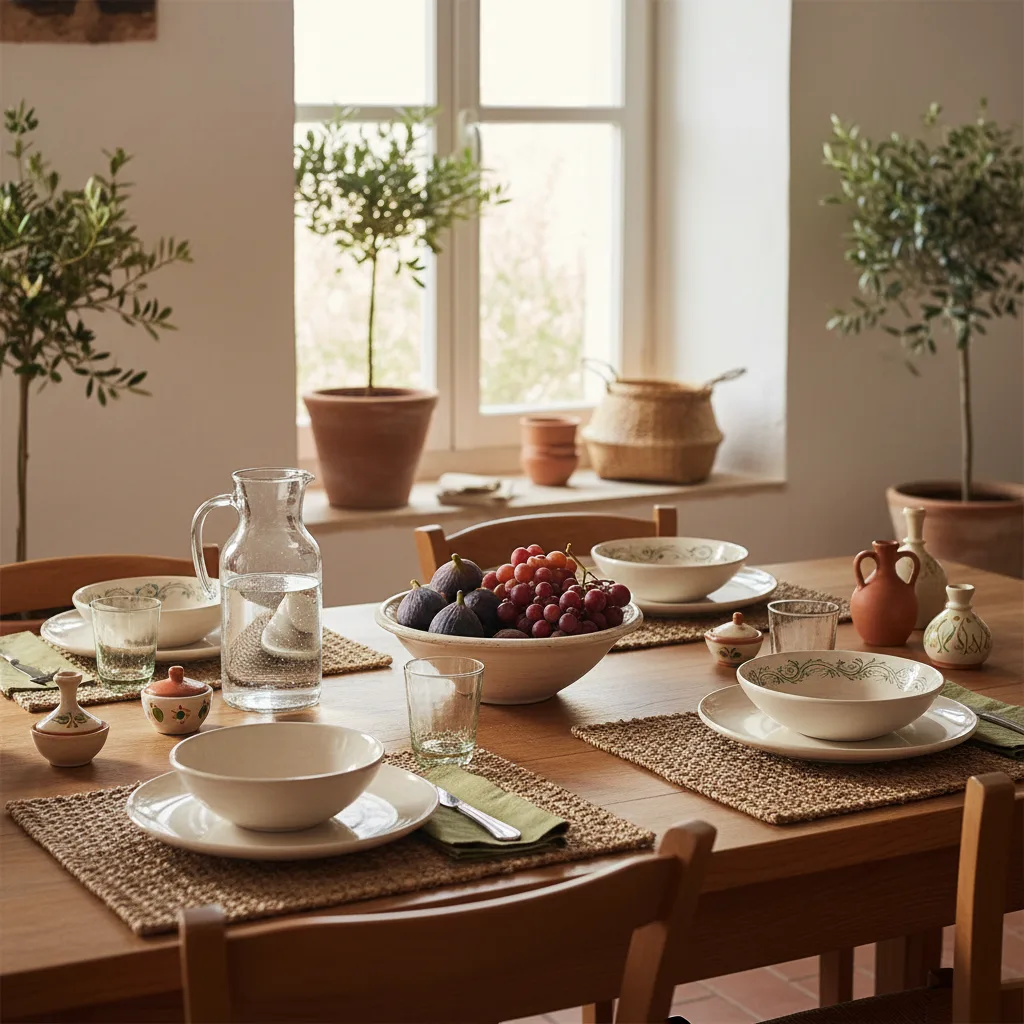
Why Zara Home and Maisons du Monde no longer surprise anyone
It's not that they're bad options. Both chains have democratised access to home design, and that deserves credit. The problem is scale: when a shop sells millions of units of the same plate, that plate stops telling a story. It becomes background, not protagonist.
Zara Home rotates collections at fast-fashion speed. What you see today disappears in six weeks. That creates buying urgency, but also fragility: the tableware you lovingly chose in March no longer has replacement pieces in September. Maisons du Monde offers more catalogue stability and an appealing Mediterranean aesthetic, but its production is still industrial and globalised — the origin of the product rarely appears on the label.
The result is a paradox: shops that promise to personalise your home end up homogenising it. Your table looks like your neighbour's because you both bought from the same place, the same month, the same collection.
What "premium" really means in tableware
The word premium is used so much that it has lost its edge. In décor, many brands apply it to any product that costs 20% more than IKEA. But when we're talking about designer tableware and homeware, premium should mean three concrete things.
Traceable origin. Knowing where the piece was made, by whom, and with what tradition behind it. Not a "designed in Europe, made somewhere in Asia," but a transparent production chain.
Design with lasting intent. Premium tableware doesn't follow the trend of the season; it transcends it. Italian designer plates that have been in production for decades prove it: their lines worked in 2005 and they work in 2026 because they start from real use, not from the Instagram feed.
Material quality you can feel by touch. The weight of a well-fired ceramic plate, the shine of a hand-applied glaze, the rim that doesn't chip after a hundred dishwasher cycles. This doesn't show in a catalogue photo, but you feel it at the table every day.
Italian homeware as a third way (neither mass-market nor unattainable luxury)
For centuries Italy has been solving a dilemma that northern Europe still hasn't cracked: how to make the everyday beautiful without it ceasing to be functional. The Italian ceramic tradition — from Tuscany to Emilia-Romagna, from Deruta to Faenza — doesn't make pieces for the display cabinet. It makes pieces to use, break, replace and enjoy.
That philosophy fits perfectly into the gap left by the big chains. You don't need a Hermès dinner plate at €200 each to have a table with character. Nor do you need to settle for the printed stoneware of the moment that half the country shares. There's a middle segment — Italian brands with decades of history, their own production and selective distribution — that offers authentic design at prices that compete directly with Maisons du Monde.
We're talking about pieces between 15 and 80 euros that you won't find at your local shopping centre. That relative exclusivity isn't a whim: it's what guarantees your table has a character of its own.
An honest comparison: what you gain and what you lose
Comparing a specialised Italian brand with retail giants isn't a black-or-white exercise. Each option has its place. But it's worth knowing what you're really choosing.
| Criterion | Zara Home | Maisons du Monde | Premium Italian homeware (e.g. Brandani) |
|---|---|---|---|
| Place of manufacture | Global (mostly Asia) | Global (Asia/Europe) | Italy — own or controlled production |
| Collection turnover | Very high (fast deco) | Medium-high | Low — stable catalogue with annual new arrivals |
| Replacement of pieces | Difficult after a season | Moderate | High — permanent ranges |
| Price range (dinner plate) | €6-15 | €8-18 | €10-25 |
| Exclusivity | Low (millions of units) | Medium-low | High (not sold in big-box stores) |
| Traceability | Scarce | Scarce | Total — identified manufacturer |
| Gift experience | Generic | Acceptable | Considered — original packaging |
The real price difference between Zara Home's mid-range and an authentic Italian piece is 3-8 euros per unit. On a set of six plates, we're talking about 20-50 euros more for a leap in quality you notice the moment you set the table.
⚠ PRODUCT_CARD sin match — A set that needs no explanation: you put it on the table and it speaks for itself.
Five signs you need to make the leap
Not everyone needs Italian tableware. If you're happy with your current tableware and you don't mind it being the same as half the neighbourhood's, that's perfectly fine. But there are clear signs that mass-market has become too small for you.
You recognise your plates in other people's homes. It's not a one-off coincidence — it happens often. It's the clearest symptom that your table has lost its identity.
You've tried to replace a broken piece and the collection no longer exists. Fast-fashion chains aren't designed to last for decades. Their business model depends on you renewing, not replacing.
You pay attention to materials and you notice the difference. When you pick up a well-made ceramic plate and then go back to lightweight industrial stoneware, the contrast is physical. If you already perceive it, you're unlikely to go back.
You entertain guests often and the table matters to you. Not for show, but because you understand that setting the table is an act of hospitality and you want the pieces to live up to the occasion.
You're looking for a gift that isn't generic. You've given things from Zara Home and, although they went down well, you know the recipient probably already had something similar. You want a gift that will be remembered.
How to spot authentic Italian homeware (and avoid imitations)
"Italian style" has become a marketing hook for products that have nothing Italian about them except the typography on the packaging. If you're going to invest in pieces with a real origin, it pays to know what to look for.
A manufacturer identified by name and location
An authentic Italian brand states who makes it, where, and since when. Brandani, for example, has been producing homeware in Italy for more than 75 years — that's verifiable with a quick search. If the brand has no published history or identifiable headquarters, be suspicious.
A specialised online store with the full catalogue in Spain
The sales channel matters. An online store specialising in Brandani like Vita Italian Living works with the manufacturer's full catalogue, answers in Spanish and handles returns under Spanish regulations. If you buy "Italian homeware" on a generic marketplace, no one answers if something arrives defective.
Materials declared with precision
"Ceramic" is a broad term. Serious Italian brands specify: stoneware, terracotta, porcelain, glazed ceramic, and detail the process (firing, glazing, manual finish). That transparency isn't a minor technical detail — it's what sets apart a piece of ceramic that lasts for decades from one that chips within months.
Beyond the plates: pieces that transform the table without replacing the whole set
You don't need to change all your tableware to elevate the table. Sometimes it's enough to introduce one or two pieces with character that break up the monotony of the set. It's a smarter (and more economical) strategy than a complete overhaul.
An Italian ceramic table centrepiece changes the perception of the whole table without touching a single plate. The same goes for a decorative tray that works as a base for serving or as a visual organiser. Or a vase with character that anchors the composition.
The key is to mix with judgement: your current tableware (wherever it's from) combined with the odd Italian piece creates a result that is yours alone. No one will replicate that exact combination, because not everyone has pieces from selective distribution.
This is, in fact, the smartest way to start: one special piece, then another, and little by little your table takes on a personality that no fast-deco catalogue can offer.
Italian decorative serving tray
The price question: does it really cost more?
It's the most common objection, and it deserves an answer with numbers. Let's look at a concrete example.
A set of 6 dinner plates at Zara Home costs between 36 and 78 euros, depending on the collection. At Maisons du Monde, between 48 and 90 euros. An equivalent set of Italian ceramic (a brand like Brandani) ranges between 50 and 95 euros — imported, with original packaging and after-sales service in Spanish.
The absolute difference does exist, but it's smaller than perception suggests. And there's a factor the chains don't tell you about: the cost per use. Tableware that lasts 15 years and can be replaced piece by piece works out cheaper than three Zara Home sets that disappear from the catalogue every couple of seasons.
What's more, when the product comes from a specialised online store with a stable catalogue, you're not competing with the January sales or the FOMO of "last units." You buy when you need to, at a fair price, knowing the piece will still be available next year.
How to take the first step (without taking a risk)
If you've never bought Italian homeware online, it's normal to have doubts. You can't touch the product, you don't know the brand, and you're used to the security of a physical shop. Here are three low-risk ways to start.
Start with a functional piece, not a decorative one. A ceramic bowl, a salad bowl with presence or a fruit bowl. Something you use daily and that lets you assess the material quality with your hands, not your eyes. If the piece convinces you in everyday use, you'll know the next step is worth it.
Take advantage of a gift occasion. If you have a wedding, a housewarming or a birthday coming up, giving an authentic Italian piece is a way to try the brand and, at the same time, come across as someone who knows how to choose a gift. Housewarming gifts under €50 are a perfect entry point.
Browse the full catalogue, not just the bestsellers. The big chains show you what they want to sell. A specialised importer shows you the manufacturer's entire catalogue, including the pieces that would never reach a shopping centre.
Frequently asked questions
Is Brandani comparable in quality to brands like Bitossi or Alessi?
Brandani occupies a different segment: affordable Italian designer homeware made for everyday use. Bitossi and Alessi sit higher in price (and, in some cases, in artisanal finish). The Brandani vs Bitossi comparison helps you decide based on your budget and style.
Can I return the product if I'm not happy with it?
Vita Italian Living is an online store specialising in Brandani with a national returns policy. It's not the same as buying from an Italian website and handling an international return. After-sales service is in Spanish and the return timeframes follow Spanish regulations.
Are Italian plates dishwasher safe?
It depends on the specific line, but most of Brandani's ceramic and stoneware collections are designed for everyday use, including the dishwasher. Each product page lists the specific care instructions.
Is it worth paying more if there are only two of us at home?
It is, precisely. When you don't need 12 place settings, you can invest more per piece and notice the difference every day. A couple of dinner plates, a couple of soup plates and a couple of dessert plates in Italian ceramic give you a table with character for less than the cost of a full chain-store set.
What's the difference between buying Brandani on Amazon and at Vita Italian Living?
On Amazon only a fraction of the catalogue is available, with no curation or context. At Vita Italian Living you have the full Brandani catalogue, service in Spanish, returns under Spanish regulations and careful gift presentation.
Complementary pieces to complete your table's transition to authentic Italian homeware.