A Gift for Your In-Laws: The Dilemma Solved with Italian Homeware
Few purchasing decisions cause as much paralysis as choosing a gift for your in-laws. Too personal and you've overstepped. Too generic and you come across as someone who grabbed the first thing they saw. You know this because you've been there: the "safe bet" bottle of wine, the box of chocolates no one remembers the next day, the scented candle gathering dust on a shelf. Choosing gifts for the home with care is, in fact, the smartest way to break out of that cycle. And Italian homeware has something that makes it the solution you hadn't considered: it's useful, it's beautiful, and it says "I thought of you" without being intrusive.
Let's take the dilemma apart, step by step.
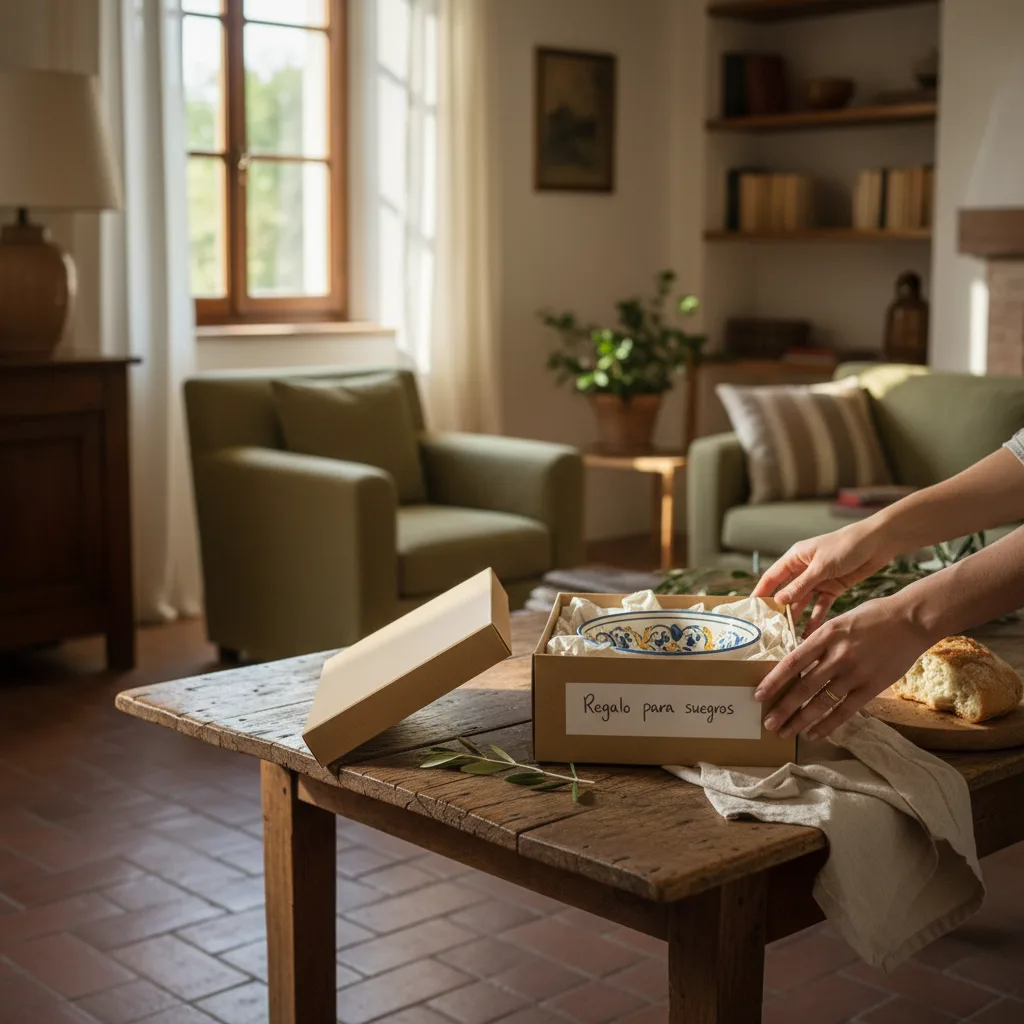
Why giving a gift to your in-laws is so complicated (and how to stop complicating it)
The problem isn't that you don't know what they like. The problem is that you're giving under social pressure. You want to make a good impression, but without looking like you're trying to make a good impression. You want something with personality, but that doesn't impose your taste over theirs. You want to spend just enough for the quality to show, but without seeming ostentatious.
This equation has so many variables that most people opt for the safe-but-boring gift. And that's exactly where the opportunity is lost: a good gift for your in-laws isn't the one that avoids risk, but the one that conveys genuine thoughtfulness. Something that shows you've paid attention to their home, their way of living, what they value. You don't need to have known them for twenty years to do that. Noticing a couple of details is enough.
The key is to switch mental categories. Instead of thinking "gift for in-laws", think "a piece for their home that they'll use and enjoy". That opens up a huge range of options that work for almost any type of person, because we all live in a home and we all eat at a table.
Homeware as a gift: why it works better than you think
When someone says "homeware", the first image that comes to mind is usually a frying pan or a set of glasses. But designer Italian homeware occupies a very different space: it sits halfway between the decorative and the functional. A ceramic centrepiece isn't an appliance you stash away in a cupboard. It's a piece you see every day, one that's part of meals, that accompanies family gatherings.
There are three reasons why Italian homeware works especially well as a gift for in-laws:
It's neutral without being impersonal. A tableware piece doesn't force a change in décor or impose a style. It blends in. A decorative Italian ceramic bowl looks good in a modern kitchen and in a classic dining room. You're not telling them how to decorate their home — you're offering them something that elevates what they already have.
It's useful without being mundane. Unlike an appliance (which can come across as solving a problem they never asked you to solve), a well-designed piece of homeware is used and enjoyed. A decorative salad bowl isn't just a container: it's the piece they bring out when there are guests, the one that sparks comments at the table.
It sits in a comfortable price range. Most premium Italian homeware pieces fall between €25 and €80, right in the range where a gift feels generous but not excessive. It's that sweet spot where quality is evident to the touch and the eye without anyone feeling uncomfortable about the price.
Quick guide: what type of piece to give depending on your in-laws' profile
Not all in-laws are the same, but almost all of them fit into one of these profiles when it comes to their relationship with the home. This table helps you choose without overthinking it:
| In-laws' profile | What they value | Ideal piece | Why it works |
|---|---|---|---|
| They love hosting at home | A well-set table, the details | Centrepiece or serving dish | They'll use it every time they have guests |
| Practical and functional | Things that serve a purpose | Stackable bowls or a multi-use tray | Useful day to day, doesn't gather dust |
| Cooking enthusiasts | Cooking well, presenting well | Large salad bowl or decorative fruit bowl | Goes from the kitchen to the table effortlessly |
| Carefully curated décor | Aesthetics, visual harmony | Ceramic vase or decorative piece | Adds character without imposing a style |
| Minimalists / "they don't need anything" | Quality over quantity, less is more | A single, well-chosen designer piece | Precisely because they own little, they value the good stuff |
The "why it works" column is the most important. Ultimately, the best gift for your in-laws isn't the most expensive or the most original: it's the one that fits their way of living. If you're still unsure which type of piece to choose, the guide on ceramic bowls: sizes and uses helps you understand the differences between formats.
Five pieces of Italian homeware that work as a safe gift
Let's get specific. These are five product categories we've seen work time and again as a gift for in-laws — mother-in-law, father-in-law or both. They all have something in common: they're pieces you can use from day one and that get better with time.
Centrepiece
The most versatile piece. An Italian ceramic centrepiece takes the leading role in the dining room without needing flowers, candles or extra accessories. It's the gift that says "your table deserves something beautiful" without being pretentious. If you want to dig into how to choose the right format, take a look at how to choose the perfect centrepiece for your dining room.
Salad bowl or serving dish
It works especially well if your in-laws enjoy cooking or hosting people at home. A large Italian ceramic salad bowl isn't just a container — it's the piece that presides over the table at family meals. It has that "you can't buy this just anywhere" quality that elevates the gift effortlessly.
Decorative fruit bowl
The safest gift on the list. A ceramic fruit bowl looks good in any kitchen, gets used every day and brings a touch of authentic Italian design to the most lived-in space in the home. If you want to compare options, the guide on decorative fruit bowl or tray gives you clear criteria.
Ceramic vase
For in-laws with a sensibility for décor, an Italian ceramic vase is an almost guaranteed hit. It doesn't need flowers to work — the current trend is precisely to use vases without flowers as a decorative piece. It looks good in an entryway, on a sideboard, on a shelf. And it has that presence that objects made with craftsmanship convey.
Decorative tray
The most versatile of all. A ceramic tray can serve to present appetisers, organise the coffee corner, decorate a side table or simply look beautiful in the kitchen. If you're looking for inspiration on the not-so-obvious uses of a tray, the article on decorative trays: 5 ways to use them will open your eyes.
decorative Italian ceramic trays
Mistakes to avoid when giving a gift to your in-laws
Just as important as knowing what to give is knowing what not to give. These are the most common mistakes — the ones that turn a kind gesture into an awkward moment:
Giving something too personal without enough closeness. Clothing, perfume, jewellery or anything that requires knowing their size, their intimate taste or their bodily preferences. If you don't have that level of closeness, home homeware is safe territory because it's given to the space, not to the person.
The generic, last-minute gift. The mass-produced box of chocolates, the supermarket bottle of wine, the candle with no defined scent. It's not that they're bad gifts — it's that they convey exactly the opposite of what you want: that you haven't spent even a minute thinking. If time gets the better of you, a beautiful fruit bowl can be chosen in five minutes and makes a very different impression.
Imposing your own decorating style. Giving a painting, a lamp or a strongly styled object is risky if you don't know their home well. Homeware and tableware pieces are safer because their design is more restrained and adapts to different decorating styles.
Giving a gift "for both" when it's clearly for just one. If you buy an apron for the father-in-law who cooks, the mother-in-law may feel left out (or vice versa). A tableware piece or a centrepiece is a gift both can enjoy, because it lives in the shared space.
Forgetting the presentation. A beautiful gift in a plastic bag loses half its effect. Presentation matters, especially with in-laws. A Brandani piece comes with carefully designed packaging that reinforces the sense of receiving something special — that detail makes all the difference.
How much to spend: the range that works
This is one of the points that causes the most anxiety. Spend too little and you look stingy; spend too much and it's awkward. The good news is that premium Italian homeware has a price range that fits perfectly with what's expected of a gift for in-laws.
For a first occasion — a birthday, Christmas, a family lunch — a piece between €25 and €50 is perfect. You're in the territory of a decorative fruit bowl, a ceramic bowl or a tray. It's a gift perceived as thoughtful and generous without creating the awkwardness of "this is too much".
For more significant occasions — a wedding anniversary, retirement, a joint gift with your partner — you can move up to the €50 to €90 range, where you'll find centrepieces, large salad bowls or vases with presence. Here the gift already carries the weight of an "important gesture" without crossing the line into the ostentatious.
What matters isn't the exact price but the relationship between what's paid and what's perceived. And this is where authentic Italian design makes the difference: a Made in Italy ceramic piece conveys a quality and a care that justify every euro, something that doesn't happen with generic gifts in the same price range.
Why Italian homeware has the edge over other "safe" gifts
Let's compare the classic gift options for in-laws with designer Italian homeware:
| Classic gift | Common problem | Italian homeware alternative | Advantage |
|---|---|---|---|
| Bottle of wine | Consumed and forgotten | Ceramic fruit bowl | Stays and is used daily |
| Box of chocolates | Fleeting, hardly memorable | Decorative bowl | Stays in the kitchen, a daily reminder |
| Scented candle | Gathers dust, personal taste | Centrepiece | Neutral, functional, the star of the table |
| Plant | Needs care, can die | Ceramic vase | Zero maintenance, always decorative |
| Gift voucher | Impersonal, no emotion | Decorative tray | Personality, usefulness and "I thought of you" |
The underlying difference is this: Italian homeware is a gift that stays. It isn't spent, isn't consumed, doesn't expire. Every time your in-laws set the table or look at their kitchen, that piece will be there reminding them that someone had the thoughtfulness to choose something with care. Not even the most expensive chocolates in the world can achieve that.
If you want to understand better why Italian pieces have that ability to endure, the article on Italian design: why it lasts longer than trends explains it in depth.
How to present the gift (without a speech)
There's no need to explain. In fact, the less you justify the gift, the better. A simple "this is for your home, I hope you like it" is enough. The piece speaks for itself.
If you want to add a personal touch without being twee, include a short handwritten note. Something like: "So your meals have even more character." That's enough. You don't need to mention that it's Italian ceramic, or which shop it came from, or that it's handmade. They'll discover all of that when they see and touch it, and the effect will be far more powerful than if you explain it yourself.
Complementary pieces that also work as a gift for in-laws: multi-use trays, versatile bowls and table sets with Italian personality.
Frequently asked questions
What do you give in-laws who "don't need anything"?
For that very reason, a designer piece of Italian homeware is ideal. It isn't just another object to pile up — it's a piece with character that elevates what they already have. A centrepiece or a ceramic fruit bowl replaces something generic with something that has personality, without adding unnecessary clutter to their home.
Is it appropriate to give homeware to in-laws you've just met?
Yes, as long as it's a neutral, elegant piece. Tableware is safe territory because it isn't a personal gift (like clothing or perfume) but a gift for the shared home. A fruit bowl, a bowl or a tray are options that convey good taste without feeling intrusive.
How much should I spend on a gift for my in-laws?
It depends on the occasion, but the €25 to €50 range works well for most situations. For special occasions such as anniversaries or Christmas, you can go up to €50-90. What matters isn't the exact price but that the piece conveys quality and attention to detail.
What's the difference between Italian homeware and homeware from big-box stores?
The main difference is the design, the materials and the durability. An authentic piece of Italian ceramic has finishes, textures and proportions you won't find in mass production. What's more, because they're pieces from a specialist online store like Vita Italian Living rather than from a big-box chain, you don't run the risk of your in-laws already owning the same piece because they saw it in the same shop as everyone else.
Can I give a single piece, or is a set better?
Both options work. A well-chosen single piece (a vase, a centrepiece) has more visual impact and is perceived as a gift chosen with care. A small set (bowls, for example) is more practical. For in-laws, the single piece usually works better because it conveys more intention and less "convenience shopping".