Real vs Fake Made in Italy: how to tell the difference
You buy a ceramic serving dish that looks Italian. The box has a name that sounds like Tuscany, the colours bring the Mediterranean to mind and the price seems reasonable. But when you turn it over, the mark says something else. Or it says nothing at all. Identifying authentic Italian tableware isn't as simple as looking for a flag on the packaging, and the market for imitations moves more money than you might imagine.
The phenomenon even has its own name —Italian Sounding— and it affects everything from parmesan to the vases in your living room. In this article you'll learn to tell the real thing from what merely looks the part, with concrete criteria you can apply before you buy.
What Italian Sounding is (and why it affects you when buying homeware)
The term Italian Sounding describes a very widespread commercial practice: using names, images or references that sound Italian to sell products that have nothing Italian about them. A name ending in "-ini", "-elli" or "-ano", a typeface that recalls a trattoria, earthy colours and a photo of an olive grove. All the cultural wrapping, without the real content.
According to figures from Coldiretti —the main Italian agricultural organisation— the global market for products passing themselves off as Italian exceeds 60 billion euros a year. The figure is so disproportionate that it far outstrips the value of genuine Italian exports in many categories. Although the most high-profile examples involve food (German parmesan, canned prosecco, Australian mozzarella), the phenomenon extends to homeware, décor and ceramics with the same logic: evoke Italy without manufacturing there.
In the world of tableware and table décor, imitation isn't always crude. Some brands design in Europe, manufacture in Asia and present the product with an unmistakably Mediterranean aesthetic. It isn't illegal as long as they don't explicitly claim the product is Italian. But it is misleading for anyone buying in the belief that they're acquiring something they're not.
What the law says: when something is really Made in Italy
Italian regulation is stricter than many people think, although it has nuances worth understanding. Italian law 135 of 2009 establishes that only products whose design, manufacturing and packaging have been carried out entirely within Italian territory may bear the 100% Made in Italy, 100% Italia or tutto italiano label.
This means it isn't enough to design in Milan and manufacture in another country. Nor is it acceptable to assemble imported parts and label the result as Italian. The entire process —from conception to finishing— must take place in Italy.
There is, however, a middle ground. A product may carry the "Made in Italy" label (without the "100%") if the last substantial transformation took place in Italy, according to the European Union's rules of origin. This distinction matters because it allows certain products with raw materials from outside Italy to be considered Italian if the significant manufacturing process happens there. In artisan ceramics, for example, the clay may come from various European quarries, but the moulding, glazing and firing in an Italian workshop make the piece legitimately Made in Italy.
For the consumer, the key is to distinguish between a legal label (verifiable) and an aesthetic suggestion (the pretty name, the photo of the Tuscan landscape). The first protects you; the second does not.
How to identify authentic Italian tableware: a practical guide
You don't need to be an expert in commercial law to buy wisely. There are concrete signals you can check before you pay, whether in a physical shop or online.
Check the manufacturer's mark
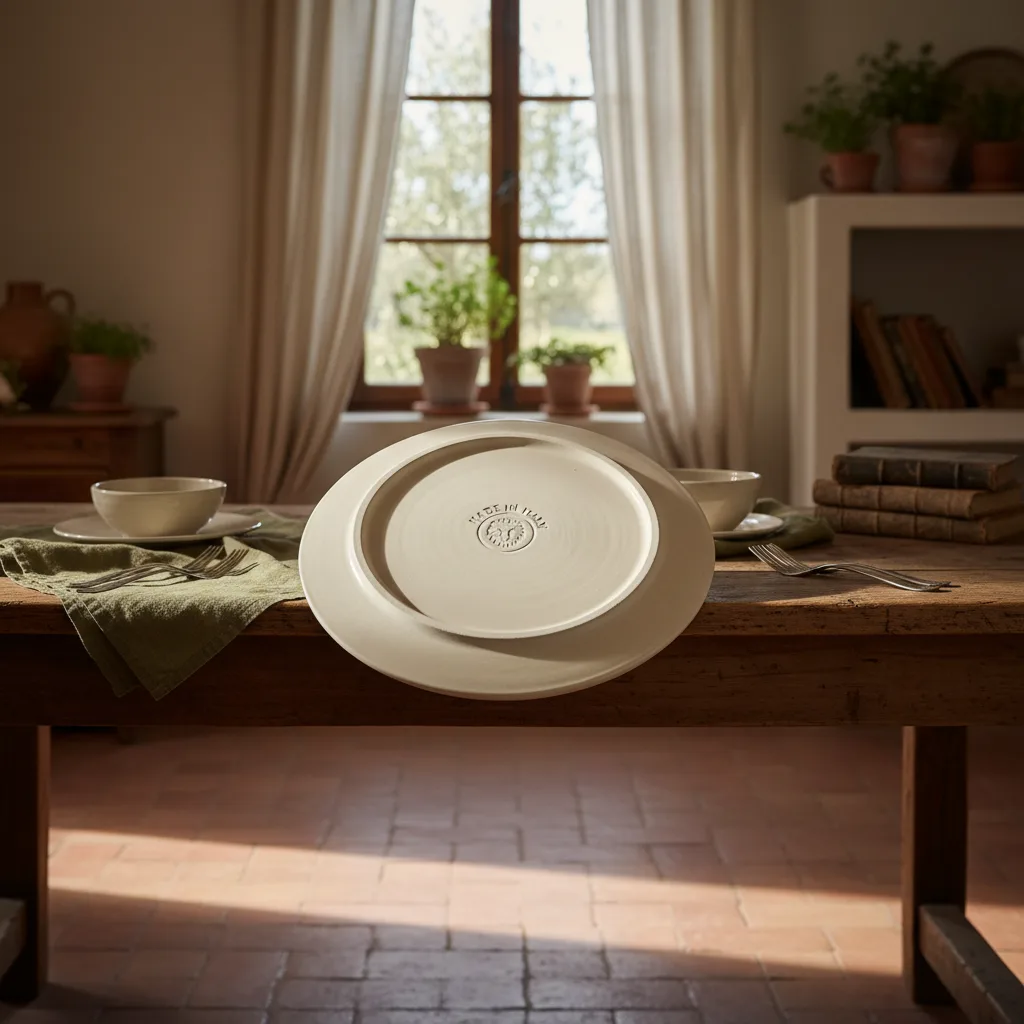
Quality Italian ceramics and porcelain carry the manufacturer's mark on the base of the piece. It isn't a sticker —it's a mark that is printed, engraved or hand-painted into the glaze before firing. This mark includes the name of the workshop or brand, and often the place of manufacture. If the piece has no marking on the base, or only a sticker that peels off, that's a warning sign.
Research the manufacturer
An authentic Italian manufacturer has a history, a verifiable headquarters and, almost always, an online presence with information about its production process. Brands like Brandani, with more than 75 years of experience, keep their facilities in Italy and document their production chain. If you search for the manufacturer's name and only find Amazon listings with no context, it's worth digging deeper before deciding.
Observe the material quality
Authentic Italian tableware has recognisable physical characteristics. Well-fired ceramic is light for its size yet surprisingly sturdy. When you gently tap a piece of porcelain with your knuckle, it should produce a clear, resonant sound, not a dull or muffled one. The finishes are even: the glaze covers without bubbles, the edges have no crude irregularities (artisan irregularities are something else, more subtle and consistent) and the colours retain their intensity.
Examine the packaging and documentation
Authentic Italian products usually come with information about the manufacturer, care instructions specific to the material and, in many cases, a brief reference to the origin. Don't confuse this with eye-catching packaging: a pretty box guarantees nothing. What matters is that there is traceable information —manufacturer's name, address, country of origin— not just an attractive design.
Verify the distribution channel
Who sells the product? A shop that specialises in the brand can answer questions about origin, warranty and the supply chain. A generic seller on a marketplace offering "Italian style" at a suspiciously low price probably can't. Buying through a specialist channel that carries the manufacturer's full catalogue is the safest way to guarantee authenticity.
Quick checklist: is it really Made in Italy?
| Signal | Authentic | Suspicious |
|---|---|---|
| Mark on the base | Manufacturer's mark printed or engraved | Only a sticker or no marking |
| Manufacturer information | Name, location, verifiable history | No data or a generic name |
| Material quality | Light, sturdy, clear sound when tapped | Heavy for its size, muffled sound |
| Finish | Even glaze, clean edges, vivid colours | Bubbles, crude irregularities, uneven colours |
| Packaging | Manufacturer's details, address, country of origin | Just a pretty design with no traceable information |
| Sales channel | Specialist shop with the brand's full catalogue | Generic seller with no link to the manufacturer |
| Price | Consistent with the Italian artisan/industrial process | Too low for what it claims to be |
Why a low price isn't always a bargain (and a high one isn't always a guarantee)
Price is an indicator, but not the only one. A piece of ceramic made in Italy has real production costs: the raw material, skilled labour, the firing kilns, quality control and European logistics. All of that is reflected in a price that, without being necessarily expensive, can't compete with an imitation mass-produced on another continent.
That said, a high price doesn't guarantee authenticity either. Some brands charge a premium for a Mediterranean aesthetic without the product being Italian. The price should be consistent with what you know about the manufacturer, the material and the distribution channel. If all those points add up, the price is usually fair. If information is missing on any of them, the price —high or low— means nothing on its own.
The accessible premium Italian homeware segment —brands with decades of experience that manufacture in Italy using efficient industrial processes— occupies a very interesting middle ground. You're not paying the premium of exclusive luxury, but you are getting genuine Italian design and manufacturing. It's the balance sought by those who want authentic quality without entering the realm of collecting.
The role of certifications and designations of origin
In food, the DOC, DOCG and IGP certifications have spent decades protecting Italian products with a geographical indication. In homeware and décor, the system is less structured, but verification mechanisms do exist.
The Italian Chamber of Commerce and bodies such as the ICE (Istituto per il Commercio Estero) promote authenticity programmes for Italian manufacturers that export. Some brands take part in these programmes and can certify their production chain. It isn't a mark you'll see on every cup, but it is information a serious specialist shop can provide if you ask for it.
In the ceramic field, the regions with a pottery tradition —Tuscany, Umbria, Campania, Emilia-Romagna— have producer associations that bring together local workshops. A brand belonging to one of these associations is an additional sign of legitimacy, although not all authentic brands are members and not all members are artisanal.
The most practical approach for the consumer is to combine several indicators rather than rely on just one. The manufacturer's mark, verifiable information, material quality and a reliable distribution channel. When all four line up, you can buy with peace of mind.
What it means to buy from a specialist shop (and why it matters)
When a shop builds its business around a single Italian brand, it works with the manufacturer's full catalogue, knows every collection and can offer a warranty and customer service in the local language.
This matters because it removes several layers of uncertainty. You're not buying from a third party who bought from another third party who may have acquired an uncontrolled batch. You're buying from someone who works with that brand every day. In the case of Vita Italian Living, for example, being the online store specialising in Brandani in Spain means that every piece comes from the Italian manufacturer, with full traceability.
What's more, a specialist shop usually offers the brand's full catalogue, not just the most popular products. This is especially important in homeware and décor, where the most interesting pieces aren't always the ones that appear on general marketplaces.
Beyond the label: what makes real Italian design different
Identifying an authentic Made in Italy product isn't just a matter of labels and marks. There's something harder to fake: the coherence between design, material and function that characterises the Italian homeware tradition.
Italian table design has a particularity that sets it apart from Nordic, French or Asian design: it starts from the premise that the piece will be used every day, not only on special occasions. That's why it favours discreet ergonomics —a bowl that's easy to hold, a plate with just the right rim, a vase with enough weight not to tip over— combined with an aesthetic that doesn't tire with repeated use. That combination of functionality and everyday beauty is what has sustained Italian manufacturers for generations, and it's what is hardest to replicate in a quick imitation.
If you're interested in how this philosophy translates into the practice of the authentic Italian table, or you want to understand why Italian design lasts longer than trends, you'll find useful context in those articles. And if you'd like to learn the story of a specific manufacturer with more than seven decades of experience, the history of Brandani is a good starting point.
Related articles:
- How to set an authentic Italian table (without the clichés)
- Italian design: why it lasts longer than trends
- The history of Brandani: 75 years of the Italian table
- Brandani vs Bitossi: which one fits your home best
Frequently asked questions
Can a product say "Made in Italy" without being 100% Italian? Yes. The "Made in Italy" label (without the "100%") indicates that the last substantial transformation took place in Italy, according to EU rules of origin. Only the "100% Made in Italy" label guarantees that design, manufacturing and packaging were carried out entirely in Italy.
How do I know if ceramic tableware is genuinely Italian? Check the manufacturer's mark on the base (printed or engraved, not a sticker), research the manufacturer (history, headquarters, documented process) and assess the material quality: consistent weight, a clear ring when tapped gently, an even glaze. If you buy online, make sure the seller is a shop that specialises in the brand and gives clear information about origin.
What is Italian Sounding? It is the practice of using names, images or references that evoke Italy to sell products with no connection to the country. It affects food, fashion and also homeware and décor. This market is estimated to exceed 60 billion euros a year globally.
Does buying on a marketplace guarantee that the product is authentic? Not necessarily. General marketplaces allow multiple sellers to offer the same product, and they don't always verify origin. For products where authenticity matters, it's safer to buy from a specialist shop with clear traceability.
Is a high price a guarantee of authenticity? Not on its own. The price should be consistent with the manufacturer, the material and the sales channel. There are products with a high price and dubious origin, just as there is authentic Italian homeware at affordable prices when bought through direct channels.