The Story of Brandani: 75 Years of the Italian Table
Brandani isn't one of those brands that shows up on Instagram one day with pretty packaging and a three-line manifesto. It's a Tuscan company that has spent decades creating objects for the table and the home with one simple conviction: that the things you use every day deserve to be well designed, well made and built to last. If you've come here looking to find out who's behind this brand, what makes it different and why a Spanish online store has decided to specialise in it, you're in the right place.
This is the story of Brandani — where it comes from, what defines it and why it remains relevant in a market saturated with homeware that has no personality.
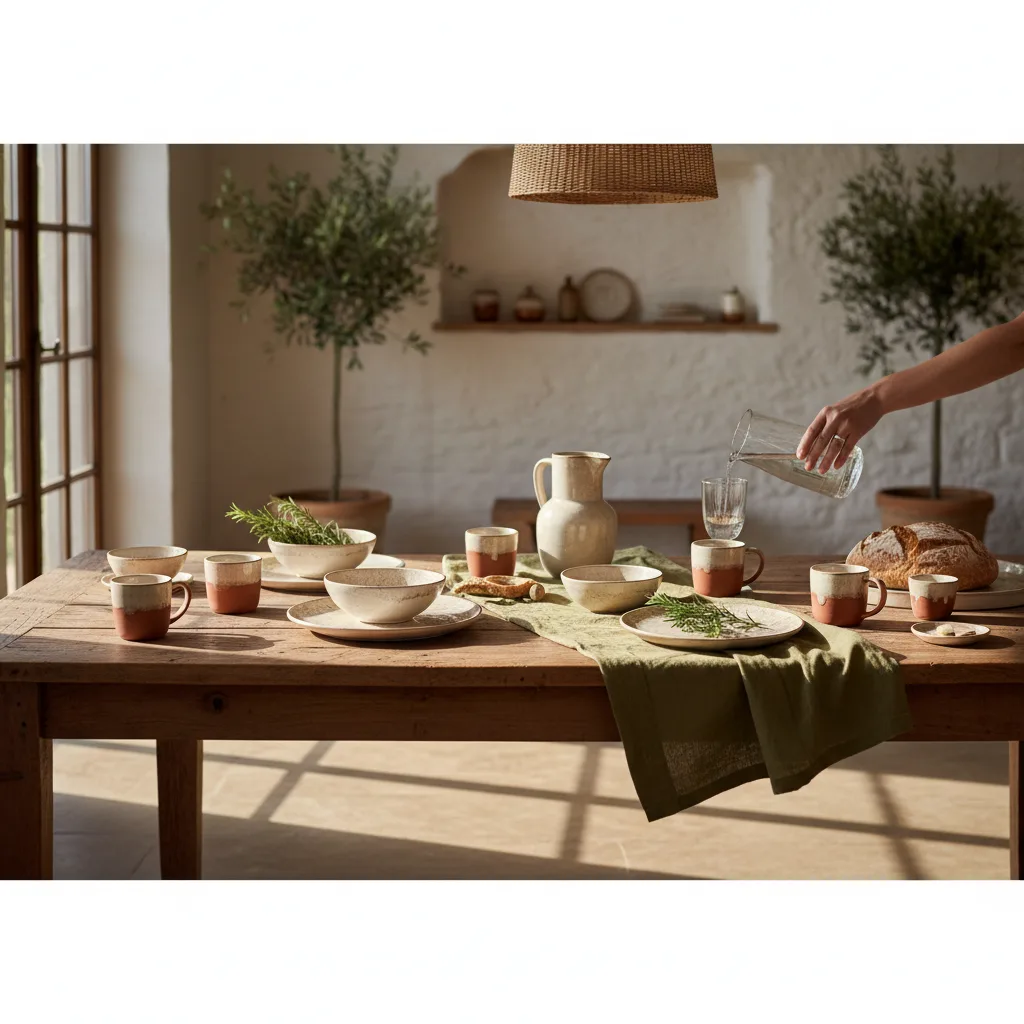
Tuscan origins: from wrought iron to the laid table
The story of Brandani doesn't begin with a tableware catalogue, but with a wrought-iron workshop. The Brandani family has Tuscan roots that go back to the 18th century, when the name was already tied to artisan metalwork in the province of Pistoia. In the 19th century, the family specialised in making precision scales and copper objects — a trade that demanded exactness, patience and a deep respect for the material.
That artisan background didn't disappear. It transformed. When Brandani was formally founded in 1976 in Pescia, a Tuscan town surrounded by flower nurseries and olive groves, the company started out specialising in the artistic working of copper and brass under the Centrorame name. It was, in essence, a continuation of the family trade adapted to a new market: that of the decorative object for the home.
Over time, Centrorame brought back the family's original name. Copper and brass gave way to silver, steel and other metals. And what had been a small Tuscan workshop began to become what we know today: a company with a full catalogue of homeware, décor and gifts with a defined Italian identity.
What didn't change — and this is the relevant part — was the underlying mindset. Brandani still designs with an artisan's logic, even though it produces on an industrial scale: every piece has to work in a real home, not just look good in a catalogue.
Pescia, Tuscany: place matters
There are brands whose headquarters are irrelevant. They could be on any industrial estate in any country and the product would be the same. Brandani isn't one of them. Its headquarters in Pescia, in the province of Pistoia, isn't a geographical coincidence: it's cultural context.
Pescia is in the Valdinievole, an area of Tuscany less well known than Chianti or the Val d'Orcia, but deeply rooted in the Italian artisan tradition. It's flower-growing country — in fact, it's one of the most important flower-cultivation centres in Italy — and home to small family businesses that have worked with their hands for generations. That environment permeates the way Brandani understands its product: as something born of a place, not of a spreadsheet.
Brandani's current headquarters, on Via Caravaggio, serves as a design centre, warehouse and showroom. From there it manages the collections that later reach distributors across Europe — including Vita Italian Living, the online store specialising in the brand in Spain.
What Brandani does (and what it doesn't do)
One of the most common mistakes when discovering Brandani is to think it's "just another tableware brand." It isn't. Brandani designs and produces objects for the entire domestic experience around the table and the kitchen. The catalogue spans very different families:
| Product family | What it includes | Who it's for |
|---|---|---|
| Tavola (Table) | Tableware, glassware, cutlery, table linen | Anyone who wants a table with everyday personality |
| Cucina & Techno | Small tabletop appliances, coffee makers, designer toasters | Anyone who values function that's also beautiful |
| Coppe e Centrotavola | Bowls, fruit dishes, decorative centrepieces | Anyone looking for pieces that transform a space |
| Casa & Décor | Vases, frames, decorative objects | Anyone who wants details with character in every corner |
| Accessori Cucina | Cutting boards, utensils, organisers | Anyone who cooks and wants tools chosen with care |
| Bambini | Children's tableware, baby accessories | Anyone looking for a gift or a little something for the youngest |
| Speciale Vetro | Special pieces in artistic glass | Anyone who appreciates glasswork as a noble material |
What Brandani doesn't do is compete on price with mass-market brands. It doesn't make disposable homeware or products meant to last a single season. Its positioning is clear: functional Italian design, with material quality that justifies the price, aimed at people who choose few pieces but choose them well.
The "Italian Style" concept: what it really means
Brandani's official payoff is "Italian Style." It sounds generic — plenty of brands use Italianness as an empty label — but in Brandani's case it has a concrete meaning that's worth explaining.
For Brandani, "Italian Style" isn't a tricolour flag on the packaging. It's a way of understanding domestic objects that has deep cultural roots: the idea that the table is an act of hospitality, that cooking and eating together are rituals that deserve a carefully set stage, that a bowl or a coffee maker aren't just tools but extensions of the personality of whoever uses them.
That philosophy translates into concrete design decisions. Brandani's pieces tend toward colour — not institutional white or Nordic grey, but Mediterranean palettes: terracotta, cobalt blue, sage green, cream. The finishes seek texture before industrial perfection: slightly irregular edges on the ceramics, matte surfaces that invite touch, shapes that recall the handmade object even when produced in series.
It's Italian design in the real sense of the term: meant to be lived with, not admired from afar. And that, in a market where many brands prioritise the photo over the use, is a difference you notice when you put a Brandani plate next to one from a fast-deco chain.
Sustainability and certifications: facts, not talk
At a time when the word "sustainability" is used as decoration on any corporate website, Brandani has chosen to get certified rather than merely declare itself sustainable. Two relevant facts:
The company holds FSC certification (Forest Stewardship Council) for its packaging and paper materials. This means the packaging of its products comes from responsibly managed forests — a detail that matters when you buy a gift and want the box not to be part of the problem.
In addition, Brandani holds SA8000 certification, an international social-responsibility standard that audits working conditions, workers' rights, health and safety. It's not a self-declaration: it's an external audit. In 2024, the company published its sustainability report, available to the public.
It isn't a brand that defines itself by sustainability — it defines itself by design and functionality — but it has decided that the way it produces and packages also counts. For anyone who values this aspect when deciding where to buy their homeware, it's a fact worth putting on the table.
Brandani in Spain: why now and why this way
For decades, Brandani has been a brand well known in Italy but practically invisible in Spain. Whoever discovered it did so by chance — a trip to Tuscany, a Christmas market in Florence, a stray search on Amazon that turned up four loose products with no context and no story. That fragmentation didn't do justice to the brand or its catalogue.
Vita Italian Living was created precisely to solve that problem. As an online store specialising in Brandani, Vita Italian Living brings the brand's full catalogue to the Spanish market — not just the four or five products that appear on generic marketplaces, but the entire range, with Spanish-language customer service, nationwide shipping and the guarantee that every piece is authentic and comes directly from the source.
Why does buying from a specialist store matter? Because it guarantees three things a marketplace can't offer: verified authenticity (no opaque middlemen, no risk of parallel product), the full catalogue (access to every collection, not the partial selection that reaches marketplaces) and real advice (someone who knows the brand, understands the collections and can help you choose).
If you've spent a while looking for Italian homeware with authentic design and you've grown tired of always finding the same thing in the same shops, you now have a dedicated channel.
What you can expect from a Brandani piece
If you've never held a Brandani product in your hands, there are a few things worth knowing before you buy. Not to convince you, but so you understand what you're buying and why the price is what it is.
Design with intention. Each Brandani collection responds to a concept — not a seasonal trend. There are collections that have been in the catalogue for years because they work, and there are new arrivals that come in when they add something real. There are no launches for the sake of launching.
Materials you can feel. The ceramic has weight. The glass has real shine. The wood has a smell. These are details you can't appreciate in a photo but that make all the difference when you set the table. If you're used to mass-market homeware, the first time you pick up a Brandani plate you'll notice the difference in your hand.
Made to use, not to store. A common mistake with design homeware is treating it as a display object. Brandani's pieces are designed for everyday use. They're hard-wearing, dishwasher safe in most cases and meant to age well — not to sit on the shelf waiting for a "special occasion" that never comes.
Packaged as a gift. Brandani has the word "gift" in its name for a reason. The presentation of its products is carefully done from the factory. For anyone looking for an original gift with Italian personality, the packaging is part of the experience — not an added cost.
A brief timeline: from the forge to the catalogue
For anyone who prefers the facts laid out in order, here's Brandani's essential timeline:
| Period | Milestone |
|---|---|
| 18th century | The Brandani family becomes linked to wrought-iron work in the province of Pistoia, Tuscany |
| 19th century | Specialisation in precision scales and copper objects under the name "Brandani Enrico" |
| 1976 | Founding of Brandani Srl in Pescia (PT). Begins with artistic work in copper and brass under the Centrorame brand |
| 1980s-90s | Transition to silver, steel and metal. The Brandani name is brought back. Expansion into conviviality and table lines |
| 2000s | Consolidation as a homeware, décor and gift brand. Opening up to European markets |
| 2020s | FSC and SA8000 certifications. Sustainability report. Catalogue expanded to Cucina & Techno and Speciale Vetro |
| 2026 | Vita Italian Living launches its Brandani online store in Spain |
What ties all these points together is a constant: objects for domestic life, made with care, from a specific place. There have been no leaps into the void and no plot twists. It's a coherent evolution spanning nearly half a century (with family roots that multiply that figure by three).
Frequently asked questions about Brandani
Is Brandani a craft brand? Not in the strict sense. Brandani produces on an industrial scale, but its design approach and family heritage come from the world of craftsmanship. The pieces aren't made by hand one by one, but they are designed with an artisan's mindset: attention to the material, the finish and the function.
Where are Brandani products made? Brandani's headquarters and design centre are in Pescia, Tuscany (Italy). Manufacturing varies by product line, but the design and creative direction are Italian.
Can you buy Brandani in Spain? Yes. Vita Italian Living is the Brandani online store in Spain, with the full catalogue, Spanish-language customer service and nationwide shipping.
What sets Brandani apart from other homeware brands? Three main things: Italian design with its own identity (it doesn't copy Nordic trends or generic minimalism), a broad catalogue covering table, kitchen, décor and gifting, and a decades-long track record that backs up the quality of the product.
Are Brandani products suitable for everyday use? Yes. They're designed to be used, not stored away. Most ceramic and glass pieces are dishwasher safe, though it's always worth checking the specific instructions for each product.
Complementary pieces to complete an authentic Italian table with Brandani pieces
— anchor text: "authentic Italian table without clichés"
- Italian design: why it lasts longer than trends — anchor text: "Italian design that lasts longer than trends"
- Real vs fake Made in Italy: how to identify it — anchor text: "how to tell real Made in Italy from fake"
- Why Italians eat better (and it's not just the food) — anchor text: "why Italians eat better"
- How to choose the perfect centrepiece for your dining room — anchor text: "how to choose a centrepiece"
- Brandani vs Bitossi: which fits your home better — anchor text: "Brandani vs Bitossi comparison"
- The best premium Italian homeware brands — anchor text: "best Italian homeware brands"
- Original wedding gift: what Italians give — anchor text: "original Italian wedding gift"