Italian design: why it outlasts trends
There are pieces you buy because they're in fashion, and pieces you buy because something about them tells you they'll still fit in ten years from now. The difference isn't always obvious in the shop, but it shows over time. A bowl that withstands cycles of trends, design tableware that doesn't need replacing every season, a vase that gets better with the years instead of looking dated. That's what Italian design achieves when it's done well: it doesn't compete with trends, it outlives them.
This isn't about nostalgia or conservatism. Italy has spent decades — centuries, in fact — producing objects for the table and the home that combine beauty and function without sacrificing either one. And the interesting part is understanding why. What is it about that approach that makes an Italian piece from the seventies still look current, while what you bought from a chain three seasons ago already looks worn out.
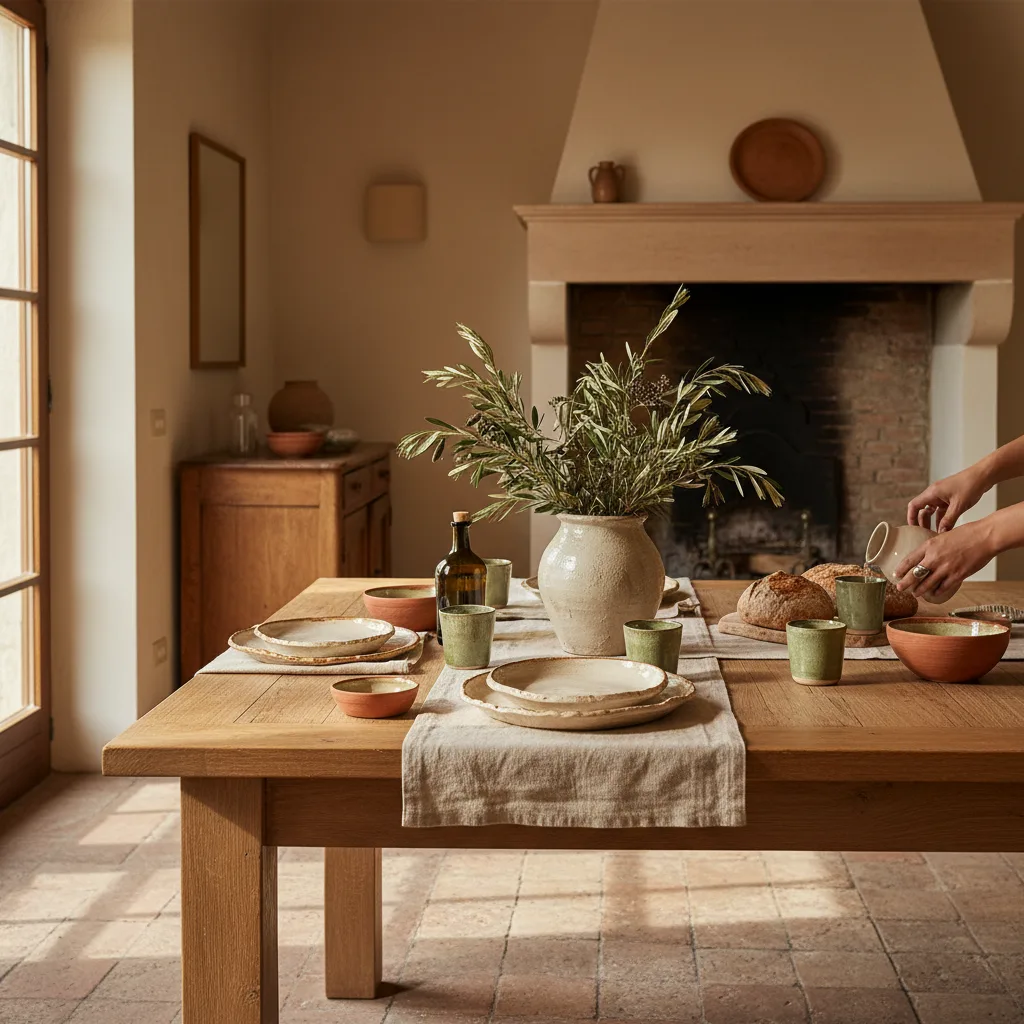
The philosophy behind the form: beauty born of function
Italian design didn't emerge as an aesthetic whim. It has roots in a very specific moment: post-war reconstruction, when Italian manufacturers and designers began collaborating to create everyday objects that were accessible, functional and, at the same time, beautiful. What was born then was called bel design, and its founding principle still holds: form doesn't decorate function, it emerges from it.
That means when an Italian designer conceives a glass, a plate or a centrepiece, they don't start with the decorative. They start with how it sits in the hand, how it occupies space on the table, how it responds to daily use. Elegance comes afterwards, as a consequence of solving those practical problems well. It's a subtle but fundamental difference from design that starts with the trend and then looks for a way to make it functional.
This philosophy explains why so many Italian pieces age well. They aren't tied to a seasonal aesthetic whim. They're tied to how we eat, how we entertain, how we live the table. And that changes far more slowly than Instagram trends.
Five traits that make Italian design timeless
Not everything that comes out of Italy is automatically timeless. But the pieces that are tend to share certain traits that set them apart from ephemeral production.
| Trait | What it means in practice | Why it withstands the passage of time |
|---|---|---|
| Formal balance | Harmonious proportions, without decorative excess | It doesn't depend on a specific trend to "work" visually |
| Genuine functionality | Every curve and every finish answers a technical decision, not just an aesthetic one | What's useful never goes out of fashion |
| Material culture | Conscious use of ceramic, glass, wood — materials that age with dignity | A noble material gains character with use; plastic only degrades |
| Clear identity | Each manufacturer's own language, real differentiation | It isn't interchangeable with any other piece on the market |
| Innovation without rupture | Constant technical improvement without losing the essence | It evolves, but doesn't reinvent itself every six months |
Notice that none of these traits has anything to do with a seasonal colour or a fashionable pattern. They're structural principles. Artisan ceramic tableware that respects these five criteria will work just as well on a 2026 table as on a 2036 one.
Materials that gain with time (instead of losing)
One of the less obvious secrets of quality Italian homeware is the choice of material. It's not a minor detail: it's what determines whether a piece improves or worsens with use.
Italian artisan ceramic, for example, behaves very differently from mass-produced industrial stoneware. The subtle variations in glaze, the small irregularities of hand-modelling, the slightly different feel of each piece — none of that is a flaw. It's what gives a piece presence and what, over the years, develops a patina that makes it more interesting, not less.
The same happens with blown glass, which gains luminous nuances over time, or with fine Italian porcelain, which keeps its characteristic shine if it's well cared for. These are materials that respond to use. They adapt. They build a relationship with whoever uses them that disposable homeware simply can't offer.
Compare this with the tableware you find in the big chains: homogeneous materials, designed to be cheap to produce and easy to replace. They serve their purpose for a couple of seasons and then disappear from the catalogue, along with the trend that inspired them. Premium Italian homeware goes the other way: produce fewer pieces, but make each one worth keeping.
Craftsmanship and industry: the combination only Italy pulled off
There's a nuance that often gets lost when people talk about "artisan products": the idea that craftsmanship and industry are opposites. In Italy, they aren't. The Italian manufacturing tradition found a formula that very few countries have replicated: integrating artisan processes within organised production, without either one losing out.
Brands like Brandani, with over 75 years of history, are a clear example. They don't make every piece in a village workshop with three employees — that would be romantic but unworkable for offering a full catalogue at an accessible price. What they do is keep artisan control at the stages where it matters (design, finish, quality control) and use modern technology where it improves the product without compromising it.
The result is a piece that has the character and care of something handmade, but the consistency and availability of serious production. That's what lets Italian design reach your table without costing what a gallery piece costs, and without losing what makes it special.
If you're interested in understanding this heritage better, the story of Brandani and its 75 years of the Italian table gives plenty of context on how this model works from the inside.
Why the big chains can't replicate this
It's a fair question: if the principles of good design are well known, why don't Zara Home or Maisons du Monde produce the same thing? The answer lies in the business model, not in a lack of talent.
Mass home-décor chains operate with short product cycles. They need to renew their catalogue every season to drive store traffic. That conditions everything: materials must be cheap to produce in volume, designs must be "on trend" to justify the renewal, and the final price must let the customer buy without thinking too much and come back the following year.
That model works for their business. But it produces objects that are designed, literally, to be replaced. It isn't a hidden flaw — it's the logic of the system. When you buy a plate for four euros at a chain, you're not buying timeless design. You're buying quick access to a trend that will expire with the change of season.
Italian design homeware operates with the opposite logic: long cycles, materials that justify their price, pieces meant to be combined over years, not to be coordinated with the autumn collection. It's an approach that asks more of the buyer (more initial investment, more judgement) but gives back more in the long run. We tell it in more detail in the comparison between premium alternatives and the big chains.
How to recognise Italian design that really lasts
Not every piece with the "Made in Italy" label is automatically timeless. There's mediocre Italian production, just as there's excellent production in other countries. What makes the difference isn't only the origin, but a set of signals you can learn to identify.
The material speaks
Quality ceramic has weight proportionate to its size — neither too light (fine but fragile production) nor needlessly heavy (thick, unrefined stoneware). The glaze is uniform but with character: it lets you see there's a process behind it, not a machine that stamped everything the same. If you gently tap a piece of authentic porcelain, it gives off a clear, clean sound, not a dull one.
The design makes sense without explanation
A well-designed piece doesn't need a style manual to fit on your table. It works with what you already have because its proportions and its palette are coherent, not because it follows the same fashion as the rest of your tableware. That's what lets a bowl of well-made Italian ceramic sit alongside pieces from different eras without clashing.
The brand has history, not just marketing
Pay attention to whether the manufacturer has a real track record. It doesn't need to be two hundred years old, but there should be a coherent product line that doesn't change radically every year. Brandani vs Bitossi: two Italian brands with different approaches, but both with decades of consistent evolution behind them.
Italian design on your everyday table: it's not just for special occasions
There's a common mistake when talking about Italian design homeware: thinking it's "for when guests come over". That mindset comes from another era, when the good tableware was kept in the cabinet and brought out three times a year. The current Italian approach is the opposite: beautiful pieces are there to be used. Every day. At breakfast, at the quick Tuesday dinner, at the improvised Sunday lunch.
Using tableware with character every day changes something subtle but real in how you live the table. It isn't pretentious — it's simply choosing for the objects you touch most to be the ones you like most. Italians have understood it that way for centuries. The authentic Italian table isn't a magazine set; it's a table that's lived in, stained and enjoyed.
That is, in the end, the most honest reason why Italian design outlasts trends: because it wasn't designed to impress for a day, but to accompany you for many.
Complementary pieces for building a complete Italian table with timeless character
Frequently asked questions
What makes Italian design different from that of other countries? The combination of artisan tradition with industrial capacity is what sets the Italian model apart. While other countries opted for pure industrialisation or kept craftsmanship as an exclusive niche, Italy found a middle path: organised production that preserves judgement and the artisan finish at the key stages of the process.
Is Italian design homeware only for high budgets? Not necessarily. There are very wide ranges within Italian homeware. Brands like Brandani offer authentic Italian design at accessible prices (between EUR 15 and EUR 90 per piece, depending on the product family), far from the ultra-premium segment of firms like Ginori or Versace Home.
How do I know if a Made in Italy piece is authentic? Look for brands with a verifiable track record, buy from official importers and be wary of prices that are too low for pieces claiming to be Italian. The packaging, the documentation of origin and the quality of the finish are reliable indicators. We go into it in depth in our guide on real vs fake Made in Italy.
Is Italian artisan ceramic durable for daily use? Yes, as long as you follow the manufacturer's guidelines. Quality Italian ceramic is designed to be used, not to be stored away. Avoid sudden temperature changes and, if in doubt, check whether the piece is dishwasher-safe. Many are.
Why does Italian design never go out of fashion? Because it doesn't start from fashion in the first place. Timeless pieces are designed from function, materials and proportions — elements that don't change with the seasons. A well-proportioned plate, with a carefully worked glaze and dimensions thought out for real meals, doesn't need "updating" every year.